
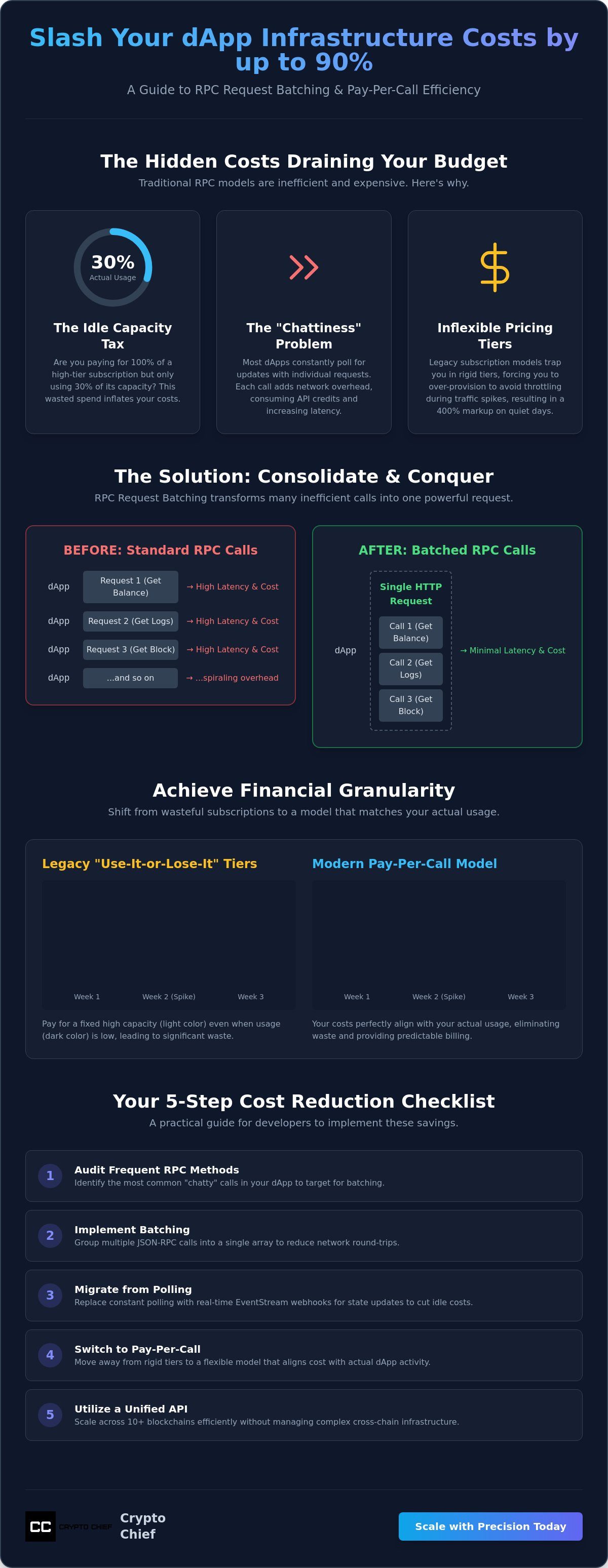
Why are you paying for 100% of a high-tier RPC subscription when your dApp only utilizes 30% of its capacity? In 2026, the gap between architectural efficiency and infrastructure waste has become a multi-thousand-dollar problem for growing teams. Implementing rpc request batching for cost reduction isn't just a technical optimization anymore; it's a financial necessity. By consolidating multiple calls into a single transport layer, you can effectively bypass the compute unit inflation that currently plagues standard API models, where the cost of a single request can vary by 200 times depending on the provider's specific weighting.
You've likely felt the sting of rate-limit throttling during critical transaction periods or watched your overhead explode during a sudden traffic spike. It's frustrating to build on decentralized rails only to be held hostage by rigid pricing tiers that don't scale with your actual usage. This guide will show you how to leverage advanced RPC batching and the modern pay-per-call model to slash your infrastructure bills by up to 90%. We'll explore how to eliminate round-trip latency, optimize your request density, and transition to a predictable cost structure that aligns perfectly with your growth.
Key Takeaways
- Eliminate the "chattiness problem" by grouping multiple JSON-RPC calls into a single transport execution to preserve your API credit balance.
- Master the technical anatomy of arrays and concurrent execution to implement rpc request batching for cost reduction and lower your infrastructure overhead.
- Shift from legacy "use-it-or-lose-it" subscription tiers to a pay-per-call model that provides the financial granularity needed for sustainable dApp growth.
- Reduce network round-trips by auditing frequent RPC methods and migrating polling-based architectures to real-time EventStream webhooks.
- Scale across 10+ blockchains using a Unified API that maintains technical precision while reducing the complexity of cross-chain infrastructure.
The Economics of RPC Calls: Why Infrastructure Costs Spiral in 2026
In the 2026 Web3 environment, technical efficiency is the only sustainable hedge against volatile infrastructure overhead. As developers, we rely on a Remote Procedure Call (RPC) to facilitate communication between our applications and the blockchain, yet the standard one-to-one request model is fundamentally broken for production-scale dApps. The explosion of Layer 2 solutions, sidechains, and app-chains has created a fragmented landscape where request volume has scaled exponentially. Without a strategy for rpc request batching for cost reduction, your infrastructure costs won't just grow; they'll spiral out of control. Defining this process is simple: it's the grouping of multiple JSON-RPC calls into a single transport execution. This allows you to fetch balances, logs, and block headers in one go, rather than paying the "network tax" on every individual item.
Maintaining a raw node is often touted as the ultimate path to decentralization, but the financial reality in 2026 tells a different story. The hardware requirements, devops hours, and 32 staked ETH required for a self-hosted Ethereum node can exceed $250,000 annually. For most teams, an optimized RPC Gateway is the only logical choice. It provides the stability of enterprise hardware without the massive capital expenditure, provided you use it efficiently. If you continue to treat your API like a series of isolated events, you're leaving money on the table.
The Hidden Cost of Web3 "Chattiness"
Most dApps are "chatty" by design. They constantly query for the latest block, update user balances, and listen for specific event logs. Each of these individual requests carries a heavy payload of HTTP headers and necessitates a fresh TLS handshake, consuming precious API credits long before the actual data is even processed. Polling for state updates creates a constant floor of expense, meaning you're paying for infrastructure even when your dApp has no active users. Transport overhead is the primary silent killer of Web3 margins. By implementing rpc request batching for cost reduction, you consolidate these tiny, expensive interactions into a single, efficient stream that maximizes every byte of data transferred.
Identifying the "Idle Capacity Tax" in Tiered Plans
Traditional RPC providers often trap developers in rigid monthly tiers that don't account for the ebb and flow of crypto markets. If you subscribe to a plan offering one million requests but only utilize 200,000 during a quiet week, you're effectively paying a 400% markup on every call you actually make. This "idle capacity tax" forces teams into a cycle of over-provisioning just to avoid being throttled during critical traffic spikes. A granular analysis of your operations usually reveals that these fixed tiers are a legacy of a less efficient era. Moving toward a more flexible model ensures that your scaling costs are linked to actual usage, rather than arbitrary subscription levels that penalize your slower days.
Mastering RPC Request Batching: Mechanics, Methods, and Cost Savings
At its core, a batch request is an array of individual request objects sent in a single HTTP POST. According to the JSON-RPC 2.0 official specification, each object must contain a unique ID to ensure the client can map asynchronous responses correctly. This structure is the engine behind rpc request batching for cost reduction, as it allows the server to process multiple commands concurrently while the developer only pays the overhead for a single connection. By consolidating network resources, you move from N round-trips to a single response, drastically reducing the latency that often degrades the user experience in complex dApps.
While some providers discourage this practice due to potential head-of-line blocking or timeout issues, the RPC Gateway from Crypto Chief is specifically engineered to handle high-density batches without sacrificing uptime. We've optimized our infrastructure to parse these arrays with technical precision, ensuring that a single heavy query doesn't bottleneck the rest of your request. This architectural choice allows you to scale your throughput without seeing a linear increase in your API expenses. If you're looking for a more efficient way to manage your calls, you can start building with a high-performance gateway today.
JSON-RPC Batching vs. On-Chain Multicall
It's vital to distinguish between transport-level batching and contract-level Multicall. You should use JSON-RPC batching when you need to retrieve disparate data, such as a user's balance on one chain and a transaction count on another. Conversely, on-chain Multicall is best for atomic state reads, like fetching Uniswap prices across several pools in a single block. In the 2026 landscape, balancing these two methods is key. While Multicall saves on API call weights, it incurs gas costs. Transport-level batching, however, remains the most cost-effective way to query off-chain data without touching the consensus layer.
Scaling Throughput Without Multiplying API Expenses
Practical implementation often starts with the wallet dashboard. Instead of firing separate requests for eth_getBalance and eth_getTransactionCount, you can group them into a single batch. This approach becomes even more powerful when using a unified blockchain api to normalize multichain data. Robust error handling is the final piece of the puzzle. You must ensure that your client-side logic can handle partial successes; one failed call within an array shouldn't invalidate the entire batch. This granular control allows you to maintain a seamless data flow while keeping your infrastructure overhead lean and predictable.
Pay-Per-Call vs. Monthly Tiers: Achieving Financial Granularity
Traditional SaaS billing models are fundamentally at odds with the volatile nature of blockchain traffic. Many providers still rely on "use-it-or-lose-it" monthly credits, a legacy structure that forces developers to pay for peak capacity even during periods of low activity. This creates a "cliff effect" where a single request over your limit can trigger exorbitant overage fees or, worse, result in catastrophic service throttling. Moving toward a web3 api pay per call pricing model aligns your infrastructure overhead with your dApp's actual unit economics. When combined with rpc request batching for cost reduction, this approach ensures you only pay for the data you consume, eliminating the financial waste inherent in over-provisioned subscription tiers.
The "Single Balance" advantage further streamlines your operations by allowing you to use one unified token pool across multiple networks. Whether you're querying state on Ethereum, managing assets on Polygon, or monitoring transactions on BNB Chain, your credits follow your traffic. This flexibility removes the need to manage separate subscriptions for each chain, reducing administrative friction and providing a clear, consolidated view of your global infrastructure spend. It's a shift from rigid service contracts to a fluid utility model that scales as you grow.
Predictive Budgeting with Prepaid Token Balances
Modeling your monthly spend shouldn't feel like guesswork. By shifting your focus to active user sessions rather than arbitrary request counts, you can create more accurate financial forecasts. Prepaid token balances act as a buffer against viral traffic spikes, ensuring that a sudden surge in users doesn't lead to unexpected "Overage Traps" on your next invoice. Crypto Chief’s model treats infrastructure as a utility, not a subscription. With auto-refill capabilities and custom threshold alerts, you can maintain 100% uptime without manual intervention, allowing your team to focus on development rather than billing management.
The ROI of Granular Infrastructure
Granular infrastructure choices yield measurable returns. Consider a mid-sized DeFi application that previously paid for a high-tier $1,000 monthly subscription but only utilized a fraction of the allocated requests. By switching to a pay-per-call model and implementing rpc request batching for cost reduction, the team was able to reduce their monthly infrastructure bill by 65%. This transition also helps eliminate "Vendor Sprawl" by consolidating various services into a single dashboard. For example, you can review our AML Intelligence for integrated risk management alongside your RPC usage, creating a unified stack that simplifies both technical architecture and financial reporting.
A Developer’s Implementation Checklist for Drastic Cost Reduction
Efficiency in Web3 infrastructure isn't an accident; it's the result of a rigorous architectural audit. Before you can optimize, you must identify the primary drivers of your overhead. Most developers find that just five RPC methods, typically eth_call, eth_getLogs, and eth_getTransactionReceipt, account for over 80% of their total API consumption. By isolating these high-frequency calls, you can prioritize rpc request batching for cost reduction where it will have the most significant impact on your bottom line. Refactoring your dApp to consolidate multiple provider subscriptions into one high-performance RPC Gateway further simplifies your stack and eliminates the "fragmentation tax" of managing disparate API keys and billing cycles.
Once you've audited your methods, the next step is to evaluate your data retrieval patterns. Are you requesting the same information multiple times within a single user session? Implementing rpc request batching for cost reduction allows you to wrap these queries into a single transport execution, but technical optimization must be paired with strategic migration. Moving away from legacy polling models and toward push-based architectures is the most effective way to protect your margins as you scale. You can create your developer account today to begin implementing these high-efficiency patterns on a unified infrastructure.
From Polling to EventStream: Slashing Request Volume
Polling is an inherently wasteful practice. If your dApp queries eth_getLogs every 12 seconds to check for new events, you're burning 7,200 requests per day, regardless of whether any on-chain activity actually occurred. Migrating to real-time blockchain webhooks through EventStream can reduce this specific request volume by 90% because data is only pushed to your backend when a relevant event is indexed. Integrating these webhooks with your Crypto Processing API ensures instant payment confirmations without the constant overhead of manual status checks, turning your infrastructure into a reactive, cost-efficient engine.
Intelligent Caching and Client-Side Persistence
Not every piece of data needs to be fetched from the chain in real-time. Static information, such as contract ABIs or historical block headers, should be stored locally with a defined Time-To-Live (TTL) to prevent redundant API calls. By using browser local storage or a server-side Redis instance for frequently accessed data like user balances, you ensure that a simple page refresh doesn't trigger a new wave of expensive requests. By caching user balances and contract ABIs, you eliminate the cost-per-refresh that otherwise drains your API balance every time a user navigates your interface.
Scaling with Precision: The Crypto Chief Unified Stack
Achieving long-term profitability in Web3 requires an infrastructure partner that values technical logic over marketing fluff. The Crypto Chief advantage lies in our Unified API, which provides a single, streamlined entry point for more than 10 major blockchains. By utilizing a non-custodial architecture, we reduce the complexity and trust requirements that often hinder enterprise-level deployments. This builder-centric approach ensures your team remains in control of its data and keys while our background engine handles the heavy lifting of global scalability. When you implement rpc request batching for cost reduction on our platform, you aren't just saving money; you're building on a foundation designed for professional-grade stability.
The core of our offering is the RPC Gateway, a high-performance solution that offers global uptime paired with absolute pay-per-call transparency. In the fast-moving landscape of 2026, future-proofing your dApp is essential. Our stack allows you to seamlessly integrate new networks like TON or TRON without the need to rewrite complex smart contracts or overhaul your backend logic. This agility ensures your application stays ahead of market trends while maintaining the leanest possible infrastructure overhead.
Unified Infrastructure, Simplified Billing
Managing multiple subscriptions across different providers is a recipe for administrative gridlock. We've simplified this by offering a single prepaid balance that covers all your Web3 needs, from RPC calls to AML checks. Many developers recognize Crypto Chief as the best Infura alternative because we prioritize both granular performance and honest, usage-based pricing. Before committing to a full production migration, you can utilize our faucet and sandbox environment for risk-free testing, ensuring your rpc request batching for cost reduction logic is perfect before it hits the mainnet.
Getting Started with Optimized Scaling
Transitioning to a more efficient model doesn't have to be a months-long project. You can migrate your existing RPC endpoints to Crypto Chief in under five minutes, immediately benefiting from our optimized request handling. We provide extensive developer documentation filled with batching-ready code samples to help your team hit the ground running. Our platform is built by people who understand the practical challenges of the field, and we're here to act as your silent, powerful partner in growth. Ready to eliminate infrastructure waste? Register for your Crypto Chief account today.
Engineering a Leaner Web3 Future: From Waste to Precision
The landscape of 2026 demands more than just technical functionality; it requires a ruthless commitment to architectural efficiency. We've explored how legacy subscription tiers and "chatty" request patterns create an unnecessary floor of expense that penalizes your growth. By implementing rpc request batching for cost reduction, you transform your infrastructure from a constant drain into a precision-tuned utility. This shift allows you to focus your resources on the creative logic of your dApp rather than the background noise of transport overhead.
Success in this environment depends on having a partner that understands these unit economics. Crypto Chief offers the stability you need with pay-per-call transparency and support for 10+ major blockchains, including BTC, ETH, and SOL. You can manage your RPC, AML, and Processing needs through a single, unified dashboard that eliminates vendor sprawl. It's time to stop over-provisioning and start building with a stack that scales as precisely as your code. Register your account and start optimizing with Crypto Chief. Your leaner, more performant infrastructure is just a few minutes away.
Frequently Asked Questions
What is the most effective way to reduce blockchain API costs?
Combining technical optimizations with granular billing models is the most effective strategy for long-term sustainability. Specifically, implementing rpc request batching for cost reduction eliminates transport-level waste by consolidating multiple JSON-RPC calls into a single execution. When you pair this with a pay-per-call gateway, you remove the financial "cliff effects" of monthly tiers and ensure you only pay for the specific compute units your dApp consumes.
Is RPC request batching better than making individual calls?
Batching is superior for high-frequency queries because it significantly reduces network overhead and transport-layer redundancy. While individual calls require a separate HTTP header and TLS handshake for every piece of data, batching wraps these requests into a single transport layer. This consolidation lowers the "per-call" cost and reduces the strain on your API credit balance, especially when fetching disparate data points like balances and transaction counts simultaneously.
How does pay-per-call pricing save money compared to monthly tiers?
Pay-per-call pricing eliminates the "Idle Capacity Tax" by charging only for actual usage rather than a fixed, pre-allocated request limit. In monthly tier models, developers often pay for millions of requests while only utilizing a fraction of that capacity, resulting in a massive effective markup. A granular model ensures that your infrastructure costs scale proportionally with your user activity, protecting your margins during quiet periods and viral traffic spikes alike.
Can I batch requests across different blockchains?
Batching is typically executed at the node level for a specific chain, but you can manage multichain data normalization through a Unified API. While a single JSON-RPC array generally targets one network's RPC Gateway, using a unified stack allows you to consolidate your billing and dashboard management for 10+ chains. This approach simplifies the administrative side of rpc request batching for cost reduction across diverse ecosystems like Ethereum, Polygon, and BNB Chain.
What is the "Idle Capacity Tax" in Web3 infrastructure?
The "Idle Capacity Tax" refers to the wasted expenditure of paying for high-tier subscriptions that exceed your dApp's actual requirements. If your monthly plan offers a set number of requests that you don't fully exhaust, the cost of each individual call effectively increases. This legacy SaaS model forces teams to over-provision their infrastructure, leading to significant financial waste that could be recovered through more granular, usage-based billing structures.
How do webhooks reduce the number of RPC requests my dApp makes?
Webhooks eliminate the need for constant "polling" by pushing data to your backend only when a specific on-chain event occurs. Instead of querying a node every few seconds to check for logs or confirmations, our EventStream service notifies your application in real-time. This reactive architecture can reduce your total request volume by up to 90%, as you no longer burn API credits on empty queries that return no new information.
Is batching supported on all Crypto Chief RPC nodes?
Full JSON-RPC batching is supported across our entire RPC Gateway infrastructure for all supported blockchains. Our systems are architected to parse high-density request arrays with technical precision, ensuring that concurrent execution doesn't lead to the reliability issues found in less robust providers. This native support allows developers to implement aggressive cost-saving measures without sacrificing the stability or uptime of their production applications.
Does batching requests increase latency for the user?
Batching actually improves perceived latency by reducing the number of network round-trips required to load an interface. Instead of waiting for five sequential requests to resolve, the client receives all necessary data in a single response. While the server-side processing time for a large batch may be slightly longer than a single call, the elimination of multiple network handshakes usually results in a faster, more seamless experience for the end user.