
What if your infrastructure bill reflected the actual utility of your network calls instead of a rigid subscription tier designed for someone else's scale? In 2026, many developers still find themselves paying for high-tier quotas while utilizing only a fraction of their allocated capacity. It's a common frustration to see unpredictable monthly invoices from providers like Infura or Alchemy, especially when complex billing across multiple RPC and AML data streams obscures your true expenses. Mastering web3 api pay per call pricing is no longer just a cost-saving measure; it's a fundamental requirement for maintaining a sustainable blockchain project.
We understand that your primary focus should be on building, not on auditing granular credit weights for every request. This guide provides a clear framework for calculating per-call ROI and introduces a unified approach to managing your infrastructure costs. You'll gain a deep dive into the credit-based models that define the current landscape, allowing you to align your spending with actual network demand. From reducing entry barriers for new dApps to consolidating your technical stack, we'll explore how to transform your infrastructure from a financial variable into a predictable engine for growth.
Key Takeaways
- Understand the transition from rigid tiered subscriptions to granular, utility-based billing that mirrors your actual network usage and eliminates waste.
- Discover how web3 api pay per call pricing incentivizes architectural efficiency by rewarding lean code and optimized query structures.
- Learn how to leverage a unified token model to fund your entire stack, including RPC Gateway, AML Intelligence, and processing calls from a single balance.
- Master a practical budgeting formula to estimate monthly infrastructure costs based on active user volume while identifying and removing "call bloat."
- Evaluate why global, non-custodial infrastructure provides the elite stability and performance required to scale blockchain projects without technical friction.
Defining the Web3 API Pay-Per-Call Landscape in 2026
The infrastructure economy has reached a definitive tipping point. For years, developers operated under the constraints of rigid monthly subscriptions that rarely aligned with actual network utility. In 2026, the industry has matured toward a more granular, utility-based approach. This transition allows teams to treat their Application Programming Interface (API) as a direct variable cost rather than a fixed overhead burden. By adopting web3 api pay per call pricing, architects ensure that every dollar spent correlates directly to a specific network event or data query. This model provides the structural integrity needed to survive in a market where efficiency is the primary differentiator.
The volatility of 2026 has made fixed-tier infrastructure a strategic liability. Projects that over-provisioned during high-traffic periods found themselves burdened with massive invoices during market lulls. Pay-per-call models mitigate this risk by scaling costs in real-time. This flexibility is supported by prepaid API token balances, which facilitate global uptime and low-latency access without the friction of monthly billing cycles. It is a builder-centric solution that prioritizes logic and scalability over arbitrary tier limits.
The Shift from Monthly Seats to Request-Level Billing
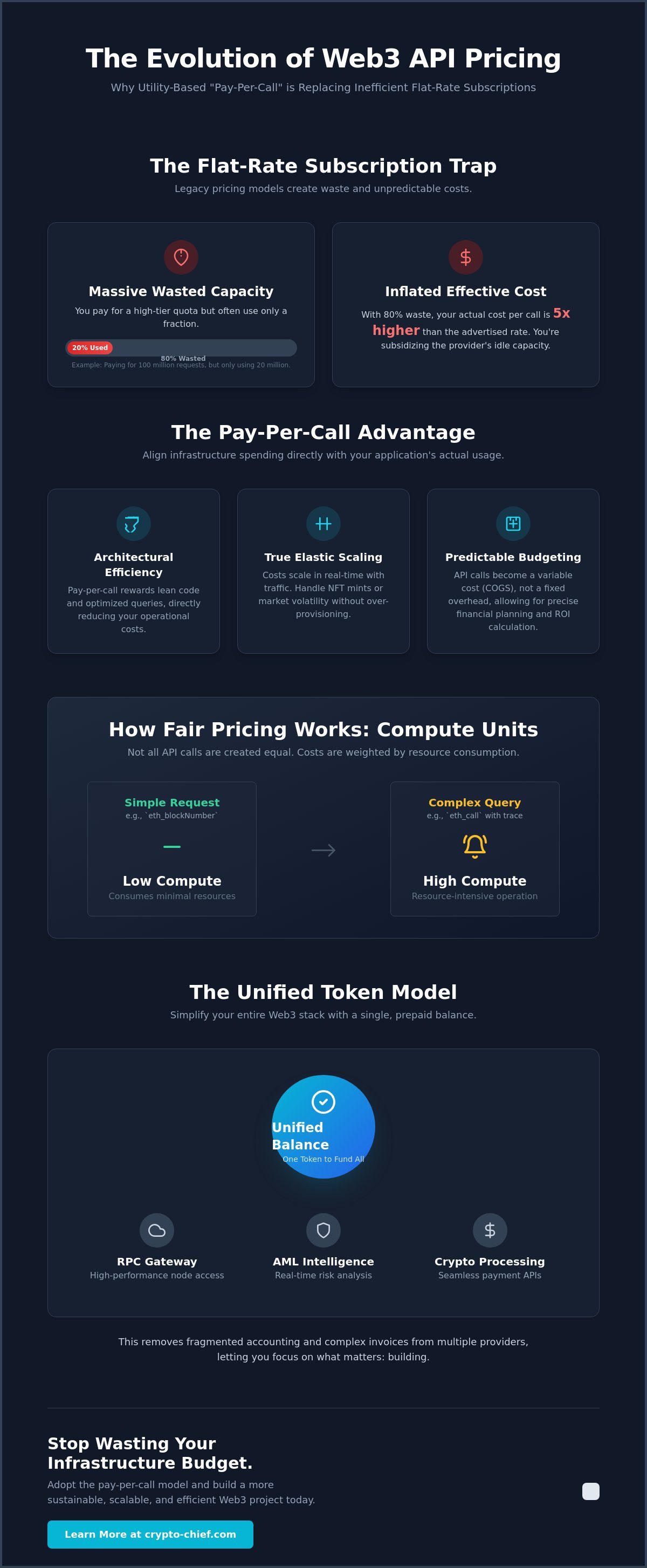
Legacy "Pro" tiers often create significant dead-weight loss for growing projects. When you pay for a subscription that includes 100 million requests but only utilize 20 million, you are effectively subsidizing the provider's idle capacity. This inefficiency is no longer acceptable. There is a psychological and financial shift occurring where developers treat API calls as a variable Cost of Goods Sold (COGS). This is especially critical for autonomous dApps and AI agents that require request-level settlement to maintain their own micro-economies. Precise web3 api pay per call pricing allows these automated systems to execute complex logic without the risk of hitting a subscription ceiling or wasting unused credits.
Key Metrics: Requests, Compute Units, and Token Balances
Modern infrastructure requires a sophisticated understanding of query weights. Not all requests are equal. A simple request like eth_blockNumber consumes far fewer resources than a complex eth_call or a multi-chain trace. Providers now weight these methods using Compute Units to ensure fair billing. Crypto Chief simplifies this technical complexity through a unified token balance. This single balance funds everything from the RPC Gateway to AML Intelligence, removing the need for fragmented accounting. Whether you are utilizing Crypto Processing API services or streaming real-time data, the unified model ensures that your focus remains on development rather than managing multiple provider invoices.
Economics Comparison: Pay-Per-Call vs. Flat-Rate Subscriptions
Choosing between a flat-rate subscription and web3 api pay per call pricing often feels like a choice between predictability and precision. In the current market, major providers like Alchemy offer rates around $0.45 per 1 million Compute Units, while QuickNode overage costs range from $0.50 to $0.62 per 1 million credits. While a $500 monthly subscription might seem safe, it often masks a significant architectural inefficiency. If your application only consumes 20% of its allocated quota, your effective cost per request is five times higher than the advertised rate. The math is clear. Transitioning to a utility-based model ensures that your capital is deployed only when your users interact with the network.
Critics occasionally mention an "Architecture Penalty," suggesting that pay-per-call models discourage caching or efficient engineering. This perspective ignores the reality of 2026 blockchain data, which is often too time-sensitive for aggressive caching strategies. In reality, request-level billing incentivizes developers to write leaner code and optimize their query structures. Understanding various API monetization strategies helps architects recognize that usage-based models are the most honest form of infrastructure commerce. They allow you to scale through bursty traffic, such as NFT mints or market liquidations, without hitting "Tier Walls" that result in service throttling or forced upgrades.
The "Ghost Usage" Problem in Tiered Plans
Startups often overpay by significant margins when tethered to legacy tiered plans. For example, a standard 1-million-call plan might cost $50 per month. If your dApp only makes 100,000 calls, you are paying for 900,000 "ghost" requests that never occurred. Industry observations suggest that teams using fixed subscriptions often waste up to 40% of their infrastructure budget on these unused allocations. To see a more granular analysis of these hidden drains, you can explore our Web3 Infrastructure Cost Breakdown. Reviewing your current logs against optimized RPC infrastructure can reveal immediate savings.
Flexibility for Multichain Scaling
Expanding your project to Solana, Polygon, or TON often incurs an "integration tax" under tiered models, as providers may require separate subscriptions for each chain. A utility-based approach removes this friction. With web3 api pay per call pricing, you can query any supported network from a single balance. This unified approach provides a strategic advantage for maintaining cross-chain liquidity via a high-performance RPC Gateway. It eliminates the need for complex billing across multiple providers, allowing your team to focus on building features rather than balancing infrastructure spreadsheets.
The Unified Token Model: Pricing Across RPC, AML, and Processing
Managing a fragmented infrastructure stack often leads to "dashboard fatigue." When developers must juggle separate API keys and billing cycles for RPC nodes, compliance checks, and transaction monitoring, the potential for failure points increases. The transition to a unified token model solves this by consolidating all costs into a single prepaid balance. This architectural shift ensures that web3 api pay per call pricing applies across your entire technical lifecycle. Whether you are querying a block or screening a wallet address, the cost is deducted from one central pool. It is a streamlined approach that reflects our "Silent Partner" philosophy: we handle the complex orchestration so you can focus on the user experience.
One significant advantage of a Unified API is the reduction of redundant requests. In legacy systems, fetching a transaction state and then checking it against a risk database required separate API keys and multiple round-trips. Our architecture allows a single call to trigger multiple downstream actions. This efficiency directly impacts your web3 api pay per call pricing by lowering the total number of requests needed to achieve a result. It is a sophisticated way to manage infrastructure that prioritizes performance over raw request volume. By integrating transaction fees into the API call lifecycle, we remove the friction of manual top-ups and fragmented accounting.
AML Intelligence and Risk Scoring
Maintaining a secure environment requires constant vigilance. Pricing for real-time risk detection and funds tracing via the AML API is calculated on a per-call basis, making it accessible for projects at any stage. This model allows small-volume dApps to implement automated compliance without the burden of heavy monthly retainers. When you compare this to legacy providers, as detailed in our Crypto AML Risk Detection Guide, the efficiency of a usage-based approach becomes undeniable. You only pay for the risk scores you actually generate, ensuring compliance never becomes a financial bottleneck.
Unified Processing and Webhooks
The efficiency of the unified model extends to transaction management. Cost structures for EventStream webhooks and real-time alerts are designed to scale with your project activity. Pay-per-call is the logical choice for non-custodial Crypto Processing because it aligns the infrastructure expense with the revenue-generating events of your business. By eliminating the need for fragmented dashboards, you reduce the integration tax associated with multichain expansion. A single high-performance engine now powers your entire stack, from the first user request to the final on-chain settlement.
Calculating Your Infrastructure ROI: A Web3 Budgeting Guide
Budgeting for Web3 infrastructure in 2026 requires a shift toward a "gas-equivalent" mindset. You don't just pay a flat fee; you allocate capital based on the computational intensity and business value of every request. To estimate your monthly spend, start with your Monthly Active Users (MAU) and multiply that by the average number of calls per session. Applying your specific web3 api pay per call pricing rate to this total provides a baseline. However, the true ROI comes from identifying transaction-critical endpoints and trimming "call bloat" through data normalization. Using a Unified API allows you to replace multiple legacy queries with a single, high-density request, immediately improving your margin.
Prepaid balances act as a natural budget cap for decentralized teams. Unlike traditional cloud billing that can spiral out of control during unexpected traffic spikes, a prepaid model ensures you never spend more than you've allocated. It forces a disciplined approach to architecture where every call must justify its cost. By focusing your budget on high-ROI endpoints, you ensure that your infrastructure spend is an investment in performance rather than a sunk cost of operation. This methodical approach to capital allocation is what separates sustainable dApps from those that burn through seed funding on inefficient node providers.
The ROI of High-Performance RPC Endpoints
Latency is a hidden tax on your project's profitability. A $0.001 call that delivers data in 50ms pays for itself many times over by reducing transaction failure rates in fast-moving markets. When comparing Ethereum RPC vs. Solana performance-to-cost ratios, the value isn't just in the price per call but in the reliability of the response. Many developers are turning to Infura alternatives to optimize regional latency and ensure their users stay connected regardless of network congestion. High-performance endpoints reduce the need for retry logic, which in turn lowers your total call volume.
Developer Tools for Cost Monitoring
Maintaining service continuity requires real-time visibility into your resource consumption. The Crypto Chief dashboard provides granular analytics on token usage, allowing you to see exactly which methods are driving your expenses. Setting up automated alerts for low balances prevents service interruptions during critical growth phases. To maximize the value of every paid call, consider implementing client-side caching for non-sensitive data. This technical discipline, combined with transparent web3 api pay per call pricing, creates a sustainable foundation for long-term scaling. Register your developer account to begin monitoring your infrastructure ROI in real-time.
The Architect’s Choice: Why Crypto Chief Wins on Pay-Per-Call
Choosing an infrastructure partner is one of the most consequential decisions a developer makes. In the high-stakes environment of 2026, you need more than just a gateway; you require a silent partner that removes friction from your scaling journey. Our "Elite Performance, Practical Pricing" ethos is built on the belief that sophisticated technology shouldn't come with a complex invoice. By adopting web3 api pay per call pricing, you reclaim control over your budget while gaining access to a global, non-custodial engine designed for structural integrity. It's a pragmatic approach that values your project's uptime as much as your bottom line.
A unique advantage of our architecture is the seamless integration of non-custodial processing fees directly into the API call lifecycle. While competitors often separate node costs from payment processing, we treat them as a unified event. This means your prepaid balance handles everything from initial data queries to the final settlement of a transaction. Transitioning from a legacy provider like Infura or Alchemy takes less than 30 minutes. You don't need to rewrite your entire backend; you simply point your requests to our high-performance endpoints and watch your "ghost usage" costs vanish. It's time to stop subsidizing provider inefficiency and start paying for the actual utility you consume.
Global Uptime and Scalability
Performance shouldn't be a regional luxury. Our distributed network ensures that your pay-per-call tokens deliver consistent value regardless of where your users are located. The reliability of our Unified Web3 Platform is a testament to our builder-centric philosophy. We've solved the hard problems of multichain latency and cross-chain accounting so you don't have to. When you choose a web3 api pay per call pricing model with us, you aren't just buying credits; you're securing a foundation that scales Decisively with your ambition. Our support team consists of engineers who understand the practical challenges of the field, providing the expert guidance you need to maintain peak efficiency.
Get Started with a High-Performance Balance
Reclaiming your infrastructure budget begins with a single step. Follow these instructions to modernize your stack today:
- Visit our portal to begin registering an account and secure your first token block.
- Review our technical documentation for immediate integration guides and API reference materials.
- Point your RPC and processing requests to our endpoints to start seeing real-time consumption analytics.
If you are managing a high-volume project or require a bespoke solution for a complex enterprise stack, we are ready to assist. Contact our architecture team to discuss custom volume pricing and strategic integration support. Let's build a more efficient Web3 together.
Future-Proof Your Infrastructure Economy
The shift toward utility-based billing is no longer optional for teams seeking long-term sustainability. By consolidating your RPC, processing, and compliance needs into a single unified balance, you eliminate the financial waste inherent in legacy subscription tiers. This transition allows you to treat infrastructure as a variable cost that scales precisely with your network utility. Mastering web3 api pay per call pricing is the most direct path to reclaiming your engineering budget and focusing on your core product.
Our platform provides the elite performance your project demands through a Unified API supporting over 20 chains. With non-custodial structural integrity and integrated real-time AML intelligence, we act as the silent partner that empowers your growth without technical friction. It's time to build on a foundation that values logic, efficiency, and performance as much as you do. Start Building with Pay-Per-Call API Tokens and experience the stability of a truly modern Web3 stack.
Frequently Asked Questions
What exactly is a "Compute Unit" in pay-per-call pricing?
A Compute Unit (CU) is a granular metric that represents the technical resource cost of an API request. While a simple query like fetching a block number requires minimal processing, a complex trace or log filter consumes significantly more server power. Providers use CUs to ensure that web3 api pay per call pricing remains fair by charging more for computationally intensive tasks and less for lightweight data retrieval.
Can I set a hard budget limit to prevent runaway API costs?
You can prevent runaway costs effectively because our model is built on prepaid token blocks. Since you fund your account in advance, there is no risk of receiving a surprise five figure invoice at the end of the month. Once your balance is utilized, the system requires a manual or automated top up to continue service, giving you absolute control over your infrastructure spending.
Does pay-per-call pricing apply to all blockchains, including Bitcoin and Solana?
Yes, the pay-per-call model applies across our entire multichain stack. Whether you are querying the Bitcoin ledger or interacting with Solana's high throughput environment, the same credit based logic governs your usage. This consistency is a core benefit of a Unified API, as it allows you to manage diverse network costs through a single, predictable accounting framework.
How does Crypto Chief handle pricing for batch requests?
Batch requests are priced by aggregating the individual Compute Units of every call contained within the batch. While batching is an excellent strategy for reducing network latency and improving client side performance, it doesn't bypass the underlying resource costs. Each method in the array is weighted according to its complexity to maintain a transparent and balanced billing structure.
What happens if my prepaid token balance reaches zero?
If your prepaid balance reaches zero, API requests will return an error code until additional tokens are added. To ensure service continuity, you can configure automated alerts that notify your team when the balance drops below a specific threshold. This proactive approach prevents downtime while maintaining the security of a hard budget cap without the risk of overage fees.
Are there any hidden fees for non-custodial crypto processing calls?
There are no hidden fees for non custodial processing calls beyond the transparent token consumption. Every interaction with the Crypto Processing API is treated as a billable event within your unified balance. This clear structure eliminates the integration tax often found with legacy payment providers who charge separate monthly maintenance or setup fees alongside their transaction percentages.
How does pay-per-call affect the performance of real-time webhooks?
Real time webhooks perform with the same elite low latency whether they are part of a subscription or a usage based plan. Using web3 api pay per call pricing for EventStream simply means you are billed only for the events successfully delivered to your endpoint. This is particularly efficient for monitoring specific wallet activities where event frequency can be highly unpredictable and bursty.
Is there a minimum monthly spend for the pay-per-call model?
We don't impose a mandatory minimum monthly spend for our standard pay-per-call model. This lack of a monthly retainer is designed to lower entry barriers for new projects and individual creators. You only pay for the infrastructure you utilize, allowing your costs to remain perfectly synchronized with your actual network demand and project growth without wasted capital.