
In 2026, a millisecond of latency on Solana isn't just a technical delay; it's a direct loss of capital for your users. You've likely felt the frustration of dropped transactions during sudden network spikes or the sting of bill shock from opaque Compute Unit pricing models. Finding the best solana rpc provider requires moving beyond simple uptime claims to look at real-world transaction landing rates and global edge network coverage. It's about building on a foundation that remains stable even when monthly stablecoin volume on the network exceeds $650 billion.
We understand that your priority is creating a seamless user experience without managing the friction of backend infrastructure. This guide compares the top five providers based on sub-millisecond performance, predictable cost-scaling, and deep integration with existing developer workflows. You'll learn how to secure a 99.99% uptime guarantee while avoiding the stale data issues that plague less resilient setups. From the specialized Solana-native tooling of Helius to the massive global reach of Alchemy and QuickNode, we'll help you select the high-performance engine your dApp deserves.
Key Takeaways
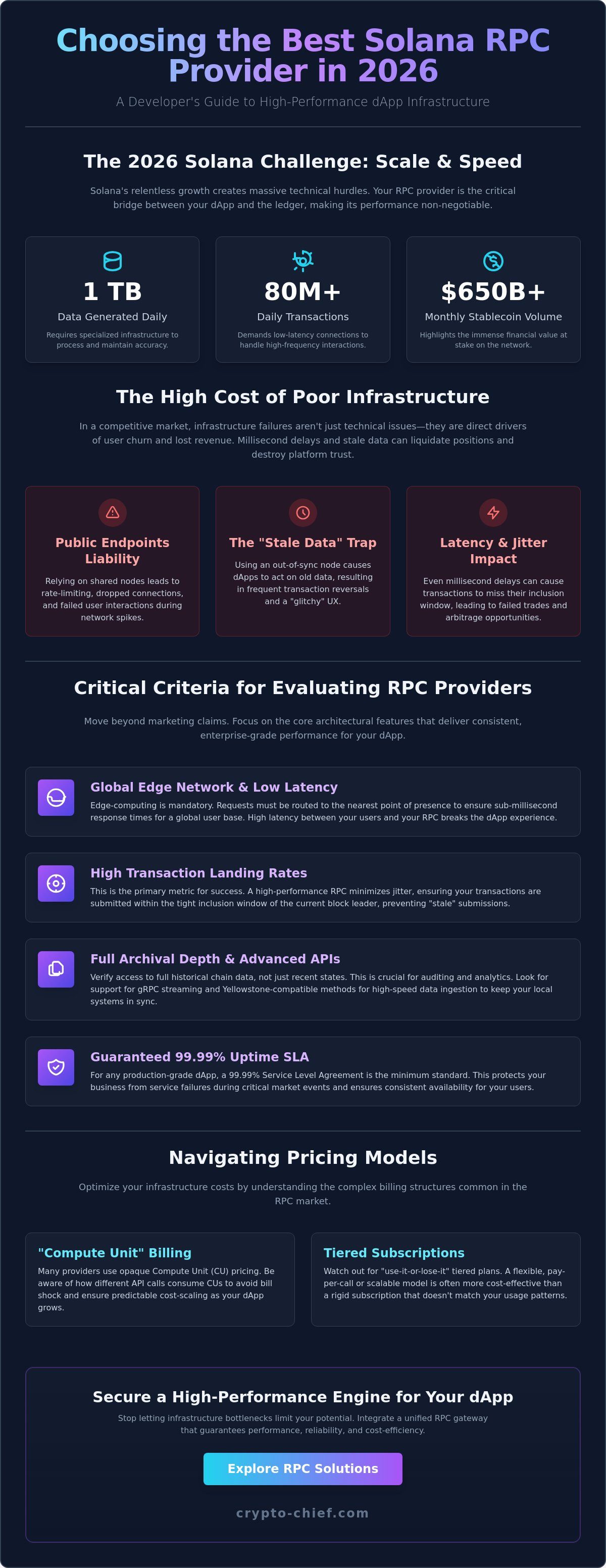
- Learn why Solana’s 1TB daily data generation in 2026 requires specialized RPC infrastructure to maintain high performance and data accuracy.
- Identify the critical technical criteria, including edge-computing distribution and archival depth, that distinguish enterprise-grade providers from basic nodes.
- Evaluate the top industry contenders to find the best solana rpc provider that balances low latency with high transaction landing rates for your users.
- Discover how to navigate complex "Compute Unit" billing and use-it-or-lose-it tiered subscriptions to optimize your infrastructure costs.
- Streamline your development workflow by integrating a unified RPC gateway that supports seamless multichain connectivity across major networks.
Why Your Solana RPC Choice Determines dApp Success in 2026
In 2026, the Solana blockchain has evolved into a high-performance engine processing over 80 million daily transactions. This relentless activity generates roughly 1TB of new chain data every day, creating a massive technical hurdle for standard infrastructure. For developers, this means the gap between "functional" and "performant" has widened significantly. A Solana RPC provider is the essential bridge between dApp logic and the ledger. Without a robust connection, your application is effectively blind to the current state of the network.
Public endpoints are a liability in this environment. While they serve well for initial prototyping, they lack the dedicated resources needed to handle production-grade traffic. During periods of high volatility or network congestion, public nodes are the first to experience rate-limiting and dropped connections. If you're building a production application, relying on shared infrastructure is a risk that leads to failed user interactions and lost revenue. Finding the best solana rpc provider ensures you have dedicated bandwidth and prioritized access to the network tip.
Transaction landing rates have become the primary metric for success. On Solana, the window for a transaction to be included in a block is incredibly tight. If your RPC introduces even a few milliseconds of jitter, your transaction might miss the current leader's window, leading to "stale" submissions that the network ignores. High-performance RPC gateways solve this by utilizing global edge networks to ensure your requests reach the validator set with minimal hop counts.
The Cost of Poor Infrastructure
Infrastructure failure isn't always a total outage; it's often a slow degradation of service. Millisecond delays in price updates can lead to failed arbitrage opportunities and liquidated positions for DeFi users. When a user sees a price on your interface that doesn't match the on-chain reality, their trust in your platform vanishes instantly. Poor infrastructure is the fastest way to drive user churn in a competitive market.
The "Stale Data" trap is particularly dangerous for modern applications. If your node isn't perfectly synchronized with the chain tip, your dApp might attempt to execute logic based on an account state that has already changed. This leads to frequent transaction reversals and a frustrating "glitchy" feeling for the end user. To remain competitive, you need the best solana rpc provider capable of maintaining sub-millisecond synchronization across a global footprint.
Critical Criteria for Evaluating Solana RPC Providers
Selecting the best solana rpc provider involves looking past marketing slogans and focusing on the underlying architecture. In 2026, the performance gap between providers is often determined by their global distribution. If your users are in Seoul but your RPC is in Frankfurt, they'll suffer from high latency that breaks the dApp experience. Edge-computing is no longer a luxury; it's a requirement to ensure sub-millisecond responses regardless of the user's location. You shouldn't settle for anything less than a provider that routes requests through the nearest possible point of presence.
Archival depth also plays a critical role in your decision. Most standard nodes only store recent state data, which is fine for simple swaps but useless for auditing or historical tracking. You need to verify if a provider offers full archival history or just "recent-state" access. Additionally, look for gRPC streaming and Yellowstone-compatible methods. These tools allow for high-speed data ingestion, which is vital for maintaining data integrity and security within your local database. Without these advanced tools, your dApp will struggle to stay in sync with the chain's rapid state changes.
Uptime Service Level Agreements (SLAs) are the final pillar of a reliable setup. For enterprise-grade Web3 projects, a 99.9% uptime is the bare minimum. Anything less puts your business at risk of total service failure during critical market events. If you're ready to upgrade your stack, exploring a professional RPC gateway is the logical next step to ensure consistent performance.
Transaction Landing and Staked Connections
In the competitive 2026 environment, simple request-response cycles aren't enough. Top-tier providers use staked identity to prioritize your transactions, ensuring they aren't ignored during network congestion. This is often coupled with Jito-optimized or MEV-aware endpoints that help traders capture opportunities faster. You can test a provider’s "Time to First Byte" (TTFB) across different regions to see how they perform under pressure. If a provider doesn't offer staked connections, your transaction landing rates will suffer when the network hits peak capacity.
Beyond the Node: Webhooks and AML
Pure RPC access is only one part of the puzzle. Modern developers also require blockchain webhooks to listen for specific on-chain events without constant polling. This reduces overhead and speeds up application response times. Security is equally important, which is why the best solana rpc provider should allow you to integrate AML intelligence at the gateway level. This proactive approach prevents illicit fund flows before they interact with your dApp, protecting your platform from regulatory risk while maintaining high-speed throughput.
The 5 Best Solana RPC Providers: 2026 Comparison
Choosing the right partner requires a deep understanding of fundamental blockchain concepts and how they translate into infrastructure performance. While many claim to be the best solana rpc provider, the reality depends on your specific use case, whether that's high-frequency trading or enterprise-scale dApp hosting. In 2026, these five providers lead the market by delivering stability and technical innovation.
- Alchemy: Widely regarded as the industry incumbent, Alchemy provides a 99.99% uptime SLA and a suite of debugging tools that simplify the developer experience. Their infrastructure supports over 70 chains, making them a safe bet for teams requiring massive scale and proven reliability.
- Helius: As a Solana-native specialist, Helius offers deep-level optimizations that multi-chain providers often miss. Their June 2026 pricing overhaul recalibrated how credits are consumed, providing a more transparent path for Solana-specific projects that need specialized NFT and token APIs.
- QuickNode: This provider is the preferred choice for rapid prototyping and global reach. With anycast routing and a flat-rate RPS plan launched in March 2026, QuickNode balances speed with predictable costs across more than 60 networks.
- Triton One: This is the high-frequency trading powerhouse. Triton is known for providing the dedicated infrastructure behind major protocols like Pyth and Wormhole. Their usage-based model focuses on bandwidth and compute complexity, catering to power users who need the lowest possible latency.
- Crypto Chief: Standing out as the efficiency leader, Crypto Chief offers a sophisticated RPC Gateway that eliminates economic waste. By providing pay-per-call access and a unified interface, it solves the complexity of managing infrastructure for growing startups and established enterprises alike.
Performance Benchmarks: Latency vs. Throughput
Response times vary significantly when executing heavy methods like getProgramAccounts. While most providers handle simple balance checks with ease, retrieving complex program data requires optimized indexing and high-performance hardware. Triton and Helius often lead in archival data retrieval speeds due to their specialized Solana indexing. However, for sheer global throughput across diverse regions, Alchemy’s edge network remains difficult to beat. You should prioritize providers that offer local node synchronization to avoid the "stale data" traps mentioned earlier.
Feature Parity: Who Offers the Full Stack?
Modern applications rarely stay on a single chain. Managing multiple providers for a multichain app creates unnecessary overhead and security risks. A multichain RPC gateway allows you to manage Solana, Ethereum, and other networks under a single API key. This unified approach ensures that your development workflow remains lean as you scale across the ecosystem. WebSocket stability and gRPC support are now standard across these top five, but the real differentiator is how seamlessly they integrate into your existing CI/CD pipelines without requiring custom middleware.
Pay-Per-Call vs. Tiered Pricing: Eliminating Web3 Overhead
In the current landscape, the economic model of your infrastructure is just as vital as its technical throughput. Many legacy providers utilize tiered subscription models that create significant economic friction for growing dApps. These "use-it-or-lose-it" credit systems often force you to pay for capacity you don't actually consume, resulting in wasted capital during periods of low market activity. For a startup, this overhead can be the difference between a sustainable runway and a premature pivot.
Budgeting becomes even more complex when you introduce "Compute Units" (CU). While a flat rate per million CUs might look attractive on a landing page, the actual cost of a single request can vary wildly based on its complexity. A simple balance check might cost very little, but a heavy getProgramAccounts call can consume hundreds of units instantly. This lack of standardization makes it difficult to find the best solana rpc provider based on price alone. You need a model that offers granular transparency without requiring a degree in infrastructure mathematics to predict your next invoice.
The solution lies in pay as you go RPC nodes, which replace rigid monthly commitments with a more fluid approach. By using prepaid token balances, you can scale your API usage in direct response to user demand. This ensures that you aren't penalized for growth or burdened by costs during quiet cycles. If you're looking for a more predictable way to manage your stack, exploring a professional RPC Gateway can help you eliminate these hidden inefficiencies.
Calculating Your Real API Costs
To truly compare providers, you must look at the "Cost per Million Requests" across your specific traffic profile. Developers are increasingly moving away from monthly commitments because variable traffic makes fixed costs inherently inefficient. When your infrastructure costs are decoupled from rigid tiers, you gain the agility needed to survive volatile market conditions. Pay-per-call pricing aligns infrastructure costs directly with dApp revenue. This alignment allows you to treat your RPC as a utility rather than a fixed overhead expense, providing a clearer path to profitability. When evaluating the best solana rpc provider for your team, prioritize those that offer a unified API key and a transparent, usage-based billing structure.
Crypto Chief: The Architect’s Choice for Solana Infrastructure
While specialized providers offer niche benefits, the 2026 developer landscape requires a more integrated approach. Finding the best solana rpc provider often leads teams to a crossroads between raw speed and operational complexity. Crypto Chief serves as the authoritative partner for builders who need more than just a raw connection. We provide high-performance Solana endpoints backed by a global network designed to minimize hop counts and maximize transaction landing rates. By positioning ourselves as a silent, powerful engine behind your dApp, we've built a platform that removes technical friction so you can focus on your core product.
Most dApps in 2026 don't live in isolation. Managing separate infrastructure for Solana, Ethereum, and BNB Smart Chain is an inefficient use of resources that introduces unnecessary security risks. Our Unified API allows you to manage these diverse networks through a single, high-performance gateway. This structural integrity is paired with integrated security features, including built-in AML risk detection and real-time EventStream capabilities. You can move from our documentation to a production-ready environment in minutes without the typical integration headaches.
Scaling Without Friction
Scale shouldn't come at the cost of data sovereignty. Our non-custodial approach ensures that while we provide the engine, you retain full control over your logic and data integrity. The RPC Gateway is specifically designed for multichain architects who value logic and scalability over flashy marketing fluff. We maintain elite uptime metrics and provide the robust infrastructure required for high-volume event streaming, ensuring your dApp remains responsive even during the most intense network spikes. It's a professional-grade foundation that supports both individual creators and enterprise-scale operations with equal reliability.
Ready to Build on Solana?
Setting up your infrastructure shouldn't be a hurdle. You can create an account and access your dedicated Solana endpoint immediately without navigating complex approval processes or restrictive tiers. Our model is built for builders who value transparency and performance. We've solved the underlying infrastructure challenges so you don't have to. Register for Crypto Chief today and start building with the best solana rpc provider experience using our efficient pay-per-call model.
Future-Proof Your Solana Infrastructure
Success on Solana in 2026 hinges on your ability to bypass network friction and eliminate economic waste. We've explored how latency directly dictates transaction landing rates and why rigid tiered pricing often leads to capital inefficiency. Selecting the best solana rpc provider is no longer just about raw speed; it's about finding a partner that offers architectural stability and transparent, usage-based scaling.
By integrating a unified solution, you can manage complex multichain environments while maintaining high-performance standards. Crypto Chief provides the necessary backbone with a 99.9% Uptime SLA and a pay-per-call pricing model that aligns with your actual growth. Our Unified Multichain API simplifies your workflow, allowing you to focus on building rather than managing backend bottlenecks. It's the silent, powerful engine you need to stay competitive in a rapidly evolving ecosystem.
Deploy your high-performance Solana RPC endpoint on Crypto Chief and experience a foundation built for the next generation of dApps. Your vision deserves a partner that scales as fast as you do.
Frequently Asked Questions
What is the fastest Solana RPC provider in 2026?
Triton One and Helius are widely recognized for raw speed, though the fastest option often depends on your geographic proximity to their nearest node. Triton One specializes in dedicated infrastructure for high-frequency trading, while Helius offers native optimizations for the Solana ecosystem. Testing Time to First Byte in your target region is the only way to verify the best solana rpc provider for your specific latency requirements.
Is there a free Solana RPC provider for developers?
Most leading providers offer free tiers to support the builder ecosystem and initial prototyping. Alchemy provides 30 million Compute Units per month, while QuickNode offers 10 million credits for developers. These tiers are ideal for testing, but production-grade applications usually require paid plans to ensure higher rate limits and guaranteed uptime SLAs during periods of intense network congestion.
How do I choose between a shared and dedicated Solana RPC node?
Shared nodes are cost-effective for low-traffic apps, but dedicated nodes provide exclusive resources and prioritized transaction landing. A dedicated node eliminates the "noisy neighbor" effect where other users' traffic spikes impact your performance. For enterprise dApps or high-stakes trading bots, dedicated infrastructure is necessary to maintain the consistent sub-millisecond response times and reliability that users expect in 2026.
What are Solana Compute Units (CUs) and how do they affect pricing?
Compute Units measure the actual computational resources an RPC call consumes on the validator. Unlike simple request counting, CU-based pricing reflects the complexity of the "work" the node performs, such as filtering large account sets. This model can lead to unpredictable billing if your dApp frequently executes resource-intensive methods, making pay-per-call models a more transparent and predictable alternative for many growing teams.
Can I use the same RPC provider for Solana and Ethereum?
You can use a unified RPC gateway to manage both Solana and Ethereum through a single, high-performance interface. This approach reduces architectural complexity and allows you to manage multiple chain connections under one API key. It's a strategic choice for multichain architects who want to streamline their developer workflow without sacrificing the performance or data integrity of individual chain endpoints.
What happens if my Solana RPC provider goes down?
Your dApp will lose its connection to the ledger, causing transaction failures and stale data displays for your users. This is why enterprise-grade providers offer a 99.9% or 99.99% uptime SLA to mitigate financial risk. Implementing a fallback strategy with a secondary provider ensures your application remains functional even if your primary gateway experiences a localized outage or service degradation.
How does gRPC improve Solana dApp performance?
gRPC uses an efficient binary format and HTTP/2 streaming to deliver faster data updates than traditional JSON-RPC methods. It allows for high-speed, bidirectional communication, which is essential for real-time applications like decentralized order books. By reducing serialization overhead, gRPC helps the best solana rpc provider deliver the low-latency throughput required for the high-volume network activity seen throughout 2026.
Does Crypto Chief support Solana mainnet-beta and devnet?
Crypto Chief provides full support for both Solana mainnet-beta and devnet through its high-performance RPC Gateway. This allows you to test your dApp logic in a safe environment before deploying your final code to the live network. Switching between environments is seamless, ensuring your development cycle remains fast and efficient while you scale your application from a prototype to a production-level success.
Tags: best solana rpc provider