
A six-second delay is the invisible wall where user patience ends and cart abandonment begins. While blockchain purists might tolerate the 45-minute wait for a Bitcoin confirmation, modern e-commerce users demand an experience that mirrors traditional fintech speed. Establishing the acceptable crypto payment latency for users is no longer a subjective design choice; it's a technical necessity for any developer building in the 2026 Web3 ecosystem. You likely feel the pressure of explaining block finality to frustrated customers who just want their transaction to work instantly. We understand that bridging the gap between decentralized protocols and centralized expectations is your biggest engineering challenge.
This guide provides the definitive technical benchmarks and psychological thresholds required to maintain user trust across different payment tiers. You'll learn how to implement sophisticated solutions to mask unavoidable on-chain delays and how to select high-performance infrastructure that eliminates API-induced lag. We will move beyond basic block times to explore how tools like RPC Gateways and EventStream can transform a "pending" state into a seamless confirmation, ensuring your checkout flow remains a bridge rather than a barrier.
Key Takeaways
- Identify why sub-5 second responses represent the acceptable crypto payment latency for users in retail, while B2B contexts prioritize secure finality.
- Analyze the technical lifecycle of a transaction, distinguishing between mempool propagation and block inclusion to optimize each stage of the delay.
- Master the use of Optimistic UI design and real-time webhooks to mask unavoidable network lag and deliver an immediate sense of success.
- Leverage a global RPC Gateway and Unified API to ensure minimal propagation latency and reliable performance across diverse blockchain networks.
- Utilize high-performance infrastructure like EventStream to trigger instant post-payment workflows as soon as a transaction is detected on-chain.
Defining Acceptable Crypto Payment Latency in 2026
In the high-velocity digital economy of 2026, latency is the definitive delta between a user clicking "Pay" and receiving a "Success" notification. It isn't merely a technical measurement of network throughput; it's the primary driver of user retention. While blockchain purists often focus on block finality, the modern consumer views payment through the lens of traditional finance. If your checkout experience feels slower than Apple Pay or a Visa tap, you've already lost. The acceptable crypto payment latency for users has shifted from "eventual consistency" to "immediate feedback." Users now expect real-time confirmation of their intent, even if the actual on-chain settlement occurs minutes later in the background.
The Psychology of the Waiting Budget
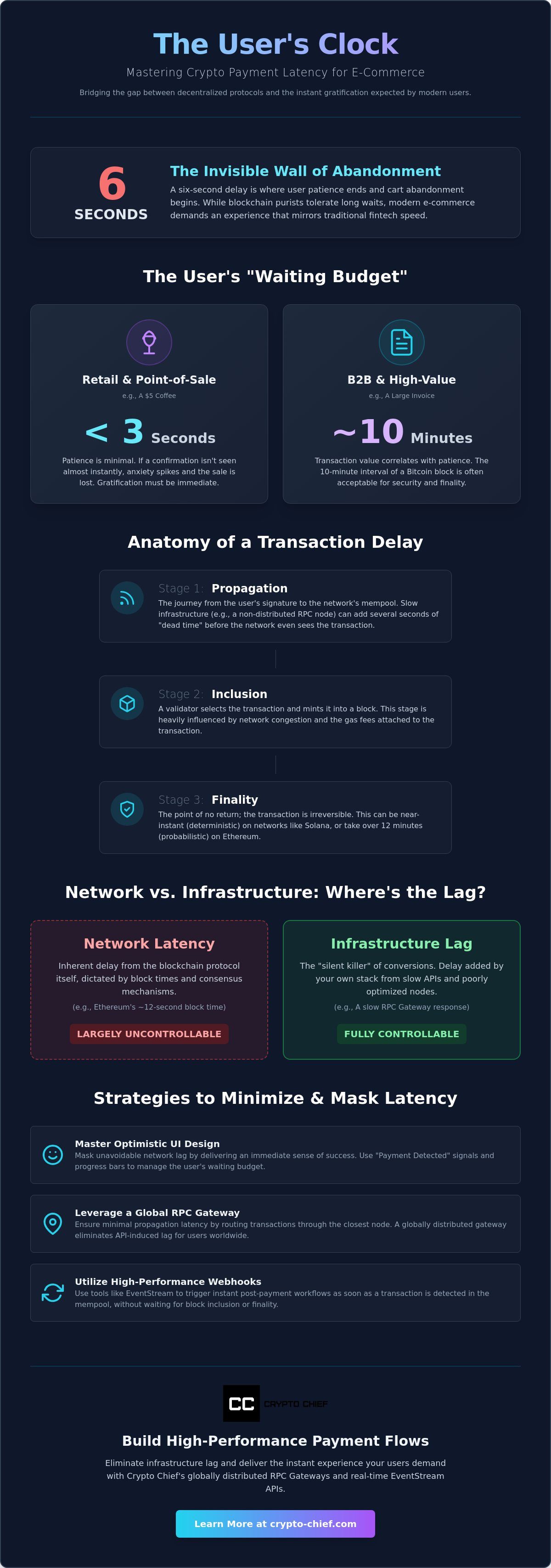
Every transaction carries a psychological "waiting budget" that varies based on the context of the purchase. For retail and point-of-sale environments, the three-second rule is absolute. If a user doesn't see a confirmation within three seconds, anxiety sets in, and abandonment rates spike. However, this budget is not static. Transaction value correlates directly with patience. A user buying a $5 coffee demands instant gratification, while a business architect settling a high-value B2B invoice might find the 10-minute interval of a Bitcoin block acceptable for security reasons. Strategic developers use visual feedback, such as progress bars or "Payment Detected" signals, to extend this window by providing the user with a sense of forward momentum.
Network vs. Infrastructure Lag
It's vital to distinguish between the inherent limitations of a blockchain and the delays introduced by your own architecture. Network latency is dictated by the protocol, such as the 12-second block time of Ethereum or the 2-second finality of Avalanche. In contrast, infrastructure lag is often the silent killer of conversion rates. A poorly optimized RPC Gateway or a non-distributed node setup can easily double the perceived delay by slowing down transaction propagation to the mempool. Infrastructure latency is the overhead added by the developer’s stack. To combat this, elite payment systems utilize global node distribution to ensure that a transaction is broadcast from the node closest to the user, minimizing the "dead time" before the network even begins its work.
The Technical Anatomy of a Crypto Transaction Delay
To the uninitiated, a transaction feels like a single event. For a developer, however, latency is a multi-stage lifecycle that dictates the acceptable crypto payment latency for users across different ecosystems. Understanding this anatomy is essential because a delay at any single point can derail the entire checkout flow. While Section 1 established the psychological thresholds of waiting, this section deconstructs the technical hurdles that create those wait times. Optimization begins with a granular look at how a transaction moves from a user's wallet to a finalized state on the ledger.
- Stage 1: Propagation. This is the journey from the client-side signature to the network's mempool. If your infrastructure is sluggish, the transaction might take several seconds just to be visible to miners or validators.
- Stage 2: Inclusion. This is the moment a validator selects the transaction and mints it into a block. This stage is heavily influenced by network congestion and the gas fees attached to the payload.
- Stage 3: Finality. This is the point of no return. It represents the technical guarantee that a payment is irreversible and cannot be wiped out by a chain reorganization.
The nature of finality varies wildly between protocols. Bitcoin and Ethereum rely on probabilistic finality, where the certainty of a transaction increases as more blocks are added on top of it. In contrast, modern networks like Solana or various Layer 2 solutions offer near-instant deterministic finality. For a retail user, waiting 12.8 minutes for Ethereum's "hard finality" is a non-starter. Developers must decide whether to trigger a "Success" UI state at the inclusion stage or wait for full finality based on the risk profile of the transaction.
The Critical Role of High-Performance RPCs
Your choice of infrastructure is the primary lever you have to control propagation speed. High-performance Web3 RPC gateways reduce the time it takes for a transaction to reach the mempool by utilizing globally distributed node clusters. By routing requests to the nearest healthy node, you eliminate the geographic lag that often plagues self-hosted setups. Advanced developers also implement request batching to reduce API overhead, ensuring that even during high-traffic periods, the initial "Payment Detected" signal remains instantaneous. If you want to see how a streamlined connection can improve your app's responsiveness, consider integrating a dedicated RPC Gateway for your primary chains.
Finality Models and User Certainty
Different consensus mechanisms produce different wait times. Proof of Work (PoW) systems like Bitcoin target 10-minute block times, making them ideal for high-value B2B settlement where security outweighs speed. Proof of Stake (PoS) systems and Directed Acyclic Graph (DAG) structures, like Avalanche, achieve finality in as little as 2 seconds. Managing these discrepancies across a multichain application is complex. Many architects now use Unified APIs to normalize latency data, allowing the frontend to deliver a consistent user experience regardless of whether the underlying chain is legacy or next-gen. This abstraction ensures that the acceptable crypto payment latency for users is maintained through clever UI handling, even when the base layer is slow.
Benchmarking Acceptable Latency by Use Case
Acceptable latency is not a universal constant; it's a variable determined by the stakes of the transaction. While the technical anatomy discussed in the previous section provides the "how," the industry context defines the "how fast." A developer building a high-speed gaming platform operates under a completely different set of constraints than one architecting a cross-border B2B settlement system. Establishing the acceptable crypto payment latency for users requires a nuanced understanding of these specific benchmarks, as a one-size-fits-all approach inevitably leads to either security vulnerabilities or poor conversion rates.
Retail Payments and the L2 Revolution
In the retail sector, the standard is set by traditional contactless payments. By 2026, networks like Base, Arbitrum, and Polygon have become the benchmarks for retail latency because they consistently deliver inclusion times under 2 seconds. This speed is critical for e-commerce checkouts where any delay beyond 5 seconds results in a measurable increase in session abandonment. Developers often leverage stablecoins in these scenarios to eliminate the "volatility anxiety" that users feel when watching a pending transaction while prices fluctuate. For retail, the goal is "inclusion-as-success," where the UI confirms the payment as soon as the transaction hits a block, relying on the high security of the underlying L2 to guarantee eventual finality.
Institutional and High-Ticket Latency
Institutional transfers and high-value asset settlements, such as real estate or OTC trades, operate on a different timeline. Here, speed is secondary to structural integrity and regulatory compliance. The waiting budget for a $1,000,000 transfer is significantly higher because the cost of a "reorg" or a failed finality is catastrophic. In these use cases, a 10-minute wait for a Bitcoin confirmation or a 12-minute wait for Ethereum's hard finality is often considered superior to an instant, less secure settlement. These workflows must also integrate AML Risk Detection to meet global compliance standards. By utilizing sophisticated intelligence tools, developers can run these checks in parallel with the propagation phase, ensuring that compliance doesn't add unnecessary friction to the already deliberate pace of high-ticket transfers.
Gaming and micro-transactions represent the most demanding end of the spectrum. In a decentralized game, even a two-second delay can break the immersion or disrupt the mechanics of play. This necessitates the use of optimistic updates, where the frontend assumes the transaction will succeed and updates the UI in sub-second time. This approach requires a robust infrastructure that can handle high-frequency requests without dropping packets. Conversely, for high-value asset transfers, the priority remains deep liquidity and absolute finality. Whether you are moving cents or millions, your architecture must align with the user's specific expectation of certainty versus speed.
Strategies to Minimize and Mask Payment Latency
While developers cannot rewrite the consensus rules of a public ledger, they can master the art of perception. Achieving an acceptable crypto payment latency for users often involves a combination of technical performance and psychological sleight of hand. Optimistic UI updates are the first line of defense. By immediately reflecting a pending state or even a "success" state for low-risk micro-transactions, you provide the instant gratification users expect from modern applications. Pairing this with smart gas estimation ensures your transaction isn't left languishing in the mempool during sudden spikes in network activity. If you ensure your payload is priced for inclusion in the very next block, you've already won half the battle.
- Optimistic Updates: Update the frontend state immediately after the user initiates the transaction to eliminate the feeling of a "dead" button.
- Smart Gas Estimation: Use real-time data to set priority fees that guarantee first-block inclusion without overpaying.
- Mempool Monitoring: Track the transaction as soon as it's broadcast to provide "Payment Detected" feedback within milliseconds.
- Direct-to-Wallet Settlement: Remove the internal accounting layers of custodial providers to ensure the shortest possible path for funds.
Real-Time Event Streaming
Real-time visibility is the key to masking the delay between propagation and inclusion. By monitoring mempool events, you can signal to the user that their payment is detected before the block is even mined. This is where Real-Time Blockchain Webhooks become indispensable. Instead of relying on inefficient server-side polling, which adds unnecessary API overhead and cost, event-driven architectures push updates to your frontend instantly. This approach reduces the "dead time" in the UI and keeps the user engaged throughout the entire lifecycle of the transaction. It's a fundamental shift from waiting for data to reacting to it.
Non-Custodial Speed Advantages
Choosing a non-custodial architecture offers distinct speed advantages over traditional centralized gateways. Centralized providers often introduce internal ledger synchronization delays as they move funds through their own accounting systems before notifying your application. Using Non-Custodial Crypto Payment APIs eliminates these middleman approval delays. The path from the user's wallet to your settlement address is direct and transparent. This architectural choice significantly lowers the barrier to reaching the acceptable crypto payment latency for users, as there is no third-party infrastructure adding invisible seconds to the clock. Settlement happens as fast as the chain allows, with no artificial bottlenecks. To implement these low-latency strategies in your own stack, you can explore our non-custodial processing solutions today.
Building High-Performance Payment Flows with Crypto Chief
Theory and strategy only go so far; the final mile of performance is determined by the quality of your underlying engine. To consistently hit the acceptable crypto payment latency for users, you need a stack that eliminates the friction between raw chain data and your application's logic. Crypto Chief provides this foundation through a unified infrastructure designed specifically for multichain processing. By abstracting the complexities of different consensus models into a single, high-performance environment, we allow you to focus on the user experience while we manage the millisecond-level optimizations required for global scale.
Our global RPC network is the cornerstone of this performance. It ensures that transaction propagation occurs with minimal delay, regardless of where your user is located. When a payment is initiated, it's broadcast through a cluster of nodes that prioritize speed and uptime, preventing the "dead air" that often leads to cart abandonment. This is paired with our high-fidelity EventStream, which delivers instant notifications the moment a transaction is detected on-chain. This synergy between broadcast and detection is what allows developers to build flows that feel instantaneous even on legacy networks.
Integrating the Crypto Processing API
Implementing a low-latency checkout requires a logical progression that prioritizes immediate feedback. When you integrate the Crypto Processing API, the technical load of chain monitoring is handled automatically. The logic is straightforward: your frontend initiates the payment, our RPC nodes propagate it to the network, and EventStream simultaneously watches for the transaction hash. This eliminates the need for complex, resource-heavy polling on your servers. You get a clean, event-driven architecture that maintains performance as you scale from an MVP to enterprise-level volume without the degradation typically associated with high-traffic periods.
Future-Proofing for 2026 and Beyond
The landscape of 2026 is defined by the rise of L3s and specialized AppChains that target sub-second finality. Preparing your application for this shift means choosing a partner that evolves alongside the technology. Our pay-per-call model ensures that your costs remain predictable and efficient as you scale, avoiding the bloated overhead of traditional gateway fees. By building on a foundation that values structural integrity and technical precision, you ensure that the acceptable crypto payment latency for users is always within reach. Don't let infrastructure be the bottleneck of your innovation. You can register your account and start building with our elite, low-latency infrastructure today.
Master the Speed of Trust in Web3
The evolution of decentralized finance in 2026 has transformed speed from a luxury into a prerequisite for survival. You've seen how the acceptable crypto payment latency for users varies across use cases, requiring a delicate balance between optimistic UI updates for retail and rigorous finality for institutional settlement. By deconstructing the lifecycle of a transaction and implementing event-driven architectures, you can eliminate the friction that historically defined on-chain payments. Success in this landscape depends on selecting a foundation that removes the technical bottlenecks of propagation and detection.
Our non-custodial, high-performance architecture provides global multichain RPC coverage and real-time EventStream webhooks, ensuring your application remains responsive even during peak congestion. These tools are designed to handle the heavy lifting so you can focus on building the next generation of digital commerce. We're here to help you turn technical constraints into competitive advantages. Ready to optimize your checkout flow?
Build faster Web3 apps with Crypto Chief’s low-latency API
Frequently Asked Questions
What is a good latency for a crypto payment?
A good latency depends entirely on the transactional context. For retail and e-commerce, the acceptable crypto payment latency for users is typically under five seconds to prevent cart abandonment. In contrast, institutional or B2B payments often prioritize security over speed. This makes a 10 to 60-minute wait for deep block finality perfectly acceptable for high-value settlement where structural integrity is the primary concern.
How does blockchain finality affect user payment experience?
Blockchain finality dictates when a transaction becomes irreversible. This directly impacts the user's sense of security. If a UI confirms a payment before reaching finality, the merchant takes on the risk of a chain reorganization. Developers often mask this by using "Payment Detected" states. This provides immediate psychological gratification while the protocol works toward deterministic finality in the background without exposing the user to technical complexity.
Can I speed up a pending crypto transaction?
You can speed up a pending transaction by utilizing Replace-By-Fee (RBF) or child-pays-for-parent (CPFP) mechanisms. These methods allow users to broadcast a new version of the transaction with a higher priority fee to incentivize validators. Smart gas estimation tools are essential here. They ensure the original transaction is priced correctly from the start. This prevents the "stuck" states that lead to user frustration and support tickets.
Why do some crypto payments take longer than others?
Payment speed is determined by a combination of the network's hardcoded block times and current mempool congestion. As of June 30, 2026, the daily average for a Bitcoin transaction confirmation is approximately 45 minutes. Ethereum averages around 12 seconds per block. If a user sets a low fee during a period of high activity, validators will prioritize higher-paying transactions. This leaves the cheaper payment in a pending state until network traffic subsides.
Is Solana faster than Ethereum for payments in 2026?
Solana remains significantly faster than Ethereum's base layer in 2026. It offers transaction finality in approximately 12.8 seconds under normal conditions. In contrast, Ethereum reaches hard finality in about 12.8 minutes. While Ethereum has improved with Layer 2 scaling, Solana's architecture provides near-instant deterministic finality that is ideal for high-frequency retail. Developers often choose Solana for micro-transactions where the acceptable crypto payment latency for users is measured in seconds.
How do webhooks help with crypto payment latency?
Webhooks eliminate the need for inefficient client-side or server-side polling by pushing data as soon as an on-chain event occurs. Instead of your application asking the node for updates every few seconds, an event-driven service broadcasts a notification the moment a transaction is detected in the mempool. This reduces perceived latency by triggering UI changes instantly. It saves both API resources and the user's limited patience budget.
What is the difference between confirmation and finality?
A confirmation occurs the moment a transaction is included in a minted block. Finality is a more rigorous standard. It represents the point where the transaction cannot be altered or reversed by the network. While a single confirmation might be enough to ship a low-cost digital good, high-value transfers usually require multiple confirmations. Hard finality ensures the funds are permanently settled and the transaction is immune to chain reorganizations.
Does the RPC provider affect transaction speed?
Your RPC provider is the gateway to the blockchain and directly impacts propagation speed. A high-performance provider with a global node network ensures that your transaction is broadcast from the node closest to the user. This reduces the initial infrastructure lag before the blockchain even begins its consensus process. It ensures the payment reaches validators as quickly as possible. This minimizes the "dead time" where a user is left waiting for a response.