
The most expensive line item in your 2026 infrastructure budget isn't your server cost, it's the developer hours lost to manual data parsing and complex credit-based billing. While Alchemy remains a powerhouse for deep, chain-specific features, the rise of the Unified API suggests that the industry's focus has shifted from raw access to operational efficiency. Deciding between alchemy vs unified api is no longer just a technical preference; it's a strategic decision that determines how fast you can deploy across new networks without breaking your budget or your backend.
You likely already know the frustration of managing separate providers for RPC, AML intelligence, and payments while trying to reconcile unpredictable Compute Unit costs. We understand that your priority is building a seamless user experience, not babysitting fragmented infrastructure. This guide compares the industry-standard Alchemy ecosystem against modern Unified APIs to determine which infrastructure best scales your multichain dApp. We'll examine how a single, standardized data schema and a predictable pay-per-call model can reduce your time-to-market for cross-chain features and stabilize your operational overhead.
Key Takeaways
- Understand the critical shift from proprietary data engines to normalized schemas that allow you to scale across Ethereum, Polygon, and L2s without rewriting chain-specific frontend logic.
- Evaluate the economic impact of alchemy vs unified api by comparing the complexity of weighted Compute Units against the transparency of a fixed pay-per-call pricing model.
- Learn how to avoid the "data-only trap" by integrating execution tools like AML Intelligence directly into your API workflow to automate compliance and security.
- Identify the specific use cases where Alchemy’s proprietary toolset excels versus where a Unified API provides the necessary velocity for rapid multichain deployment.
Defining the 2026 Standard: Alchemy vs. Unified API
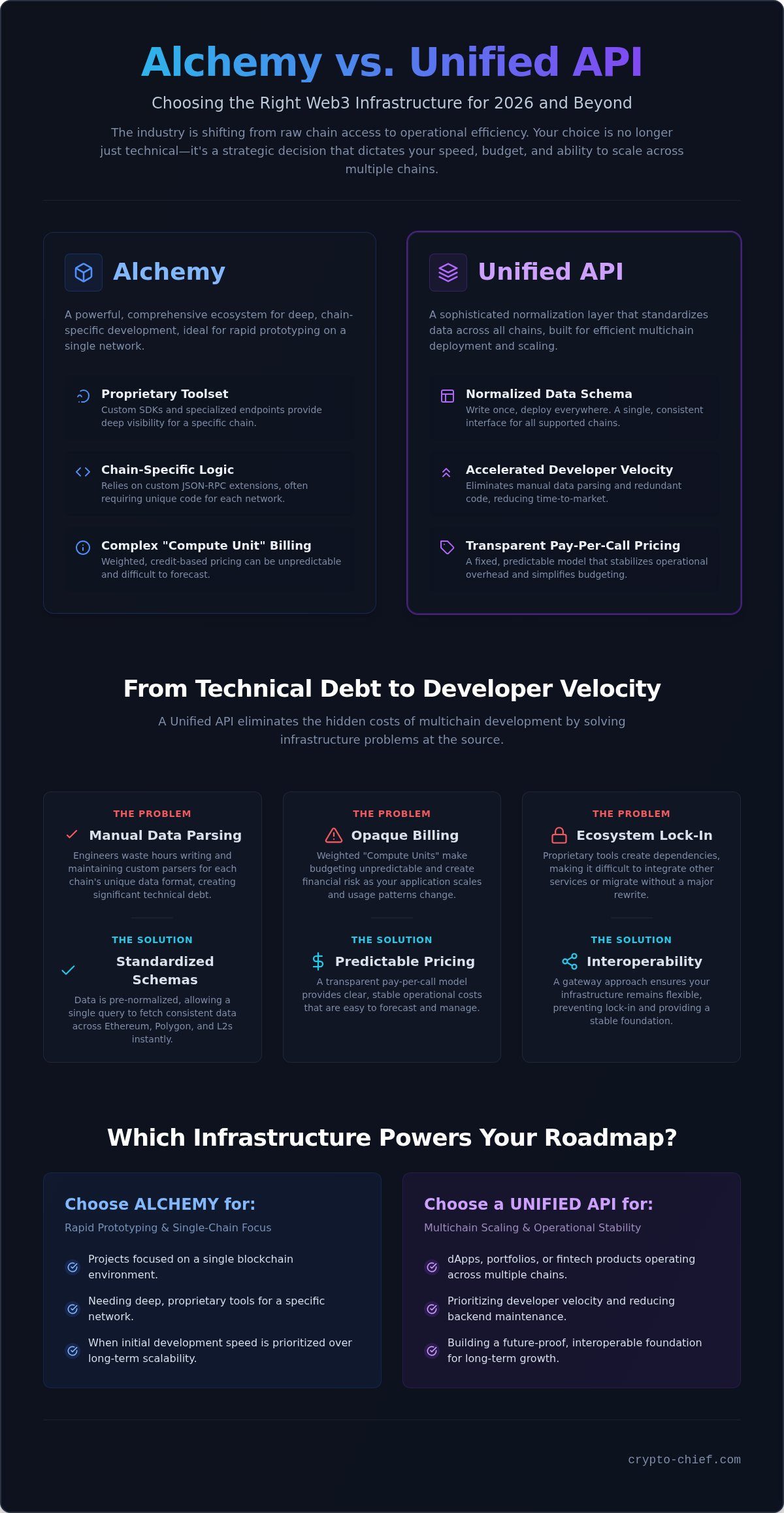
Alchemy has long been the industry's default choice, providing a robust suite of proprietary tools and custom SDKs designed to simplify complex blockchain interactions. It functions as a comprehensive ecosystem where everything from node access to data indexing is managed under one roof. Conversely, a Unified API acts as a sophisticated normalization layer. It standardizes multichain data into a single, consistent schema, allowing developers to query different blockchains using identical parameters. When evaluating alchemy vs unified api in 2026, the choice depends on whether you prioritize deep, proprietary features or the flexibility of a standardized, integration-first architecture.
The Evolution of Web3 Infrastructure
The journey of Web3 development has evolved from managing raw RPC nodes to utilizing sophisticated data indexers that handle massive throughput. In 2026, data fragmentation has emerged as the primary bottleneck for multichain dApps. Developers often find themselves writing redundant code to handle the unique data formats of every new Layer 2 or sidechain they integrate. This friction is driving a shift toward the Unified Web3 Developer Platform, where normalization happens at the infrastructure level rather than in the application logic. By abstracting the complexities of individual chains, these platforms allow teams to focus on core product features instead of backend maintenance.
When to Choose an Ecosystem vs. a Gateway
Alchemy’s strengths are most apparent during the rapid prototyping phase of single-chain applications. Their specific tools offer immediate utility for teams focused on a narrow environment. However, the Unified API provides a distinct advantage for cross-chain portfolios and complex fintech applications that require high data integrity across diverse networks. There is a clear tipping point where proprietary schemas become a liability. As your dApp grows to support multiple chains, the overhead of maintaining chain-specific logic for each network can stifle your development velocity. A gateway approach ensures that your infrastructure remains interoperable, preventing ecosystem lock-in and providing a more stable foundation for long-term scaling. This distinction is critical for architects who value predictable growth over the convenience of a closed-loop system.
Technical Architecture: Proprietary Schemas vs. Normalized REST
Alchemy's Data APIs are undeniably powerful. They offer deep visibility into token balances, transaction history, and NFT metadata through specialized endpoints. However, their reliance on custom JSON-RPC extensions often forces developers to write chain-specific logic for each network integrated. This architectural choice stands in stark contrast to the normalization offered by Crypto Chief. By standardizing responses across Ethereum, Polygon, and various L2s, a Unified API allows your frontend to interact with multichain data through a single, consistent interface. Choosing between alchemy vs unified api often comes down to whether you want to manage a library of custom parsers or leverage a pre-normalized data stream that accelerates your development cycle.
The Burden of Manual Data Parsing
Raw blockchain data is inherently unstructured and inconsistent across different protocols. When a network like Polygon updates its client or an L2 changes its event logging format, dApps using raw RPC or non-normalized providers often break. Maintaining custom parsers for every new chain update consumes significant engineering resources, creating a heavy layer of technical debt. Following established ITU Web3 Infrastructure Standards, modern architects are prioritizing data normalization to ensure long-term stability. Standardized schemas eliminate the need for manual parsing, which significantly increases developer velocity. Fetching a user's total portfolio across multiple chains can be reduced from hundreds of lines of boilerplate code to a few structured calls.
GraphQL Flexibility vs. REST Simplicity
Alchemy frequently promotes GraphQL for its flexibility in querying specific data points within their ecosystem. While powerful for complex data relationships, production environments often favor the predictability and caching capabilities of a streamlined REST approach. Crypto Chief’s RESTful architecture provides a clear, documented path for every request, reducing the cognitive load on your development team. For high-stakes applications, real-time data delivery is non-negotiable. Utilizing Real-Time Blockchain Webhooks ensures that your application stays synchronized with the chain without the latency spikes often associated with complex GraphQL queries.
Global delivery and high uptime are the final pieces of the architectural puzzle. A high-performance Web3 RPC Gateway ensures that your requests are routed through the most efficient nodes, minimizing latency regardless of where your users are located. This infrastructure removes the friction of managing fragmented providers for different regions. If you're ready to simplify your stack and improve your app's performance, you can register for a free account to test our normalized endpoints today.
Infrastructure Depth: Moving Beyond Data Retrieval to Execution
Many architects fall into the 'Data Only' trap. They spend months optimizing RPC calls but forget that fetching balances is only half the battle for 2026 dApps. In the current landscape of alchemy vs unified api, the winner is determined by how well the infrastructure supports the full transaction lifecycle. While Alchemy excels at providing the rails for reading and writing to the blockchain, it often leaves the execution layer to be handled by secondary integrations. A Unified API consolidates data with execution tools like AML Intelligence and Non-Custodial Crypto Processing. This consolidation is the foundation for achieving 99.99% uptime and significantly lower dev-ops costs by eliminating the need to monitor and maintain five different service level agreements.
Compliance in the Call: Integrated AML
The regulatory environment of 2026, shaped by frameworks like MiCA and the CLARITY Act, demands real-time risk scoring for every interaction. Relying on fragmented third-party AML providers introduces unnecessary latency and complicates your codebase with redundant API keys and varying response formats. When you use a Unified API, risk assessment happens natively within the same workflow. You can score wallets before they ever interact with your smart contract, reducing friction for legitimate users while blocking malicious actors instantly. This integrated approach aligns with the principles of Web3 Transaction Cost Economics, where reducing the number of external dependencies directly lowers the operational cost of the dApp. Why build a bridge between three different providers when you can query a single source?
Closing the Loop with Crypto Processing
Moving from monitoring data to processing payments is where architectural efficiency truly shines. A Unified API enables seamless 'Pay-In' and 'Pay-Out' workflows by bridging the gap between chain data and non-custodial execution. Enterprise users particularly value the security benefits of non-custodial gateways, as they maintain control over their private keys while benefiting from an automated payment flow. Imagine a single sequence: your app fetches the user's multichain data, performs an AML check, and processes a payment without ever leaving the unified infrastructure. This streamlined logic removes the overhead of managing separate providers for RPC, compliance, and payments. It allows your team to focus on the core user experience rather than troubleshooting the hand-off between fragmented services. By consolidating these functions, you create a more resilient system that scales effortlessly across new networks.
Economic Modeling: Compute Units vs. Pay-Per-Call Transparency
Financial predictability is often the deciding factor in the alchemy vs unified api debate. Alchemy utilizes a Compute Unit (CU) system, where every API request is assigned a "weight" based on its computational intensity. While a basic JSON-RPC call might consume 10 CUs, complex queries like fetching asset transfers can exceed 100 CUs. This weighting makes it notoriously difficult for high-volume applications to forecast their monthly expenses accurately. In contrast, Crypto Chief employs a transparent pay-per-call model. Every request has a fixed cost, regardless of its complexity, allowing architects to align their infrastructure spend directly with their actual user activity without performing complex math for every endpoint.
The Hidden Costs of Tiered Subscriptions
Many developers start with free tiers only to face aggressive overage charges once their dApp hits production. Free tiers often have strict throughput limits that force an early upgrade to expensive monthly plans. To mitigate these costs in a weighted system, teams are often forced to invest engineering time into RPC Request Batching just to keep their credit consumption under control. With a pay-per-call model, you eliminate the cognitive load of "gaming" the API to save credits. Startups can utilize prepaid token balances to avoid month-end bill shock, ensuring that infrastructure costs never outpace revenue. This linear approach is essential for teams that need to maintain a lean operational profile while scaling their user base.
Budgeting for Multichain Expansion
Expanding your dApp to include networks like TON or Solana introduces new cost variables that can quickly spiral. In a fragmented ecosystem, you might find yourself managing five different subscriptions, each with its own billing cycle and credit logic. Consolidating these into a single provider reduces administrative overhead and simplifies your ROI analysis. Modern CFOs prefer the predictability of a unified billing engine over the "weighted" uncertainty of proprietary data suites. By removing the friction of complex pricing, you can focus on optimizing your API spend without sacrificing data depth or execution speed. Managing one unified account is significantly more cost-effective than juggling multiple fragmented service providers.
Ready to switch to a more predictable billing model for your multichain infrastructure? Register for a free account and start with a transparent prepaid balance today.
The 2026 Verdict: Which Infrastructure Powers Your Roadmap?
The decision between alchemy vs unified api ultimately rests on your application's specific architectural goals. You should choose Alchemy if your roadmap depends heavily on their proprietary ecosystem tools, such as their Gas Manager or specific AI-agentic frameworks that are tightly coupled with their SDK. However, if your objective is to build a resilient, multichain dApp that requires normalized data, integrated AML compliance, and predictable operational costs, a Unified API is the superior choice. The "best" API in 2026 is no longer the one with the most experimental features. It is the one you don't have to rewrite every six months when a new network gains traction or a regulatory requirement changes. Infrastructure consolidation has emerged as the winning strategy for teams that value long-term stability over ecosystem lock-in.
A Decision Framework for Technical Architects
Before committing to a stack, assess your team's current proficiency and future needs. Do you have the bandwidth to manage multiple proprietary SDKs, or would your velocity improve with a standard REST interface? Evaluating the need for integrated compliance and processing is equally vital. If your application handles significant transaction volume, the friction of managing separate providers for data and execution will eventually lead to maintenance fatigue. We recommend testing for latency and normalization accuracy across several networks. A high-performance gateway should deliver consistent response times whether you are querying a legacy chain or a brand-new Layer 2. If the data schemas vary significantly between networks, your technical debt will grow alongside your user base.
Getting Started with a Unified Stack
Migrating from Alchemy to a Unified API is a straightforward process that can be achieved without downtime. Because a unified approach uses standardized REST endpoints, you can swap out chain-specific logic for normalized calls in a staged rollout. You can immediately access high-performance nodes for Ethereum, BNB Smart Chain, and Polygon through a single interface. This transition simplifies your backend and provides a clear path for adding new networks as they emerge. By centralizing your RPC, AML, and processing needs, you create a more manageable and scalable infrastructure. You can register your account to start building with the Crypto Chief Unified API today and experience the efficiency of a consolidated Web3 stack.
Architecting for Multichain Resilience
Choosing your backend is a long-term commitment to your team's velocity and your project's bottom line. The comparison of alchemy vs unified api reveals that while deep proprietary tools have their place, the modern architect requires a foundation built on interoperability and transparency. By adopting a normalized data schema, you eliminate the need to maintain custom parsers for every new chain integrated. This shift allows your developers to focus on the user experience rather than backend maintenance.
True scalability in 2026 comes from infrastructure consolidation. Managing a global multichain RPC gateway with 99.99% uptime alongside integrated AML risk scoring and non-custodial processing removes the friction of fragmented service layers. You can finally replace complex credit systems with transparent pay-per-call pricing that scales linearly with your success. It's time to stop troubleshooting background infrastructure and start focusing on your core product. Build faster with the Crypto Chief Unified API and secure a stable foundation for your dApp's roadmap. We look forward to seeing what you create.
Frequently Asked Questions
Is Alchemy a Unified API?
Alchemy is a proprietary Web3 developer platform rather than a Unified API. While it provides access to multiple blockchains, it utilizes distinct data formats and custom JSON-RPC extensions for different networks. A Unified API acts as a normalization layer that standardizes all multichain data into a single, consistent schema. This architectural difference is a core factor when evaluating alchemy vs unified api for long-term scalability and developer velocity.
What is the difference between Alchemy Compute Units and pay-per-call pricing?
The primary difference lies in predictability and calculation complexity. Alchemy’s Compute Units (CU) assign varying weights to different API methods, meaning a complex query costs significantly more than a simple one. Pay-per-call pricing offers a fixed cost for every request, regardless of the computational resources required. This transparency allows architects to forecast infrastructure expenses with precision, avoiding the weighted uncertainty that often leads to budget overages in production.
Can a Unified API handle real-time blockchain event streaming?
Yes, modern Unified API providers utilize event-driven architectures to handle real-time data. Through services like EventStream, developers receive instant notifications for on-chain events via webhooks. This eliminates the need for resource-intensive polling and ensures your application remains synchronized with the blockchain. By integrating these streams into a normalized schema, you can monitor events across multiple chains through a single configuration, significantly reducing your dev-ops overhead.
Does Alchemy offer integrated AML risk scoring for transactions?
No, Alchemy does not provide native, integrated AML risk scoring within its API workflow. Developers using Alchemy must typically integrate separate third-party compliance providers to handle wallet screening and transaction monitoring. In contrast, a Unified API often includes integrated AML Intelligence. This allows you to perform risk assessments as part of the same API call, streamlining your compliance logic and reducing the number of external dependencies in your technical stack.
Which chains are supported by Crypto Chief's Unified API in 2026?
In 2026, the Unified API supports a wide range of leading networks including Ethereum, BNB Smart Chain, and Polygon. It also provides deep integration for various Layer 2 solutions and emerging sidechains. This broad support ensures that you can scale your dApp across the most active ecosystems without rewriting your backend for every new network. The normalization engine handles the specificities of each chain, providing a consistent experience for developers.
Is it difficult to migrate from Alchemy to a Unified API provider?
Migration is a methodical process that typically results in a cleaner, more maintainable codebase. Because a Unified API standardizes data, you can replace multiple chain-specific parsers with a single, normalized logic layer. Most teams find that the transition allows them to delete significant amounts of boilerplate code. The move from alchemy vs unified api is often driven by the desire to reduce technical debt and simplify the multichain expansion roadmap.
What is the latency difference between Alchemy's Cortex and a global RPC Gateway?
Cortex is a proprietary indexing engine designed for fast data retrieval within the Alchemy stack. A global RPC Gateway focuses on minimizing network latency by routing requests to the geographically nearest node. For dApps with a global user base, an RPC Gateway often provides more consistent performance by reducing the physical distance data must travel. This infrastructure ensures high uptime and low-latency responses, which are critical for maintaining a seamless user experience.
Can I process non-custodial crypto payments through Alchemy's API?
No, Alchemy’s suite is focused primarily on data retrieval and node interaction rather than payment execution. To handle transactions, you would need to integrate a separate payment gateway. A Unified API provider solves this by offering non-custodial crypto processing as part of a consolidated stack. This allows you to move from simply monitoring chain data to executing secure, non-custodial payments within a single, unified architectural framework that handles both data and execution.
Tags: alchemy vs unified api