
What if the infrastructure powering your dApp is actually the primary bottleneck stifling your growth? While Ankr processed more than 12 trillion RPC requests in 2025, many developers now face a difficult reality where unpredictable tiered billing and geographic latency spikes erode their bottom line. Searching for ankr rpc alternatives isn't just about finding a new endpoint; it's about reclaiming control over your operational overhead. Managing fragmented providers for RPC, AML, and payments creates a friction that slows down even the most efficient teams, especially when a single latency spike in a key market disrupts your entire user experience.
It's clear that the standard approach to Web3 infrastructure is failing the modern builder who requires both technical precision and financial stability. This article will help you discover the most reliable and cost-effective Ankr RPC alternatives to optimize your dApp's performance while reducing heavy infrastructure overhead. We will examine the top-performing providers for 2026, focusing on unified solutions that offer higher uptime, lower latency, and a more logical path to global scale.
Key Takeaways
- Understand why scaling enterprises are shifting from tiered subscription models to pay-per-call structures to eliminate the unpredictable "scaling tax" on successful dApps.
- Learn to evaluate ankr rpc alternatives using 2026 technical benchmarks that prioritize data integrity and block header consistency over simple latency metrics.
- Compare the feature parity and performance of leading providers to ensure your infrastructure supports advanced requirements like archive nodes and trace calls.
- Discover how a Unified API streamlines multi-chain development by providing a single interface for Ethereum, BNB Chain, and Polygon interactions.
- Identify the operational benefits of consolidating your RPC Gateway and AML intelligence into a cohesive, high-performance architectural framework.
Evaluating Ankr RPC Alternatives in 2026: Why Developers are Switching
The Web3 infrastructure landscape has shifted fundamentally between 2024 and 2026. While the early days of decentralized development focused on simply finding any stable connection to the chain, today's architects demand sophisticated Infrastructure-as-a-Service (IaaS) models. Ankr has solidified its reputation as a dominant force for public endpoints, supporting over 80 chains and processing trillions of requests. However, as dApps move from experimental stages to enterprise-level production, the limitations of generalist providers become apparent. This maturity in the market is driving a significant surge in teams seeking ankr rpc alternatives that offer deeper structural integrity and more predictable resource management.
The decision to migrate often stems from a combination of cost volatility and feature bloat. While Ankr's freemium model serves hobbyists well, scaling enterprises frequently encounter friction with credit-based systems and complex billing tiers. When your application handles millions of transactions, a slight latency spike or a delayed support response isn't just an inconvenience; it's a financial risk. Developers are moving toward providers that prioritize a Remote Procedure Call (RPC) gateway that feels like a silent, powerful partner rather than a complex administrative hurdle. The focus has moved from quantity of supported chains to the quality and consistency of each individual connection.
The Problem with Traditional Tiered Pricing
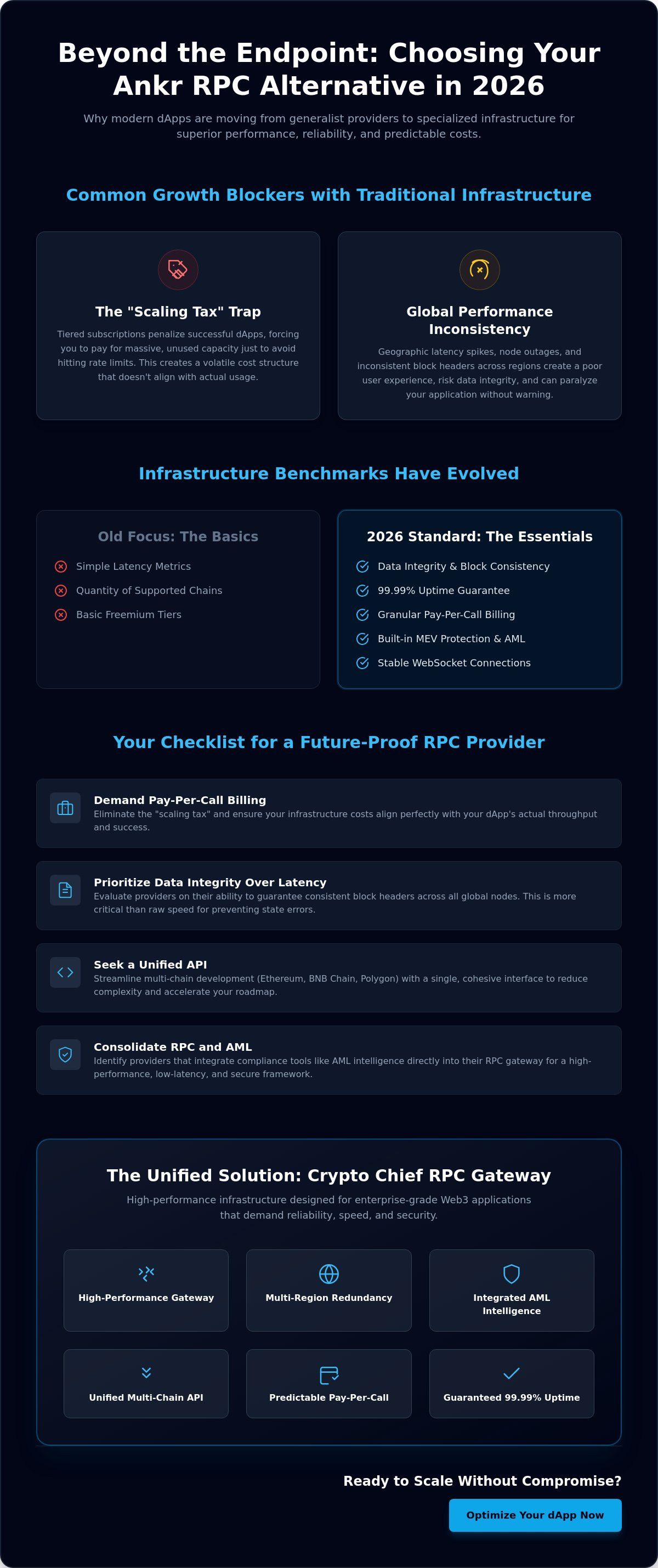
Traditional tiered models often force developers into a "pay-for-what-you-might-use" trap. You often find yourself paying for massive unused capacity simply to avoid the catastrophic psychological friction of hitting a rate limit mid-cycle. By 2026, the industry standard has shifted toward granular, pay-per-call billing. This eliminates the "scaling tax" where successful applications are penalized with higher overhead. Modern architects demand a system where costs align perfectly with actual throughput, ensuring that infrastructure remains an asset rather than a liability.
Performance Bottlenecks in Global dApps
Global coverage is no longer a luxury; it's a baseline requirement. However, simply having nodes scattered worldwide isn't enough. Regional node density determines whether a user in Singapore experiences the same seamlessness as one in New York. Centralized provider outages can paralyze even the most robust decentralized applications if they lack a redundant failover strategy. Switching to a high-performance RPC Gateway allows teams to implement multi-region redundancy and ensure consistent block header integrity across all nodes, regardless of geographic location. This stability is essential for maintaining user trust in a competitive market.
Technical Benchmarks for Web3 Infrastructure: Beyond Latency
Latency is often the primary metric used to evaluate node performance, yet in 2026, speed is merely the entry fee for professional infrastructure. High-performance RPC now requires absolute data integrity. If a provider's nodes return inconsistent block headers across different regions, your dApp risks state synchronization errors or failed transactions. This technical maturity reflects the evolving state of the Web3 infrastructure market, where reliability has transitioned from a technical preference to a core business imperative for scaling enterprises.
Real-time interaction depends heavily on WebSocket stability. Many ankr rpc alternatives focus on standard request-response cycles but struggle to sustain thousands of concurrent event streams without dropping connections. Security has also moved directly into the infrastructure layer. Modern nodes must offer MEV protection to prevent predatory front-running and should ideally incorporate AML Intelligence to maintain compliance without the latency penalties of external third-party checks. If you are building for a global audience, these benchmarks determine whether your application feels like a toy or a professional financial tool.
Uptime and Reliability Metrics
The gap between 99.9% and 99.99% uptime might seem negligible, but it represents the difference between nearly nine hours of annual downtime and just fifty-two minutes. In a production environment, those lost hours translate directly into lost revenue and diminished user trust. High-availability RPC is a resilient system architecture that utilizes redundant load balancing across geographically distributed clusters to ensure zero single points of failure. You should verify provider claims using independent monitoring tools rather than relying solely on internal status pages, as true reliability is proven through transparent, third-party data.
Multichain Breadth vs. Depth
While some providers boast support for over 100 blockchains, the 2026 developer prioritizes infrastructure depth. Supporting ten chains perfectly, with full archive node access and robust debug APIs, is far more valuable than a wide but shallow network that fails during high-traffic periods. Before committing to ankr rpc alternatives, ensure they provide the specific L2 and sidechain support your roadmap requires. For a more comprehensive breakdown of these trade-offs, read our Web3 RPC Gateway: The Architect’s Guide to help align your stack with your long-term goals. If your current provider can't maintain consistency during network upgrades, it's time to consider a more stable RPC Gateway that treats your uptime as a priority.
Ankr vs. Top Competitors: A 2026 Pricing and Performance Breakdown
Selecting between ankr rpc alternatives requires a granular look at how each provider balances technical depth with architectural accessibility. While Ankr serves as a broad entry point for many, competitors like Infura, QuickNode, and Crypto Chief have carved out specific niches based on reliability and specialized tooling. This evolution in the market directly reflects the core principles of Web3, where decentralized access must be paired with industrial-grade performance to support the next generation of global dApps.
Feature parity across these leaders is high, yet the execution varies significantly. Archive nodes, debug APIs, and trace calls are standard offerings, but the difference lies in the consistency of the data returned. Established platforms are widely recognized for their developer tooling, providing robust documentation and SDKs. QuickNode often leads in raw latency benchmarks within the Americas, while other legacy providers maintain a strong foothold in European markets. In contrast, Crypto Chief focuses on providing a high-performance multichain RPC gateway that prioritizes structural integrity and cost-efficiency for teams operating at global scale.
Infura and QuickNode: The Enterprise Giants
These providers have built their reputations on massive feature sets and specialized add-ons that simplify the development lifecycle. Their strengths lie in sophisticated developer tooling that allows for rapid prototyping and deployment. However, this often comes with a "walled garden" risk. By relying on proprietary APIs and specialized features, teams may find it difficult to migrate later if pricing becomes unsustainable. Their enterprise tiers are designed for stability, but they can become a heavy financial burden once a dApp reaches high-volume throughput, often leading back to the "scaling tax" issues that drive developers to look for more flexible options.
Crypto Chief: The Disrupter in Pay-Per-Call Infrastructure
Crypto Chief has emerged as a powerful alternative by eliminating the friction of monthly commitments and tiered restrictions. It competes on raw performance by offering a streamlined RPC Gateway that aligns costs directly with usage. This model is particularly attractive for architects who value a silent, powerful partner that doesn't penalize growth. Beyond just connectivity, it integrates essential services into a single ecosystem. You can access high-speed RPC while simultaneously leveraging AML Intelligence and a Crypto Processing API, creating a unified foundation that removes the need to manage multiple fragmented providers.
- Asia/Pacific: Crypto Chief and Infura show high regional node density.
- Europe: Infura and Ankr maintain extensive coverage.
- Americas: QuickNode remains a leader in regional latency benchmarks.
Optimizing Web3 API Costs: The Shift to Pay-Per-Call Models
While technical performance is the engine of a dApp, the financial architecture of your infrastructure is its fuel. Many developers exploring ankr rpc alternatives quickly realize that the traditional tiered pricing model contains a hidden "scaling tax." This tax penalizes success; as your user base grows and your request volume doubles, you are often forced into an enterprise tier that might quadruple your monthly overhead. By 2026, the industry has shifted toward a more logical pay-per-call structure that aligns expenses with actual resource consumption.
The mathematics of pay-per-call is simple yet transformative. Instead of paying for a massive ceiling of "unused capacity" that you rarely hit, you maintain a pre-paid balance that only diminishes when a call is successfully executed. This transparency prevents the billing surprises that often haunt teams during unexpected market volatility. To understand how these models are reshaping the industry, you can explore our deep dive into Pay As You Go RPC Nodes: Busting the Myths, which details the long-term savings for production-grade applications.
Budgeting for Volatile Network Traffic
Handling traffic spikes shouldn't require a permanent upgrade to a thousand-dollar monthly plan. In a pay-per-call ecosystem, a sudden surge in requests is handled seamlessly by your existing balance without triggering rate limits or forced tier migrations. The benefit of "forever-valid" pre-paid balances is that your capital remains an asset on your books until it's used, rather than a "use-it-or-lose-it" monthly expense. Pay-per-call models reduce infrastructure waste by ensuring every dollar spent corresponds directly to a functional interaction with the blockchain.
The Migration Roadmap: Switching Without Friction
Transitioning to ankr rpc alternatives doesn't have to be a high-risk operation. A methodical approach ensures that your service remains uninterrupted while you optimize your costs. Follow this three-step roadmap to ensure a seamless transition:
- Step 1: Audit Method Usage. Analyze your current request volume to identify which methods, such as
eth_calloreth_getLogs, are your primary cost drivers. - Step 2: Parallel Testing. Set up a parallel endpoint with your new provider to test latency and data consistency against your live environment.
- Step 3: Weighted Shifting. Gradually migrate your traffic using a weighted load balancer, moving 10% of your requests initially and increasing the load as you verify stability.
By treating your infrastructure as a dynamic component of your stack, you can maintain high performance without the burden of rigid contracts. If you're ready to eliminate the scaling tax, you can register for an account to begin auditing your throughput in a live environment.
Crypto Chief RPC Gateway: The High-Performance Ankr Alternative
Infrastructure shouldn't be a puzzle of disconnected services that drain your team's time and resources. While many ankr rpc alternatives focus exclusively on node connectivity, Crypto Chief provides a comprehensive foundation designed for the modern Web3 architect. It acts as a silent, powerful partner that removes the friction of managing multiple providers, allowing you to focus on your application's logic while we handle the structural integrity of the underlying network. By consolidating high-performance connectivity with built-in security, we provide the stability required for enterprise-grade scaling in 2026.
The core of our platform is a Unified API that streamlines multi-chain development. You can access Ethereum, BNB Chain, and Polygon through a single, consistent interface that eliminates the need for custom middleware for every new network. This depth of support extends to global reliability for Bitcoin and Tron, as well as high-uptime endpoints for Solana. Every request is backed by enterprise-grade security, including integrated AML risk detection that identifies illicit funds before they can affect your ecosystem.
Beyond the Node: A Unified Web3 Stack
True efficiency comes from a unified stack where every component works in harmony. By combining our RPC Gateway with our Real-Time EventStream, you gain the ability to monitor on-chain events with surgical precision. This integration ensures that your dApp remains responsive and secure. Furthermore, our AML Intelligence protects your platform from regulatory risks, while the non-custodial Crypto Processing API allows you to handle transactions without the security vulnerabilities associated with custodial hosting. It is a complete engine for the decentralized economy.
Getting Started with Crypto Chief
We designed our onboarding experience to be as seamless as our infrastructure. The registration process is simple, and our pre-paid model ensures you never face the unpredictable monthly bills common with tiered providers. Once your account is active, you can consult our comprehensive developer documentation to begin immediate integration. Our guides provide the granular technical details needed to switch endpoints without disrupting your service. If you are ready to optimize your infrastructure and eliminate the "scaling tax" of traditional providers, scale your dApp with Crypto Chief’s RPC Gateway today.
Future-Proofing Your Web3 Infrastructure
The landscape of Web3 development in 2026 demands more than just a functional connection to the blockchain; it requires a strategic partnership that values uptime, cost-efficiency, and structural integrity. By transitioning from restrictive tiered subscriptions to a granular pay-per-call model, you eliminate the scaling tax that often penalizes successful dApps. We've explored how regional node density and data consistency are the true benchmarks of performance, moving beyond simple latency metrics to ensure your application remains stable at a global scale.
Selecting the most effective ankr rpc alternatives is ultimately about consolidating your infrastructure into a unified, high-performance engine. Crypto Chief provides this foundation through a resilient RPC Gateway that maintains 99.99% uptime across more than 15 major blockchains. With integrated AML Intelligence and Payment Processing APIs, you can manage your entire stack through a single interface without the friction of fragmented providers. Your dApp deserves a foundation that grows as fast as your vision, and we're ready to provide the stability you need to succeed.
Register for Crypto Chief and optimize your RPC costs today
Frequently Asked Questions
What are the main benefits of using an Ankr RPC alternative?
Developers often seek ankr rpc alternatives to escape the "scaling tax" of tiered pricing and to access more unified infrastructure. These alternatives frequently provide integrated security features, such as AML risk detection, and better regional node density. This ensures consistent performance for global users without the administrative burden of managing multiple separate providers for connectivity and compliance.
How does pay-per-call pricing compare to Ankr’s premium plans?
Pay-per-call pricing eliminates the waste of unused capacity found in traditional tiered or credit-based premium models. While Ankr's plans often involve monthly deposits or subscriptions, a pay-per-call structure ensures that you only pay for the actual requests your dApp executes. This creates a transparent billing environment where your pre-paid balance remains valid until consumed, preventing the financial friction of sudden tier upgrades.
Is it difficult to switch my dApp from Ankr to another RPC provider?
Switching is a straightforward process because most high-performance providers adhere to standard JSON-RPC specifications. You typically only need to update your environment variables with the new endpoint URL. We recommend conducting parallel tests using a weighted load balancer to ensure data consistency and latency stability before fully migrating your production traffic.
Do Ankr alternatives support all the same blockchain networks?
Most leading ankr rpc alternatives support major networks like Ethereum, BNB Chain, and Polygon, though the depth of support can vary. While some focus on a massive list of chains, others prioritize the quality of their connections by offering full archive node access and robust debug APIs. It's essential to verify that your chosen provider supports the specific Layer 2 or sidechain your project requires.
What is the most reliable RPC provider for Solana and Ethereum in 2026?
Reliability is determined by geographic node density and the ability to maintain block header consistency across global clusters. For Ethereum and Solana, a provider that utilizes a globally distributed RPC Gateway with redundant load balancing is the optimal choice. This architecture prevents single points of failure and ensures that your dApp remains responsive even during periods of extreme network congestion.
How can I test the latency of different RPC providers?
You can test latency by executing a simple request, such as fetching the latest block number, using tools like curl or specialized benchmarking scripts. It's important to run these tests from multiple geographic regions to understand how the provider performs for your specific user base. Look for providers that offer consistent response times rather than just occasional bursts of speed.
Are there free Ankr alternatives for small projects?
Yes, many providers offer public endpoints or limited free tiers for developers in the prototyping stage. However, as your project moves toward production, these free connections often become a bottleneck due to strict rate limits. Transitioning to a professional gateway ensures you have the dedicated throughput and support needed to maintain a high-quality user experience as you scale.
Does Crypto Chief offer archive node access?
Yes, Crypto Chief provides full archive node access for developers who need to query historical blockchain state. This feature is essential for building sophisticated analytical tools, block explorers, or any application that requires data beyond the most recent blocks. You can access this historical data through the same high-performance RPC Gateway used for standard requests.
Tags: ankr rpc alternatives