
Why should your dApp's success be penalized by a rigid subscription tier that triggers massive overage fees the moment your traffic peaks? Most developers accept these hidden costs as an inevitable part of scaling, but this financial friction often masks a deeper technical bottleneck. When network congestion hits, legacy nodes often struggle to maintain the stability required for high-frequency operations. You've likely experienced the frustration of latency spikes during peak volume, or perhaps you're tired of managing a fragmented stack of separate vendors for AML intelligence and node access. Choosing the right bsc rpc gateway provider shouldn't feel like a compromise between performance and predictability.
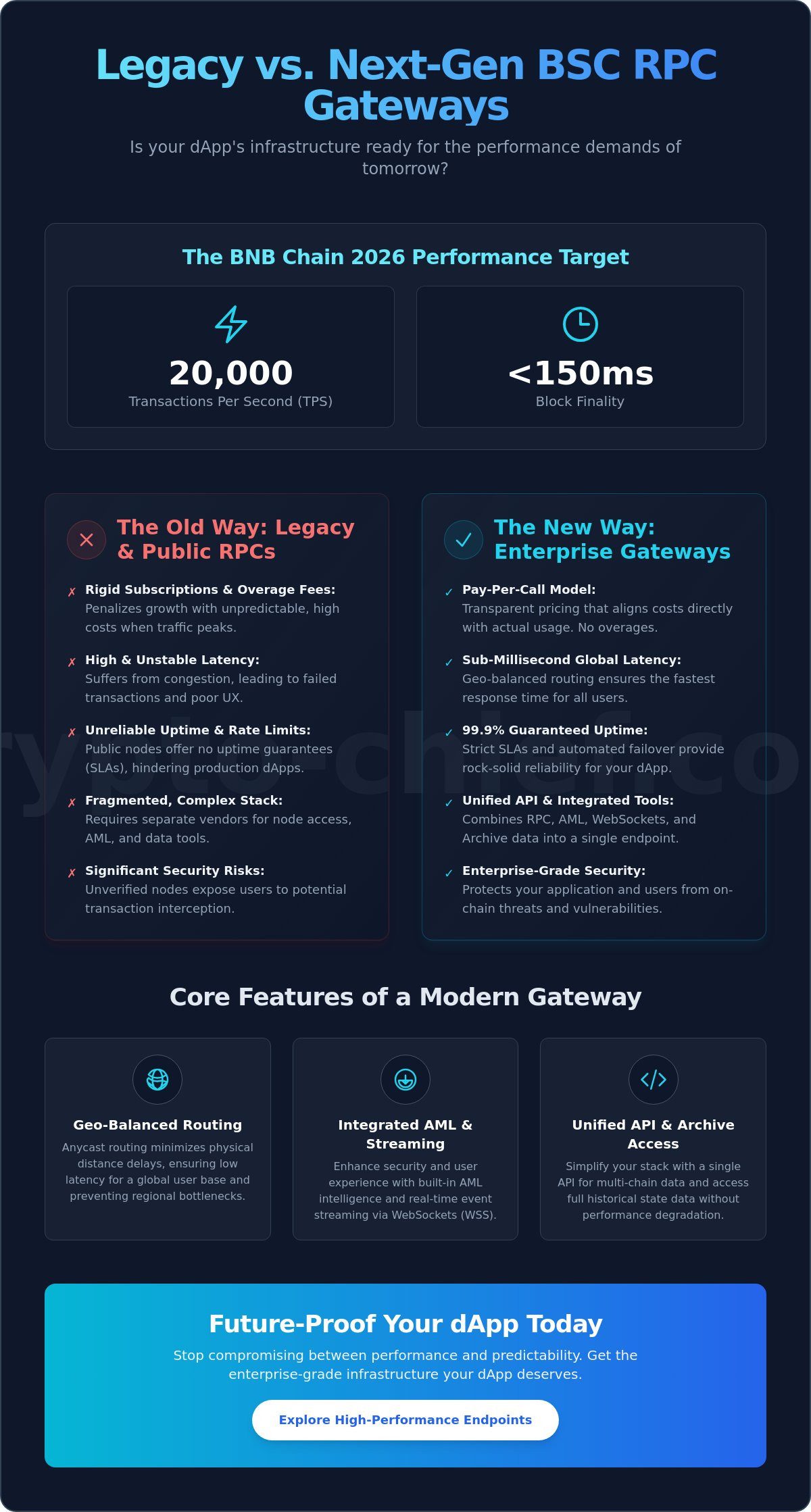
You'll discover how to select a high-performance infrastructure that balances sub-millisecond global latency with a transparent, cost-effective pay-per-call model. We'll examine the technical requirements for handling the BNB Chain’s 2026 roadmap of 20,000 transactions per second and sub-150ms finality. This article provides a roadmap for integrating enterprise-grade security and data tools directly into your RPC layer, ensuring your infrastructure remains a silent, powerful partner in your growth. We'll break down the shift toward unified API solutions that simplify your stack while maximizing uptime.
Key Takeaways
- Understand why 2026 dApp requirements necessitate a shift from simple connectivity to a high-performance infrastructure layer capable of handling massive throughput.
- Learn how geo-balanced routing and sub-millisecond response times eliminate technical friction for MEV-resistant trading and real-time gaming applications.
- Discover how a bsc rpc gateway provider utilizing a pay-per-call model can eliminate overage fees and align your operational costs directly with actual network usage.
- Explore the benefits of integrating AML Intelligence and real-time event streaming directly into your RPC stack to enhance security and user experience.
- Identify the specific criteria for selecting a gateway that offers 99.9% uptime and global coverage without the constraints of rigid, tiered monthly subscriptions.
The Evolution of BSC RPC Gateway Providers in 2026
The RPC gateway acts as the vital bridge between your application's logic and the underlying BNB Smart Chain ledger. In 2026, this role has shifted from a basic data pipe to a sophisticated performance and security layer. As the network targets sub-150ms finality and throughput exceeding 20,000 transactions per second, the infrastructure supporting your dApp must operate with surgical precision. A modern bsc rpc gateway provider now manages the heavy lifting of node synchronization, load balancing, and global request routing. This shift from self-hosted clusters to managed services has significantly reduced DevOps overhead for growing teams. Instead of managing complex server environments, developers can leverage a high-performance engine that ensures global users experience consistent, low-latency connectivity regardless of their physical location.
The Shift from Public Endpoints to Enterprise Gateways
Public RPC endpoints serve as a useful entry point for testing, but they're fundamentally unsuited for production environments in 2026. High-volume DeFi protocols and GameFi ecosystems frequently encounter rate limits and latency spikes on public infrastructure, leading to failed transactions and poor user retention. Beyond performance, security remains a critical concern. Using unverified public nodes exposes your users to potential transaction interception or delayed broadcasting. For any commercial venture, an enterprise-grade RPC Gateway is non-negotiable. Developers must demand strict Service Level Agreements (SLAs) that guarantee at least 99.9% uptime and consistent response times to remain competitive in a crowded market.
Key Features of a Modern BSC Gateway
Modern infrastructure demands more than just standard JSON-RPC connectivity. A sophisticated bsc rpc gateway provider offers a suite of tools designed for real-time responsiveness and deep data access. WebSocket (WSS) support is now the standard for streaming live chain events, while HTTPS ensures reliable request-response cycles for standard queries. Access to archive nodes is equally vital, enabling dApps to query historical state data without the performance degradation typically associated with older node architectures. Many teams now prefer a Unified API structure. This allows them to normalize data across multiple chains, reducing the complexity of multi-chain expansion while maintaining the specific high-speed benefits of the BNB ecosystem. This integrated approach ensures that your backend remains lean and your data remains accurate.
Performance Architecture: Latency, Uptime, and Global Routing
The physical proximity of infrastructure to the end user remains the most significant variable in the latency equation. In 2026, a top-tier bsc rpc gateway provider utilizes sophisticated Anycast routing to ensure that a request from Tokyo never travels to a data center in London before hitting the blockchain. By geo-balancing traffic across a distributed network of nodes, providers minimize the "speed-of-light" delay that often plagues centralized setups. This global routing doesn't just improve the user experience; it builds a foundation of structural integrity that allows your dApp to scale without regional performance degradation. By 2026, the industry benchmark for enterprise-grade BSC node uptime is strictly defined at 99.99%.
Sub-millisecond response times are no longer a luxury for specialized high-frequency traders; they're a baseline requirement for MEV-resistant applications. In the competitive landscape of decentralized finance, being the first to see a state change or the first to broadcast a transaction can be the difference between a successful trade and a failed execution. Recent academic research on Layer-1 blockchains highlights how network topology directly impacts the economic efficiency of these systems. To counter regional outages, modern gateways employ automated failover strategies. If a node cluster in North America experiences a localized spike or hardware failure, traffic is instantly rerouted to the next healthiest region without the dApp ever losing connectivity. Builders looking for this level of stability can explore our high-performance BSC endpoints to see these metrics in action.
Optimizing for BNB Smart Chain Congestion
Peak traffic during popular token launches or major network events can cripple standard infrastructure. A robust BSC RPC gateway mitigates these risks through dynamic load balancing, which distributes the volume across dozens of synchronized nodes. This prevents the dreaded 429 "Too Many Requests" errors and ensures that transaction broadcasting remains fluid even when the network is under heavy load. This architecture prioritizes throughput, allowing your application to maintain its responsiveness when your users need it most.
Archive Data and Indexing Capabilities
Archive nodes are essential for any dApp that requires a comprehensive historical view, such as portfolio trackers or tax reporting tools. Maintaining the full state history of the BNB Smart Chain in 2026 is a massive technical undertaking given the network's high transaction volume. While a standard full node only keeps recent state data, archive nodes store every change since the genesis block. Querying an archive node is traditionally slower, but modern indexing layers now allow for complex smart contract queries that are significantly faster than raw node requests, providing the depth of data needed for sophisticated analytics without the lag.
Cost Efficiency for High-Volume dApps: The Pay-Per-Call Advantage
Financial predictability is often the first casualty of rapid growth in the Web3 space. Many developers find themselves trapped in rigid, tiered subscription models where they pay for "ghost" capacity, essentially funding idle server resources that their application doesn't currently require. This inefficiency becomes particularly painful during market lulls when traffic drops but the monthly bill remains static. A modern bsc rpc gateway provider should offer a more logical alternative: a pay-per-call model that aligns your infrastructure expenditures directly with your actual network usage. By shifting to this utility-based approach, you ensure that every dollar spent correlates to real user activity or backend processes.
This alignment is critical for maintaining healthy margins as you scale. When your dApp experiences a sudden viral surge, you don't want to be penalized with aggressive overage fees or forced into a higher, more expensive contract tier that you might not need next month. Instead, a flexible billing structure allows your costs to expand and contract organically. To better understand how this compares to legacy infrastructure, you can explore our Pay As You Go RPC Nodes guide, which deconstructs common cost myths in the current landscape.
Comparing Billing Models: Tiers vs. Pay-Per-Call
The "Cost Per Request" metric often reveals hidden premiums in tiered plans. For instance, if a tier provides 50 million requests but your dApp only utilizes 30 million, the effective price per call is nearly double the advertised rate. Startups particularly benefit from the low entry barrier of prepaid token balances, as they can begin operations without significant upfront capital. This model also simplifies scalability; it handles 10x traffic spikes seamlessly without requiring manual account upgrades or contract renegotiations. It's a system designed for builders who value logic over legacy constraints.
Prepaid Token Management and Transparency
Transparency is the foundation of a reliable partnership between a developer and their bsc rpc gateway provider. Real-time balance monitoring allows teams to track consumption with granular precision, preventing unexpected service interruptions. One of the most significant advantages of a sophisticated platform is the ability to use a unified balance across multiple services. This means your prepaid tokens can simultaneously power your RPC Gateway, AML Intelligence, and Crypto Processing API. Prepaid models eliminate the risk of surprise end-of-month invoices by ensuring that service costs never exceed the pre-allocated budget.
Beyond Connectivity: Integrating AML and Event Streaming
Connectivity is no longer the sole metric of success for a bsc rpc gateway provider. In 2026, a robust infrastructure layer must also serve as a security and data orchestration engine. As decentralized applications face increasing regulatory scrutiny and user demand for instantaneous feedback, the ability to integrate compliance and real-time streaming directly into the RPC layer becomes a competitive necessity. This convergence of services allows developers to move away from fragmented stacks and toward a unified, high-performance solution that handles both the transfer of value and the integrity of data. It's about building a foundation that is as secure as it is fast.
Risk Detection at the RPC Layer
Compliance shouldn't be an afterthought that adds friction to the user journey or complicates your backend logic. By integrating AML intelligence directly at the gateway level, dApps can identify high-risk or sanctioned addresses before they ever interact with a smart contract. This proactive approach automates compliance workflows without introducing the latency typically associated with third-party verification calls. Crypto Chief simplifies this process by combining high-speed RPC access with native risk detection, ensuring your application remains compliant while maintaining the sub-millisecond performance discussed earlier. You can explore our Crypto AML Risk Detection API to see how these checks are seamlessly woven into the transaction flow.
Real-Time Blockchain Event Streaming
Traditional polling methods, where an application repeatedly asks a node for updates, are inherently inefficient and often lead to delayed user interfaces. The 2026 standard has shifted toward push-based EventStream notifications. By using webhooks, your backend receives instant alerts the moment a specific smart contract event occurs on the BNB Smart Chain. This allows for immediate user notifications, real-time database syncing, and a significantly more responsive UI/UX. For high-frequency BSC applications, choosing a bsc rpc gateway provider that supports native webhooks is vital for scaling efficiently. Polling creates unnecessary overhead for both the provider and the client, whereas event streaming ensures that data moves only when it's relevant.
A truly Unified API allows you to manage these event streams across BSC, Ethereum, and Polygon through a single interface, providing a consistent development experience across the most active ecosystems. This centralization of data management reduces the technical debt associated with maintaining separate integrations for different chains. To streamline your development and security stack, register for our Unified API and gain access to high-performance BSC endpoints today.
The Crypto Chief BSC RPC Solution: Getting Started
The transition from conceptual architecture to production-ready deployment requires a partner that understands the specific technical nuances of the 2026 blockchain landscape. Crypto Chief provides high-performance BSC endpoints engineered for global reach, ensuring your users interact with the network through a stable, low-latency interface. Our infrastructure guarantees a minimum of 99.9% uptime, providing the structural integrity necessary for enterprise-grade applications. By utilizing a non-custodial model, we prioritize developer autonomy and security, ensuring that you remain in full control of your application's logic and data flow. This builder-centric approach removes the friction of legacy systems, allowing you to focus entirely on your product's unique value proposition.
Our solution integrates a transparent pay-per-call pricing model powered by a unified prepaid token system. This eliminates the complexity of managing multiple, overlapping subscriptions for different blockchain services. Whether you're querying the blockchain or performing high-speed AML checks, your balance remains central and visible. Comprehensive technical documentation supports your team through every stage of development, while our specialized support ensures a smooth migration for existing projects. We act as a silent, powerful partner in your growth, providing the engine that drives your dApp's success without the administrative overhead.
Quick Integration Guide
Getting your application connected to the BNB Smart Chain is a streamlined process designed to respect your development timeline. You can generate your unique BSC RPC API key in under 60 seconds through our intuitive dashboard. Once you've secured your key, updating your provider URL in standard frameworks like Ethers.js or Web3.js is a simple matter of swapping the endpoint string in your configuration file. This immediate accessibility ensures that your development flow remains uninterrupted. Before moving to production, you can test your connection and smart contract interactions using the Crypto Chief Faucet, which provides the necessary testnet assets for rigorous debugging and environment validation.
Scaling with Crypto Chief
As your project matures, the transition from testnet to mainnet is accomplished with a single configuration change, maintaining the same high-performance standards across both environments. For organizations requiring a bespoke presence, we offer white-label solutions that allow for the deployment of enterprise-grade custom gateways tailored to specific institutional needs. This level of flexibility ensures that your infrastructure evolves alongside your user base rather than becoming a bottleneck. Choosing the right bsc rpc gateway provider is the final step in securing your dApp's future in a competitive market. It's time to build with a foundation designed for the demands of 2026. Register your account and start building on BSC to experience the difference of a truly unified infrastructure.
Future-Proof Your Infrastructure on the BNB Smart Chain
Your dApp's success depends on a foundation that eliminates technical friction while maintaining financial logic. The shift toward high-performance architecture in 2026 means that selecting the right bsc rpc gateway provider is no longer just about basic connectivity; it's about securing a unified partner for performance and compliance. By leveraging geo-balanced nodes and sub-millisecond routing, you provide your users with the stability they expect from an elite service. Shifting to a pay-per-call model ensures your budget is spent on actual growth rather than idle capacity.
Crypto Chief offers the structural integrity required for the next generation of decentralized applications. With a global 99.9% uptime SLA, unified pay-per-call billing, and enterprise-grade AML integration, our platform removes the complexity of managing a fragmented stack. It's time to empower your team with a silent, powerful engine that prioritizes uptime and scalability. Deploy your high-performance BSC RPC gateway today and focus on what matters most: building the future. Your users deserve an experience that is as seamless as it is secure.
Frequently Asked Questions
What is a BSC RPC gateway provider and why do I need one?
A bsc rpc gateway provider acts as the dedicated infrastructure layer that connects your application logic to the BNB Smart Chain ledger. While public nodes are often rate-limited and unreliable, a private gateway provides the stability and throughput required for production-grade dApps. It's the engine that broadcasts your transactions and retrieves real-time chain data with high availability and enterprise-grade security.
How does pay-per-call pricing compare to monthly RPC subscriptions?
Pay-per-call pricing aligns your infrastructure costs directly with your actual network usage, whereas monthly subscriptions often force you to pay for unused capacity. This utility-based approach eliminates the risk of unexpected overage fees during traffic spikes by utilizing a prepaid token system. It's a more logical model for startups and enterprise builders who value cost efficiency and granular budget control over rigid, tiered contracts.
Does Crypto Chief support both BSC Mainnet and Testnet?
Yes, we provide full support for both the BSC Mainnet and the Testnet environments to ensure a seamless development lifecycle. You can easily switch between these networks with a simple configuration change in your provider URL. This allows your team to move from initial smart contract debugging to full-scale commercial deployment without the friction of changing your infrastructure partner or API structure.
Can I use the same API key for BSC and other chains like Ethereum?
Our Unified API allows you to manage multiple blockchain networks, including BSC, Ethereum, and Polygon, using a single interface and a centralized balance. This architectural choice reduces the technical debt associated with multi-chain development and simplifies your backend management. You won't need to juggle separate API keys or billing cycles for each network your application supports, creating a more streamlined workflow.
What is the latency for Crypto Chief’s BSC RPC endpoints?
We achieve sub-millisecond global latency by utilizing Anycast routing and geo-balanced node clusters across multiple regions. This architecture ensures that your requests are always handled by the healthiest node closest to your user's physical location, minimizing the speed-of-light delay. It's a critical feature for high-frequency trading and real-time gaming applications where every millisecond impacts the finality and user experience.
How do I monitor my API usage and token balance?
You can monitor your API usage and token balance in real-time through our intuitive developer dashboard. The system provides granular insights into your request volume and remaining credits across all integrated services. Because we use a unified prepaid token system, your balance is shared between the RPC Gateway, AML Intelligence, and Crypto Processing API, allowing for transparent and predictable budgeting.
Is there a limit on the number of concurrent requests I can make?
Our infrastructure is designed to handle high-concurrency environments without the rigid limitations often found in legacy tiered plans. The gateway utilizes dynamic load balancing to distribute traffic across dozens of synchronized nodes, which prevents 429 "Too Many Requests" errors. This ensures that your application remains responsive and stable even during periods of extreme network congestion or sudden viral growth.
Does the gateway provide access to BSC archive data?
Yes, our gateway provides full access to BSC archive data for applications that require deep historical state history. This is essential for building portfolio trackers, tax reporting tools, or any service that needs to query data from previous blocks beyond the standard full node window. Our archive nodes are optimized to handle these resource-intensive queries without compromising the performance of your standard request-response cycles.
Tags: bsc rpc gateway provider