
Your dApp's reputation rests on a single version of the truth, yet many architects are still building on shifting sand. When a user sees a successful transaction on a block explorer but an empty balance in your interface, the friction isn't just a minor bug; it's a fundamental breach of trust. Avoiding blockchain data inconsistencies in 2026 requires moving beyond basic polling toward a resilient, unified infrastructure that anticipates the inherent chaos of the chain.
It's frustrating to spend countless hours writing custom logic to handle deep reorgs or varying finality times across ten different networks, only to have a double-counted event slip through the cracks. You've likely felt the weight of a bloated codebase that struggles to keep up with the unique quirks of every new L2. This guide provides a definitive roadmap for eliminating those synchronization gaps, automating reorg handling, and maintaining absolute data integrity across multichain environments. We'll examine how to transition from fragmented node management to high-performance gateways, ensuring your application remains a reliable, enterprise-ready foundation for every user transaction.
Key Takeaways
- Identify the root causes of "phantom transactions" where divergent node states create temporary, misleading data for end users.
- Analyze how different consensus mechanisms handle conflicting block proposals to better predict and manage chain reorganizations.
- Transition from fragile single-node setups to unified architectures that normalize data formats across multiple L1 and L2 networks.
- Deploy advanced engineering tactics like multi-node verification and dynamic confirmation thresholds for avoiding blockchain data inconsistencies.
- Streamline multichain operations by using a single API key for real-time event tracking, reducing the complexity of handling diverse finality times.
Defining Blockchain Data Inconsistencies and Their Impact
Inconsistency occurs when two nodes report different states for the same block height. This isn't just a technical glitch; it's a fundamental challenge for anyone building production-grade applications. When your backend queries a node that is out of sync or on a temporary fork, the result is incorrect data. For architects, avoiding blockchain data inconsistencies is the difference between a reliable service and a broken user experience.
The "Phantom Transaction" problem is perhaps the most visible symptom. A user sees a "Success" message on their dashboard, yet minutes later, the transaction disappears. This happens because the initial node was following a block that was eventually discarded. The Mechanics of Chain Reorgs explain how these temporary splits occur, often leaving dApps in a state of data drift where the local view doesn't match the network's final consensus. This erosion of trust is particularly damaging for DeFi platforms, where users expect instantaneous and immutable finality.
The Difference Between Latency and Inconsistency
Latency represents a delay in receiving information, but inconsistency represents receiving the wrong information. High latency leads to stale data reads, which is particularly dangerous in high-frequency environments where prices move in milliseconds. Global node networks suffer from peer-to-peer propagation delays. A node in Tokyo might see a different "latest block" than one in London for several seconds. Data drift is the delta between a local node and the canonical chain.
Business Consequences of Unreliable Web3 Data
The stakes are high for enterprise-level operations. In non-custodial payment gateways, inconsistent data creates a window for double-spending if a merchant ships goods based on an unconfirmed block. Compliance also suffers. If your AML Intelligence tool calculates risk scores using stale block data, you might inadvertently process a high-risk transaction that has already been flagged on the main chain. Avoiding blockchain data inconsistencies is therefore a matter of regulatory safety as much as technical performance.
Beyond direct financial loss, the resource drain is immense. Engineering teams frequently report spending a significant portion of their development cycles on manual data reconciliation. They're forced to build complex "cleanup" scripts to fix errors that should have been prevented at the infrastructure level. This overhead slows down innovation and increases the total cost of ownership for any multichain application.
The Mechanics of Chain Reorgs and Node Synchronization
Blockchain networks operate on the principle of distributed agreement, but this agreement isn't always instantaneous. Consensus mechanisms like Proof of Stake (PoS) or Lachesis handle conflicting block proposals by following specific rules to determine the canonical path. However, during periods of high network activity or latency, two different blocks might be produced at the same height. A chain reorganization occurs when a node realizes that a different branch of the ledger has become the valid one, forcing it to discard blocks and roll back transactions. Understanding these underlying dynamics is the first step toward Defining Blockchain Data Inconsistencies within your architecture.
While some providers claim reorgs are rare, the reality in 2026 is more complex. Layer 2 solutions and sidechains are particularly susceptible to frequent micro-reorgs due to their aggressive block times and modular settlement layers. If your dApp relies on a single node that falls victim to "State Lag," you might find your backend is three or four blocks behind the actual network state. This gap creates a window where your application displays data that no longer exists on the main chain, leading to the phantom transactions discussed previously. Avoiding blockchain data inconsistencies requires a proactive approach to monitoring these state transitions in real time.
Soft Finality vs. Hard Finality
Architects must distinguish between soft and hard finality to ensure absolute data integrity. Ethereum's Casper FFG provides a robust "Point of No Return" after specific epochs, whereas Solana utilizes optimistic confirmations to prioritize speed. For high-value transactions, relying on a single confirmation is insufficient. You should implement dynamic confirmation thresholds that adjust based on the specific chain's finality profile. For instance, a transaction on a maturing L2 might require 15 confirmations to be considered "Safe," while a mainnet Ethereum transaction might only need two or three once it reaches the finalized state.
The Node Synchronization Gap
The choice between running full nodes or light nodes directly impacts your data consistency. Full nodes provide a complete record but are resource-intensive and prone to "split-brain" scenarios in distributed RPC clusters, where different nodes in the same load balancer report different block heights. This is why many teams are moving toward a Unified Web3 Developer Platform to bridge the synchronization gap. By using a high-performance RPC Gateway, you can access a consolidated view of the chain that filters out unstable blocks before they reach your application logic. This approach simplifies the complex task of avoiding blockchain data inconsistencies by offloading the reorg logic to a specialized infrastructure partner that acts as your silent, powerful foundation.
Infrastructure Architecture: Single-Node vs. Unified API
Relying on a single RPC endpoint is a gamble that professional architects can't afford. When a node falls behind or encounters a local fork, your application inherits that inaccuracy immediately. Academic research into Node Synchronization demonstrates that the relationship between node lag and data divergence is a constant threat in decentralized networks. By moving to a unified architecture, you shift the responsibility of state verification from your application to a globally distributed infrastructure layer. This transition is essential for avoiding blockchain data inconsistencies because it replaces a single source of failure with a resilient, load-balanced consensus view.
Global load balancing ensures that your requests are routed to the healthiest, most up-to-date nodes. Instead of managing a list of individual endpoints for Ethereum, BSC, and Polygon, a Unified API provides a single entry point. This architecture removes the 'Chain-Specific Logic' burden that often clutters backends, allowing developers to focus on core features rather than handling the unique quirks of each network's RPC implementation. It's a structural shift that prioritizes stability and global reach.
The Multichain Normalization Challenge
Engineering teams often struggle with the fact that 'Transaction Receipt' formats differ significantly across EVM and non-EVM chains. One chain might return hex values while another uses integers, requiring custom translation layers for every new integration. Crypto Chief’s Unified API solves this by providing a standardized JSON response across all supported networks. By offloading this data translation to the infrastructure layer, you reduce code complexity and minimize the risk of bugs introduced during manual normalization. You gain a "single source of truth" that remains consistent regardless of the underlying protocol's specific syntax.
Cost-Efficiency of the Pay-Per-Call Model
Scaling a multichain dApp often involves a difficult trade-off between data integrity and infrastructure costs. Flat-rate tiers often force you to overpay for "integrity insurance" even during low-traffic periods. Using pay per call pricing allows you to scale your data polling dynamically during high volatility without being locked into expensive monthly contracts. This model ensures you have the necessary resources for avoiding blockchain data inconsistencies during market spikes while maintaining a lean budget during quieter times. It's a pragmatic approach that aligns your infrastructure spend with actual utility and real-time data requirements.
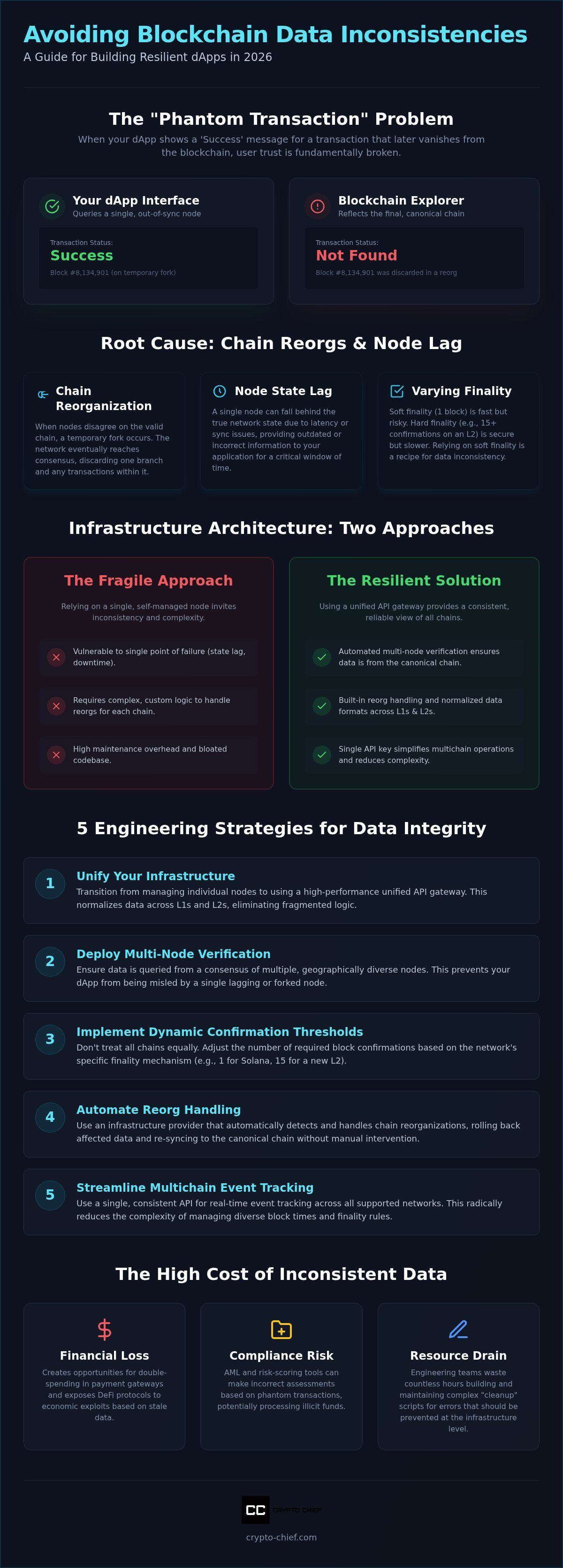
5 Engineering Strategies to Maintain Data Integrity
Designing for resilience means assuming the network will eventually fork. Professional architects prioritize avoiding blockchain data inconsistencies by implementing a defense-in-depth strategy that combines infrastructure reliability with smart backend logic. It isn't enough to simply query a node; your system must be capable of interpreting the nuances of block finality across diverse environments. By adopting the following five strategies, you can build applications that remain accurate even during periods of extreme network volatility.
- Dynamic Confirmation Thresholds: Assign confirmation requirements based on the economic weight of a transaction. A small retail payment on Polygon might be safe after 12 blocks, but a high-value settlement should wait for hard finality.
- Multi-Node Verification: Cross-reference the canonical status of a block by querying multiple nodes within your RPC Gateway. This prevents your backend from acting on a local fork that hasn't been accepted by the wider network.
- Idempotent Event Handlers: Ensure every database operation is idempotent. Use the transaction hash as a unique key to prevent double-counting or duplicate processing if a reorg causes an event to be re-emitted.
- State Marking: Clearly differentiate between "observed", "confirmed", and "finalized" states in your user interface. This transparency manages user expectations and prevents the "phantom transaction" problem.
- Integrated Risk Scoring: Perform compliance checks during the confirmation window to ensure that funds are legitimate before they are fully credited to a user's balance.
Implementing Event-Driven Architecture
Modern dApps are moving away from inefficient polling in favor of event-driven models. Real-Time Blockchain Webhooks provide instant state updates by pushing data directly to your infrastructure the moment a block is produced. Your webhook listener should be designed to handle "Reorg" events, which signal that a previously reported block has been discarded. When these events arrive, your system must automatically revert any pending states to maintain a "single source of truth". EventStream removes the need for manual block polling by pushing real-time state changes directly to your backend via high-performance webhooks.
Automating Compliance and Risk Consistency
Data integrity extends beyond simple balances; it also includes the metadata surrounding a transaction's legitimacy. Risk data must be as consistent as balance data to prevent compliance gaps during network congestion. Using the AML Intelligence API allows you to trace the origin of funds across inconsistent block states, ensuring you remain compliant with the latest CARF and DAC8 regulations. This automated approach ensures that your risk scores stay synchronized with the canonical chain, even when individual nodes are lagging. To ensure your platform maintains absolute integrity at scale, secure your multichain transactions with a unified processing engine.
Scaling with Crypto Chief: Inconsistency-Proof Infrastructure
Architects building for a multichain future require more than just a raw connection; they need a sophisticated filter that provides a "Consensus View" of the network. Crypto Chief’s global RPC gateway acts as this intelligent layer, cross-referencing state data across multiple nodes to ensure that what your application sees is the actual canonical chain. This infrastructure is fundamental to avoiding blockchain data inconsistencies at scale, as it eliminates the risk of a single lagging node poisoning your backend with stale or forked data.
Managing a growing portfolio of 100+ chains shouldn't mean managing 100+ different integration patterns. The power of a single API key for multichain event tracking and processing allows your team to maintain a lean codebase while expanding your dApp’s reach. This modular approach is the only sustainable way to handle the explosion of new L2s and app-chains without increasing your technical debt. From initial sandbox testing to full-scale enterprise deployment, the transition is seamless, providing a steady foundation for high-performance applications.
A Unified Approach to Web3 Development
The synergy between Multichain RPC Nodes and real-time risk detection creates a secure environment for both developers and users. By integrating these services, you ensure that every transaction is not only verified for consensus but also screened for potential threats. Crypto Chief positions itself as the elite partner for business architects who value uptime and structural integrity over marketing hype. For detailed implementation workflows and technical specs, you can refer to the official documentation to begin your integration.
Future-Proofing Your Data Strategy
We are entering the "Modular Era" of blockchains, a period where specialized layers for data availability and settlement make reorgs more frequent and complex. Your data strategy must evolve to handle this fragmented landscape automatically. Crypto Chief’s infrastructure is designed to adapt, onboarding new L1s and L2s while shielding your application from the underlying instability of emerging protocols. This proactive approach ensures your "single source of truth" remains intact regardless of network congestion or protocol upgrades. It's the ultimate solution for avoiding blockchain data inconsistencies in a rapidly expanding ecosystem. If you're ready to build on a high-performance engine that values logic and scalability, register your account today and secure your data integrity.
Securing the Foundation of Your Multichain Future
The complexity of the 2026 blockchain landscape demands a shift from reactive troubleshooting to proactive structural integrity. By transitioning from fragile, single-node dependencies to a unified infrastructure, you eliminate the synchronization gaps and state lag that erode user trust. Mastering the mechanics of chain reorgs and implementing idempotent handlers isn't just a technical preference; it's a business necessity for any enterprise-ready application. Your reputation depends on the accuracy of your data, and your architecture must reflect that priority.
Achieving absolute data integrity shouldn't require an army of engineers to manage manual reconciliation. Avoiding blockchain data inconsistencies becomes a streamlined process when you leverage tools designed for the modern builder. With a Unified API supporting over 20 chains and a real-time EventStream featuring automated reorg detection, you can focus on shipping features while your infrastructure handles the complex consensus logic. This approach ensures your platform remains a reliable source of truth even as the ecosystem scales.
Build on high-integrity Web3 infrastructure with Crypto Chief to maximize your ROI through a cost-effective pay-per-call model. Your dApp deserves a stable engine that scales as fast as your vision. Let's build a more resilient decentralized future together.
Frequently Asked Questions
What is the primary cause of blockchain data inconsistency?
The primary cause of data inconsistency is the delay in global block propagation and the subsequent emergence of temporary forks. When nodes across a global network receive block data at slightly different times, they may briefly disagree on the canonical head of the chain. This leads to divergent states where your application might read data from a node that is eventually superseded by a longer or more heavy chain.
How many confirmations are considered 'safe' for high-value transactions?
Safety thresholds depend entirely on the specific consensus mechanism and the economic value of the transaction. For high-value settlements in 2026, Ethereum typically requires reaching the "finalized" state, while faster L2s or sidechains may necessitate 15 to 30 confirmations to mitigate the risk of deep reorganizations. Architects must balance the need for speed with the necessity of avoiding blockchain data inconsistencies by setting dynamic thresholds.
Can a unified API really handle reorgs automatically?
Yes, a sophisticated unified API handles reorgs by abstracting the consensus logic away from your backend. It achieves this by cross-referencing multiple high-performance nodes to establish a "Consensus View," effectively filtering out blocks that haven't reached a sufficient level of network agreement. This allows developers to receive a single, verified stream of data rather than managing the complexity of rollback logic for every individual chain.
Why does my local node show a different balance than a block explorer?
Your local node often shows a different balance because of "State Lag" or because it's currently following a temporary local fork. Block explorers typically aggregate data from multiple high-availability nodes to provide a more stable view of the network. If your node hasn't processed the latest blocks or is stuck on a discarded branch, its local state will remain out of sync until it reconciles with the canonical chain.
How do blockchain webhooks handle transactions that get dropped during a reorg?
Modern blockchain webhooks handle dropped transactions by emitting specific "rollback" or "reorg" events to notify your system of the state change. When a transaction is removed from the canonical chain due to a reorganization, the webhook provider sends a signal that allows your application to revert the pending state. This event-driven approach ensures your database stays synchronized without the overhead of constant manual polling.
What is the difference between a soft fork and a chain reorg in terms of data?
A soft fork is a backward-compatible upgrade to the protocol rules, whereas a chain reorg is the process of a node switching to a different branch of the ledger. From a data perspective, a soft fork changes how transactions are validated moving forward. A reorg actually changes the historical record of recent blocks, requiring your application to discard previously accepted data and process the new canonical blocks.
Is it better to poll a node or use an event streaming service for data integrity?
Event streaming services are generally superior for maintaining data integrity because they provide real-time updates with built-in reorg detection. Manual polling is not only resource-intensive but also prone to missing the brief windows where inconsistencies occur. By using a service like EventStream, you gain immediate awareness of network changes, which is a critical component of avoiding blockchain data inconsistencies in high-frequency production environments.
How does Crypto Chief ensure my data is consistent across multiple chains?
Crypto Chief ensures consistency by using an RPC Gateway that acts as an intelligent load balancer across a global network of nodes. It normalizes data formats through a Unified API, ensuring that transaction receipts and event logs follow a standardized structure regardless of the underlying chain. This centralized infrastructure layer performs the heavy lifting of state verification, providing your application with a reliable and consistent version of the truth.