
If your Web3 stack relies on a single provider's proprietary API, you haven't built a decentralized application. You've built a high-stakes dependency that could evaporate the moment a provider pivots their pricing or alters their schema. Avoiding vendor lock-in web3 infrastructure has become the primary challenge for developers in a 2026 market where the global infrastructure sector is projected to reach 7.55 billion dollars. You likely already feel the friction of chain-specific silos that prevent easy expansion, or perhaps you've faced the daunting reality of migration costs when a legacy partner raises rates without warning.
It's a common struggle for those building at scale, but this friction doesn't have to be permanent. This strategic guide promises to teach you how to architect a portable, modular Web3 stack that maintains total independence from individual providers while optimizing for both performance and cost. We will examine the transition toward unified APIs, the necessity of multi-chain interoperability, and the tactical steps required to ensure your backend remains agile enough to move as fast as the market demands. By the end of this analysis, you'll have a blueprint for a resilient infrastructure that scales predictably and securely.
Key Takeaways
- Identify the hidden risks of proprietary API schemas and RPC monocultures that create single points of failure within otherwise decentralized applications.
- Discover why avoiding vendor lock-in web3 infrastructure requires shifting from restrictive tiered subscription models to flexible, pay-per-call financial structures.
- Learn how to implement a middleware abstraction layer to decouple your application logic from provider-specific code, ensuring seamless backend portability.
- Evaluate the technical advantages of utilizing normalized, multichain data responses to simplify code maintenance and accelerate cross-chain expansion.
- Master five strategic steps to architecting a modular infrastructure that prioritizes developer sovereignty and maintains predictable operational costs as you scale.
What is Vendor Lock-in in Web3 Infrastructure?
In the context of blockchain development, vendor lock-in represents a critical strategic bottleneck. It describes the technical and financial inability to transition between Web3 service providers without incurring significant downtime or extensive code refactoring. This creates a striking irony. While the underlying blockchain protocols are decentralized, the infrastructure layer often relies on centralized silos. For developers in 2026, What is Vendor Lock-in in Web3 Infrastructure? is no longer just a cloud computing concern; it's a fundamental risk to protocol sovereignty.
Avoiding vendor lock-in web3 infrastructure requires understanding the distinction between soft and hard lock-in. Soft lock-in often stems from convenience, such as adopting a specific provider's SDK that speeds up initial deployment. Hard lock-in occurs when a provider uses proprietary data schemas or non-standard RPC methods that aren't compatible with other node providers. As the Web3 market grows toward its projected 7.55 billion dollar valuation in 2026, the complexity of managing multi-chain requirements across various L2 and L3 networks only amplifies these risks.
The Hidden Costs of Web3 Dependency
Building on a closed ecosystem carries long-term financial weight. When a provider alters their proprietary webhook structures, your team loses hundreds of developer hours to refactoring rather than building new features. There is also the opportunity cost of chain-specific silos. If your infrastructure partner fails to support a trending new network, your application remains trapped while competitors expand. Perhaps most dangerous is the 'API Sunset' scenario. If a provider pivots their business model or closes operations, a locked-in stack faces a total service blackout.
Why Traditional Cloud Strategies Fail in Web3
You can't simply apply legacy DevOps logic to blockchain backends. While blockchain data is public, the access methods are often proprietary. This leads to the 'State Problem': syncing nodes and indexing historical data is vastly more complex than migrating a standard SQL database. Additionally, regulatory requirements like the FATF Travel Rule or MiCA compliance in the EU create new traps. If your AML Intelligence or compliance flow is deeply integrated into a single provider's non-standard API, moving to a new partner could trigger a full audit or a complete halt in processing transactions. Relying on a standard RPC Gateway that follows open standards is the only way to maintain the flexibility needed for 2026 compliance and performance demands.
The Three Pillars of Infrastructure Entrapment
Entrapment in the Web3 space isn't always a matter of legal contracts or long-term commitments. Often, it's a series of architectural decisions that slowly erode your ability to pivot. When we discuss avoiding vendor lock-in web3 infrastructure, we must address the three specific pillars that hold dApps hostage: RPC monocultures, proprietary data schemas, and event streaming silos. These technical dependencies create a structural gravity that makes migration nearly impossible without a total system overhaul.
Relying on a single node provider creates a dangerous single point of failure. If that provider experiences latency spikes or service outages, your application effectively ceases to function. Integrating web3 rpc gateway strategies allows you to distribute requests across multiple providers, ensuring that your application remains online even if one partner fails. Beyond uptime, proprietary data schemas represent a more subtle trap. Many providers offer a "Unified API," but if that API returns data in a format unique only to them, you've simply traded one silo for another. True portability requires data normalization that adheres to industry standards.
Real-time alerts and event streaming are the pulse of modern decentralized applications. However, if your webhook formats are proprietary, migrating your alerting system becomes a nightmare of refactoring. You shouldn't have to rewrite your backend logic just because you found a more cost-effective provider. Maintaining a modular approach to event streams ensures that your data remains yours, regardless of where it's hosted.
RPC Dependencies and Latency Traps
Custom JSON-RPC methods are the ultimate bait. They offer short-term convenience but effectively tether your codebase to a specific provider's ecosystem. If you use a non-standard method to fetch NFT metadata or transaction history, you can't simply point your application to a new node. RPC Fallback is a critical redundancy measure for 2026 dApps. By maintaining a list of alternative endpoints, you ensure uptime and performance. You can explore a high-performance RPC Gateway that prioritizes these open standards to keep your stack agile.
Schema Divergence in Unified APIs
A "Unified" label doesn't guarantee a portable stack. If a provider's API normalizes data in a way that doesn't follow open-source conventions, you've simply moved your dependency to a higher layer. Success in 2026 depends on selecting platforms that prioritize interoperability and clean data mapping. For a deeper look at building these systems, consult the architect's guide to a unified web3 developer platform in 2026. Building with portable data formats ensures that your application logic stays independent of the underlying infrastructure provider.
Subscription Models vs. Pay-Per-Call: The Financial Lock-in
Financial structures often act as invisible walls. While technical silos are obvious, the 'Tiered Plan' trap creates a psychological and fiscal barrier to migration. Companies often find themselves paying for massive capacity they don't use simply to avoid the punitive overage fees of lower brackets. This monthly recurring revenue model favors the vendor's stability over the builder's agility. Avoiding vendor lock-in web3 infrastructure requires a shift toward consumption-based models that align cost directly with actual utility.
Pay-per-call models with pre-paid token balances eliminate the pressure of monthly contracts. In this framework, every request is a transparent transaction, allowing you to track costs at the request level with surgical precision. This ensures zero-waste scaling; you only pay for the data you consume, whether you're processing ten calls or ten million. It transforms infrastructure from a fixed overhead into a variable expense that mirrors your application's growth. By removing the "use-it-or-lose-it" mentality, you retain the capital necessary to pivot when market conditions shift.
Analyzing the TCO (Total Cost of Ownership)
Calculating the true cost of infrastructure means accounting for idle capacity. In traditional tiered plans, the gap between your actual usage and your plan's limit is essentially wasted capital. Pay-per-call models allow for granular budgeting across different dApp features, ensuring that experimental modules don't bloat your primary operational budget. Pre-paid API tokens are a liquid asset for infrastructure management, allowing teams to secure resources without being tethered to a rigid billing cycle.
Scalability Without Commitment
The ability to spin resources up or down shouldn't require a legal review or a renegotiated enterprise contract. Startups and individual creators need the freedom to pivot instantly. Crypto Chief's RPC Gateway facilitates this flexibility by removing the friction of long-term commitments. By utilizing a unified, tokenized system, you can maintain high-performance access to multiple chains without the financial weight of multiple subscriptions. This approach reduces the barrier to entry and ensures that your capital is always working toward your next breakthrough rather than sitting idle in a vendor's bank account.
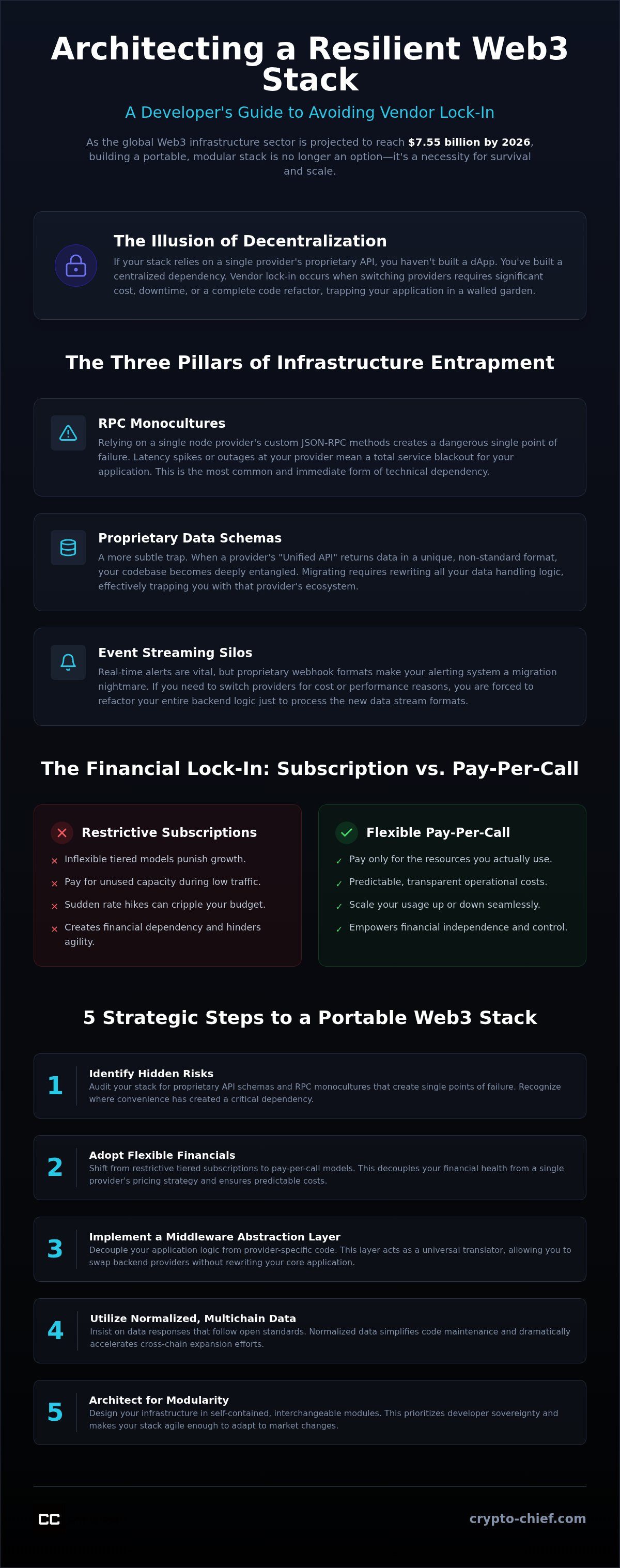
5 Strategic Steps for Building a Portable Web3 Stack
Achieving total independence requires a shift from passive consumption to active architectural design. While many teams focus on speed to market, the most resilient dApps prioritize the ability to pivot. Avoiding vendor lock-in web3 infrastructure is not a one-time setup; it's a continuous practice of maintaining technical sovereignty through modularity. By following a structured approach, you can ensure that your application remains agile enough to survive provider outages or pricing shifts.
- Step 1: Abstract your provider-specific code. Build a middleware layer that isolates your core logic from external API changes and proprietary schemas.
- Step 2: Prioritize normalized, multichain responses. Use tools like a unified blockchain api to ensure your data remains consistent across Ethereum, Polygon, and BNB.
- Step 3: Implement RPC fallbacks. Maintain redundancy by routing requests through an RPC Gateway that supports multiple endpoints simultaneously.
- Step 4: Adopt non-custodial processing. Ensure your platform maintains absolute control over private keys to avoid the custodial database trap.
- Step 5: Conduct regular fire drills. Test your stack's portability by migrating endpoints in a staging environment at least once per quarter to verify your exit strategy.
Abstraction Layers and Middleware
Building internal wrappers around external APIs is the most effective way to simplify replacement. Instead of calling a specific provider's method directly in your application logic, you call your own internal function. This wrapper then translates the request for the current provider. If you decide to switch, you only update the wrapper, not your entire codebase. While some SDKs offer convenience, they often hinder portability by introducing deep, proprietary dependencies. A successful transition often involves moving from a legacy provider to a unified system that normalizes data across multiple networks automatically.
Sovereignty in Payment Processing
The most dangerous form of lock-in is the 'Custodial Trap.' If your users' funds or private keys are tied to a provider's internal database, you're effectively held hostage by their platform. This is why non-custodial crypto processing is the ultimate guard against vendor lock-in. By maintaining direct on-chain relationships with your users, you ensure that your business remains operational regardless of your infrastructure partner's status. You don't just want a service; you want a partner that understands the necessity of non-custodial architecture. You can register for a non-custodial processing account to secure your protocol's independence and maintain full control over your financial flows.
Future-Proofing with Crypto Chief’s Unified Infrastructure
The transition from architectural strategy to operational reality requires a partner that prioritizes your sovereignty. Avoiding vendor lock-in web3 infrastructure is the cornerstone of our platform design, ensuring that your application remains portable and performant as the market evolves. We provide a single, high-performance engine that consolidates your blockchain needs without creating the proprietary silos that traditionally trap growing dApps. By centering our services on open standards, we empower you to maintain control over your technical destiny.
Our Unified API acts as a sophisticated translation layer, normalizing data across 10+ chains including Ethereum, BNB Smart Chain, and Polygon. Instead of managing dozens of unique data schemas, your team interacts with a consistent interface that simplifies cross-chain expansion. We also integrate AML Intelligence directly with our RPC services, reducing integration complexity and ensuring that compliance doesn't become a technical bottleneck. This unified approach allows you to focus on building features rather than maintaining fragmented infrastructure connections.
A Builder-Centric Ethos
Crypto Chief was designed by developers who have navigated the frustrations of rigid tiered plans and non-standard schemas. We prioritize global uptime and low latency, positioning our services as a silent, powerful partner in your stack. Our infrastructure supports a wide range of networks, including high-growth ecosystems like TON and Solana, providing the structural integrity needed for enterprise-grade applications. We understand that in 2026, stability is a prerequisite for innovation, and our platform is engineered to remove the friction that often hinders professional builders.
Getting Started Without the Gilded Cage
We believe that your loyalty should be earned through performance, not enforced through contracts. Our pay-per-call model is the standard for 2026 Web3 budgeting, allowing you to start with a pre-paid balance and scale your usage as your user base grows. There are no long-term commitments or hidden fees; you only pay for the resources you consume. This financial flexibility is essential for startups and established enterprises alike, ensuring that capital remains available for development rather than being locked in idle capacity. You can access our comprehensive documentation for a seamless integration process. We invite you to register an account today and experience an infrastructure platform that values your independence as much as your success.
Architecting for Autonomy in 2026
The path toward avoiding vendor lock-in web3 infrastructure requires a proactive shift from passive consumption to intentional, modular design. You've seen how proprietary schemas and rigid subscription tiers create invisible walls that stifle growth and inflate operational costs. By prioritizing normalized data through a Unified API and implementing robust middleware abstraction, you ensure that your protocol remains agile. True sovereignty isn't just about decentralization on-chain; it's about maintaining technical and financial flexibility at the infrastructure layer.
As the Web3 market continues its rapid expansion, the builders who prioritize portability will be the ones who scale without friction. Crypto Chief provides the foundation for this independence with a Unified API supporting 10+ major blockchains, a transparent pay-per-call model, and real-time EventStream notifications. You don't have to be trapped by legacy provider limitations. Build your future-proof dApp with Crypto Chief and register now to secure your platform's long-term resilience. The future of the decentralized web belongs to those who own their stack.
Frequently Asked Questions
What is the primary cause of vendor lock-in for Web3 developers?
The primary cause is the reliance on proprietary data schemas and non-standard JSON-RPC methods that aren't compatible across different node providers. When developers integrate these unique features directly into their core application logic, switching providers requires an extensive and costly code refactoring. Avoiding vendor lock-in web3 infrastructure starts by identifying these custom dependencies early in the development cycle to ensure your backend remains portable and independent of any single service provider's ecosystem.
How does a pay-per-call API model help avoid infrastructure lock-in?
A pay-per-call model removes the financial pressure of monthly recurring revenue contracts and tiered subscription plans. By using pre-paid tokens, you only pay for the actual data requests your application makes, eliminating the "use-it-or-lose-it" credit trap. This financial flexibility allows you to migrate services or scale down operations instantly. You aren't tethered to a vendor by unspent credits or long-term contractual obligations that prioritize the provider’s stability over your own operational agility.
Can I use multiple RPC providers simultaneously to ensure dApp uptime?
Yes, you can maintain high availability by implementing a middleware fallback layer or a unified RPC Gateway. This architectural approach ensures 100% uptime by automatically routing traffic to a secondary provider if the primary endpoint experiences latency or downtime. Distributing requests across various infrastructure partners prevents a single point of failure. It is a critical step in avoiding vendor lock-in web3 infrastructure while maintaining a high-performance global reach for your decentralized application.
What is the difference between a custodial and non-custodial crypto processing API?
A custodial API requires the provider to manage the private keys and hold user funds within their internal database, creating a significant technical and legal dependency. In contrast, a non-custodial crypto processing API ensures that you or your users maintain absolute control over private keys and on-chain assets. This distinction is vital for sovereignty. Non-custodial solutions allow you to switch infrastructure partners without risking the loss of access to your users' funds or historical transaction data.
How do I migrate my dApp from a proprietary API to a unified blockchain API?
Migration begins by abstracting your existing provider-specific code into a dedicated middleware layer. Instead of calling proprietary methods throughout your application, you route all requests through internal wrappers that translate the data into a standard format. Once this abstraction is in place, you can swap the backend for a unified blockchain API by updating only the wrapper logic. This methodical approach minimizes downtime and prevents the need for a full-scale rewrite of your application’s frontend.
Are there open-source standards for Web3 infrastructure that I should follow?
The JSON-RPC specification is the foundational open-source standard for blockchain communication. You should prioritize providers that strictly adhere to these standard methods rather than those pushing custom, "value-add" extensions that create technical debt. Following these baseline protocols ensures that your application remains compatible with any standard node provider. This allows for seamless transitions between different infrastructure layers as your project scales or as market conditions shift toward more efficient, standard-compliant solutions.
Does using a unified API increase the latency of my blockchain requests?
A well-architected unified API does not inherently increase latency; in many cases, it improves performance through optimized indexing and global caching. While the API adds a normalization layer, this overhead is typically offset by the provider’s high-performance infrastructure and proximity to the underlying nodes. For developers, the slight trade-off in processing time is often negligible compared to the massive gains in developer efficiency and the long-term benefit of maintaining a portable, multichain-ready codebase. To learn more about high-performance GPU infrastructure for AI and blockchain, consider how specialized hardware optimizes these environments.
What happens to my data if my Web3 infrastructure provider goes offline?
While the underlying blockchain data is public and permanent, your access to indexed historical data and real-time event streams is lost if a provider goes offline. Without a portable infrastructure strategy, your dApp will face a total service blackout until you can sync new nodes or refactor for a different provider. Maintaining a modular stack with multiple endpoints ensures that your application remains operational and your data access remains uninterrupted even during a provider’s catastrophic failure or business pivot.