
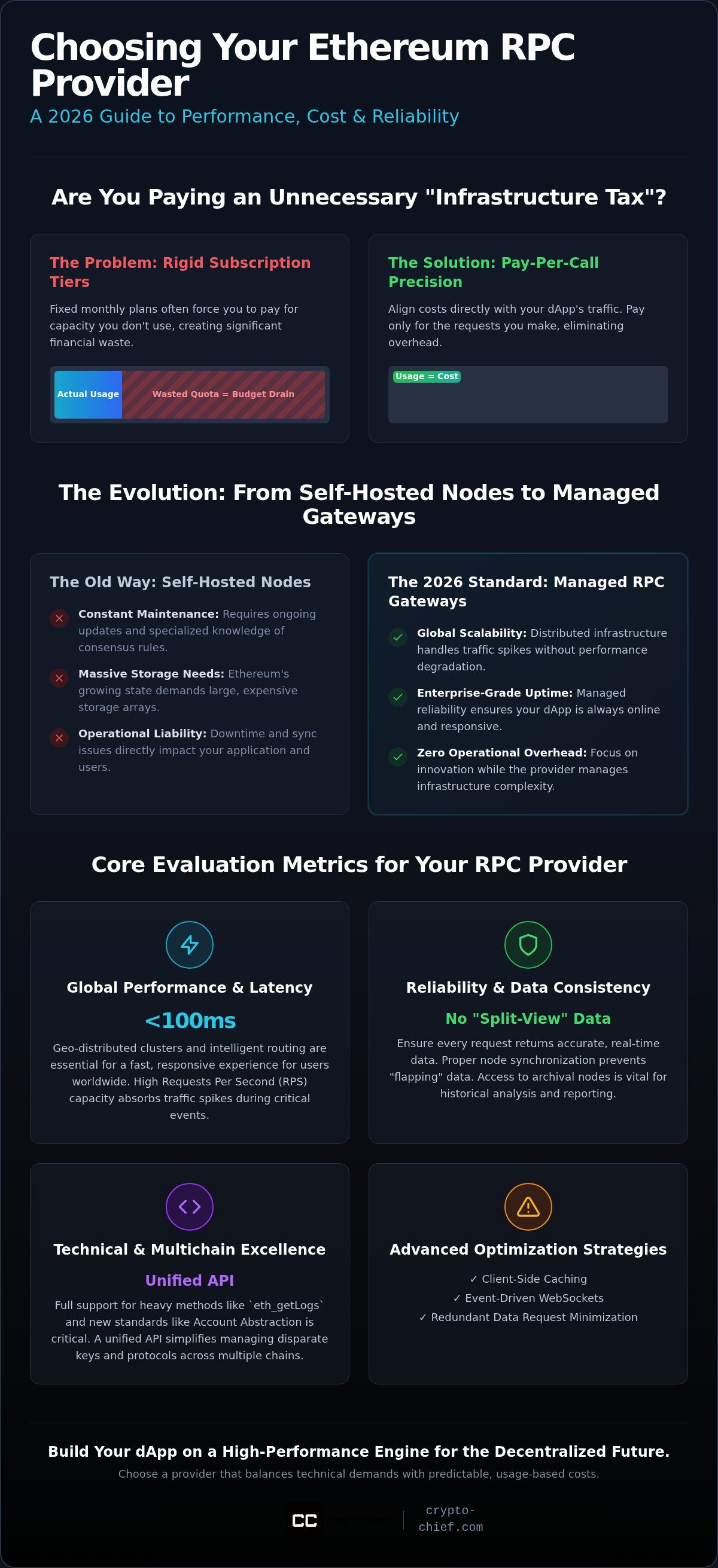
What if the most significant drain on your project's budget isn't your development team, but the "infrastructure tax" you pay for unused request quotas every month? You've likely experienced the frustration of high monthly overhead from rigid tiers that don't align with your actual traffic, or felt the impact of latency spikes during periods of intense network congestion. Identifying the best ethereum rpc provider in 2026 requires a shift in perspective, moving away from simple connectivity toward a model that prioritizes structural integrity and fiscal precision. We understand that you need a silent, powerful partner to provide a reliable foundation, allowing you to focus on innovation rather than API key management.
This guide provides a comprehensive framework for evaluating Ethereum RPC providers based on critical metrics like global latency, system reliability, and the cost-efficiency of pay-per-call models. You'll discover how to achieve sub-100ms response times and predictable pricing tied to actual usage, ensuring your dApp remains performant without financial waste. We'll explore the technical standards necessary for enterprise-ready applications and demonstrate how seamless multichain support can simplify your entire stack. By the end of this guide, you'll have the insights needed to select a gateway that acts as a high-performance engine for your decentralized future.
Key Takeaways
- Identify critical performance metrics for high-performance nodes, focusing on round-trip latency and requests per second to maintain stability during traffic spikes.
- Evaluate why the best ethereum rpc provider in 2026 prioritizes pay-per-call precision over rigid subscription tiers to eliminate unnecessary infrastructure overhead.
- Implement advanced optimization strategies, including client-side caching and event-driven WebSocket architectures, to minimize redundant data requests and improve responsiveness.
- Leverage a unified API to normalize data across multiple chains, reducing the technical complexity of managing disparate keys and protocols.
- Transition from self-hosted nodes to managed RPC gateways to secure enterprise-grade uptime and global low-latency routing for your decentralized applications.
The State of Ethereum RPC in 2026: Beyond Simple Connectivity
Ethereum nodes are the silent engines of the decentralized web. They act as the essential bridge between user interfaces and the immutable ledger, translating complex interactions into the standardized JSON-RPC protocol. By 2026, the complexity of the network has rendered self-hosted nodes a liability for most teams. Managing a local instance now requires constant maintenance, massive storage arrays for Ethereum's growing state, and specialized knowledge of ever-changing consensus rules. The industry has shifted toward managed RPC gateways that offer global scalability without the operational overhead.
Selecting the best ethereum rpc provider is no longer a one-size-fits-all decision. Your choice must align with your specific throughput requirements and compliance obligations. High-frequency trading dApps prioritize raw speed, while enterprise platforms might require integrated AML intelligence to filter illicit activity at the gateway level. As Layer 2 solutions dominate transaction volume, your provider must also offer seamless multichain support to keep your application relevant. Finding the best ethereum rpc provider means looking for a partner that balances these technical demands with predictable costs.
Why RPC Reliability is the Backbone of Web3
Downtime in Web3 isn't just a nuisance; it's a financial catastrophe. For a DeFi protocol, a few minutes of latency or a disconnected node can lead to failed liquidations or missed arbitrage opportunities. Providers now face the challenge of Ethereum's increasing state size, which demands high-performance hardware and sophisticated indexing. Access to archival nodes is equally vital. Without them, historical data analysis for tax reporting or portfolio tracking becomes impossible. A reliable provider ensures that every request returns accurate, real-time data regardless of network congestion.
New Standards for 2026: EIPs and Node Performance
Recent Ethereum upgrades have fundamentally altered how dApps interact with the chain. The widespread adoption of account abstraction has introduced more complex RPC calls that require greater computational power from the node. It's no longer enough to offer a simple endpoint. Modern apps require regional distribution to maintain sub-100ms latency for a global user base. When users in Tokyo and New York interact with the same contract, their requests should route to the nearest physical node. This geographic precision ensures that your application feels fast and responsive, regardless of where your users are located.
Critical Evaluation Criteria for High-Performance RPC Nodes
Identifying the best ethereum rpc provider requires moving beyond simple uptime percentages. You must audit how a service handles the Ethereum JSON-RPC specification under extreme stress. High-performance nodes are defined by their ability to maintain low latency while processing thousands of requests per second (RPS). Without this headroom, your dApp will experience timeouts during the very moments it needs to be most responsive, such as during a high-traffic NFT mint or a volatile market event. Throughput is not just about the total volume of calls, but about the provider's ability to absorb sudden spikes without degrading the user experience.
Method coverage is a common technical hurdle that separates elite providers from mid-tier services. While basic balance checks are standard, support for heavy methods like eth_getLogs or debug_traceTransaction varies significantly. Data consistency is equally vital. The "split-view" problem occurs when a provider's internal nodes are at different block heights, leading to "flapping" data where a transaction appears confirmed and then disappears on the next refresh. To avoid this, the best ethereum rpc provider implements synchronization checks that ensure every node in a cluster is within a tight margin of the chain head.
Global Latency and Intelligent Routing
Latency is the total time elapsed between an application sending a request and receiving a validated response from the blockchain. Reducing this metric requires more than just fast servers; it demands a global presence. Geo-distributed clusters allow for "time to first byte" reductions that are impossible with centralized setups. Intelligent edge routing goes a step further than basic load balancing by analyzing node health and network congestion in real-time. This ensures that a user in Singapore isn't waiting on a server in Frankfurt to process their transaction, creating a seamless experience regardless of geographic location.
Uptime SLAs and Redundancy Strategies
A 99.9% uptime SLA is the standard for 2026, but professional-grade infrastructure should exceed this through redundant failover mechanisms. If a primary node cluster fails, traffic must transition to a secondary region without dropping the connection. This redundancy prevents the single-point-of-failure risks that plague smaller, self-managed setups. Additionally, WebSocket support is essential for event-driven architectures. WebSockets allow your application to listen for specific logs or block headers without the overhead of constant polling, significantly reducing your total call volume. For teams looking to optimize these costs while maintaining elite performance, exploring a dedicated RPC Gateway is a logical next step.
Tiered Pricing vs. Pay-Per-Call: Solving the Infrastructure Tax
Traditional SaaS models often fail when applied to the volatile world of blockchain development. When you sign up for a monthly tier, you're essentially gambling on your own traffic. If your dApp sees lower engagement than expected, you're subsidizing the provider's unused capacity. Conversely, if your project goes viral, you risk being throttled at the exact moment your users need reliability. The best ethereum rpc provider in 2026 is one that replaces this "infrastructure tax" with a precision-based billing system. By moving away from complex credit systems that obfuscate the actual cost of an eth_call, developers can finally achieve the budget transparency required for enterprise-grade planning.
The industry's reliance on "Compute Units" often masks the true expense of heavy methods like debug_traceTransaction. While a provider might claim a low price per million units, a single trace call could consume thousands of those units, making it nearly impossible for business architects to predict monthly overhead with any certainty. Finding the best ethereum rpc provider involves looking for a model where costs are predictable and tied to the technical weight of the request. This allows teams to focus on building logic rather than auditing their infrastructure bills every thirty days.
The Problem with Monthly Tier Overages
Hard caps on requests can kill a viral dApp in hours. Most tiered plans operate on a "use it or lose it" basis, where allocated credits vanish at the end of the billing cycle regardless of usage. This creates a trap where developers are forced to choose between overpaying for safety or risking a service outage during a traffic spike. To calculate your real cost per transaction, you must look at your average monthly volume against the total tier price, including potential overage fees. Often, the effective cost per million requests is significantly higher than the advertised entry price once unused capacity is factored in.
Advantages of a Pay-As-You-Go Gateway
Adopting a pay-per-call model allows for infinite scalability without the friction of manual plan upgrades. Using a system based on prepaid token balances ensures that your infrastructure costs align perfectly with actual user growth. This approach simplifies multi-chain accounting, as a single balance can cover requests across Ethereum and other major chains without managing separate subscriptions. For a deeper dive into how this architecture supports high-growth projects, consult our Web3 RPC gateway guide. By utilizing a high-performance RPC Gateway, you ensure that your budget remains as agile as your codebase.
How to Optimize Your Ethereum RPC Integration
Optimization is where architectural theory meets production reality. Even with the best ethereum rpc provider, a poorly optimized client can lead to performance bottlenecks and unnecessary overhead. Implementing client-side caching for static data, such as contract metadata or historical logs, is a foundational step. By storing this information locally, you eliminate redundant calls and ensure your application remains responsive even during periods of network congestion. This proactive approach ensures your infrastructure remains lean and cost-effective. Likewise, for developers building advanced AI-driven features, Moltline Studio provides a catalog of agent skills and MCP servers optimized for production-grade performance.
Robust error handling is equally critical for maintaining a professional-grade user experience. Implementing exponential backoff strategies ensures that your application doesn't overwhelm a busy endpoint during temporary outages or rate-limiting events. Instead of failing immediately, your dApp should wait for increasing intervals before retrying the request. Monitoring your usage patterns allows you to identify inefficient code paths that might be inflating your costs. If you notice a specific method is being called with high frequency without a corresponding benefit to the user, it's time to refactor your logic. Leveraging WebSockets for event-driven architectures further reduces the need for constant polling, allowing your application to react to blockchain events in real-time with minimal resource consumption.
JSON-RPC allows you to combine multiple calls into a single request array, significantly reducing the overhead of HTTP headers and TCP handshakes. To implement this, wrap your individual request objects into a single JSON array and send them to the endpoint. The node processes these calls and returns a matching array of results in a single response. This technique is particularly effective for loading complex dashboard data or fetching balances for multiple assets across different contracts. For a detailed technical walkthrough on implementing these efficiencies, see our guide on RPC Request Batching for Cost Reduction.
Selecting the Right Endpoints for Multichain Apps
Managing a fragmented stack of API keys for different chains creates unnecessary friction and security risks. A unified gateway allows you to access Ethereum mainnet and various Layer 2 solutions through a single interface, simplifying your authentication logic and improving developer velocity. This approach is vastly superior to juggling separate accounts across multiple disparate platforms. For sophisticated event-driven logic, integrating real-time blockchain webhooks allows your backend to react instantly to on-chain events without the need for manual monitoring. To streamline your multichain operations and secure the best ethereum rpc provider experience, consider migrating your traffic to a high-performance RPC Gateway designed for elite builders.
Crypto Chief: The Unified RPC Infrastructure for 2026
The search for the best ethereum rpc provider often leads developers to a crossroads between raw performance and cost efficiency. Crypto Chief eliminates this compromise by offering a high-performance RPC Gateway designed for the rigorous demands of 2026. Unlike traditional providers that lock you into rigid monthly tiers, our pay-per-call model ensures you only pay for the infrastructure you actually use. This approach effectively removes the "infrastructure tax" that often drains the budgets of growing dApps, allowing you to reallocate resources toward core product development.
Modern applications are rarely confined to a single network. Our Unified API acts as a sophisticated normalization layer, allowing your team to access data across more than 10 major blockchains through a single, consistent interface. This consolidation solves the fragmented management problems discussed earlier; you no longer need to juggle separate API keys for Ethereum, Polygon, or BNB Chain. By providing a unified stream of blockchain data, we act as a silent, powerful partner that handles the underlying complexity so you don't have to. It's this combination of structural integrity and builder-centric logic that positions us as the best ethereum rpc provider for enterprise-ready projects.
Security and compliance are no longer optional add-ons. Crypto Chief integrates advanced AML Intelligence directly into the gateway. This allows you to secure your dApp and filter high-risk transactions without the need for cumbersome third-party plugins. By embedding compliance into the RPC layer, we provide a seamless workflow that protects your project while maintaining the non-custodial ethos of Web3.
Enterprise-Grade Performance with Developer Simplicity
Reliability is the foundation of our infrastructure. Our Ethereum RPC endpoints are geo-distributed to provide global low-latency routing, ensuring your users experience sub-100ms response times regardless of their location. You can monitor every aspect of your integration through an intuitive dashboard that tracks your prepaid balance and usage patterns in real-time. This visibility empowers you to leverage AML risk detection and performance metrics directly within your existing development cycle.
Scaling with a Silent, Powerful Partner
Crypto Chief is built by architects who understand the practical challenges of scaling decentralized applications. We've solved the difficult problems of node synchronization and data consistency so your team can stay focused on innovation. Transitioning to our gateway is straightforward. You can explore our comprehensive documentation for technical specifications and best practices. When you're ready to experience the stability of a managed gateway, register for a free account and begin testing the most efficient RPC infrastructure available today.
Secure Your Infrastructure for the Next Wave of Web3 Growth
We've analyzed how the shift toward managed gateways and pay-per-call billing has redefined what it means to be the best ethereum rpc provider in 2026. Success now depends on your ability to eliminate unused overhead while maintaining sub-100ms latency across a global user base. By prioritizing structural integrity and cost precision, you can ensure your dApp remains stable during the most volatile market conditions. It's no longer enough to just connect to the blockchain; you must do so with an architecture that scales as efficiently as your code. Choosing a partner that understands these technical nuances is the first step toward long-term operational success.
Crypto Chief stands ready as your silent, powerful partner, offering a Unified API and integrated AML risk scoring to streamline your multichain operations. Our non-custodial architecture and token-based pricing align perfectly with the needs of modern builders who value technical logic over marketing fluff. You don't have to manage the complexity of node synchronization alone when a reliable foundation is already built for you. Start building with Crypto Chief’s Ethereum RPC Gateway today and experience the performance your users deserve. The future of decentralized infrastructure is built on stability, and we're here to help you lead the way.
Frequently Asked Questions
What is an Ethereum RPC provider and why do I need one?
An Ethereum RPC provider is a service that hosts blockchain nodes and provides an API endpoint for dApps to communicate with the network. You need one because self-hosting a node in 2026 requires massive storage and constant maintenance. Managed providers offer the structural integrity and uptime needed for production apps. They act as a silent partner, handling the complex backend so you can focus on building your user interface.
How does pay-per-call pricing differ from monthly subscription tiers?
Pay-per-call pricing charges you only for the exact number of requests your application makes, eliminating the wasted overhead of unused monthly quotas. Monthly tiers often lock you into a "use it or lose it" model where you pay for capacity you might not need. The best ethereum rpc provider in 2026 uses a prepaid token system to align your infrastructure costs directly with your actual user growth and traffic patterns.
What is the average latency for a high-performance Ethereum RPC node?
High-performance nodes typically deliver an average latency of approximately 29 ms, with p95 latency staying under 45 ms to ensure a snappy user experience. These metrics are achieved through geo-distributed node clusters that route requests to the nearest physical server. To maintain professional-grade responsiveness, your provider should offer sub-100ms global round-trip times even during periods of high network activity or regional congestion.
Can I use a single RPC gateway for multiple blockchains like Polygon and BSC?
Yes, a Unified API allows you to access Ethereum, Polygon, BNB Smart Chain, and other major networks through a single gateway interface. This eliminates the friction of managing separate API keys and different data formats for each chain. By using one high-performance RPC Gateway, you normalize your data stream and simplify your backend architecture, which significantly improves developer velocity and reduces the risk of authentication errors.
How do I reduce my RPC costs as my dApp grows?
You can reduce costs by implementing client-side caching and request batching to minimize the total number of calls sent to the node. Moving to a pay-per-call model also prevents you from overpaying for high-tier subscriptions. Monitoring your usage patterns helps identify inefficient code that triggers redundant requests. Selecting the best ethereum rpc provider with transparent, usage-based pricing ensures that your costs remain predictable as your user base expands.
What is the difference between a public RPC and a private provider?
Public RPCs are free, rate-limited endpoints intended for testing or light usage; they often suffer from high latency and frequent downtime. Private providers offer dedicated infrastructure with guaranteed uptime SLAs, higher rate limits, and advanced features like WebSocket support. For enterprise-ready applications, private providers are essential because they offer the stability and security that public endpoints lack, especially during critical network events.
Why is archival node access important for developer tools?
Archival nodes store the entire history of the blockchain, allowing you to query the state of any account or contract at any specific block in the past. This is vital for building portfolio trackers, tax reporting tools, or any application that requires historical data analysis. While standard full nodes only keep recent state data, archival access ensures your tool can provide a complete and accurate financial history for your users.
How does Crypto Chief handle Ethereum network congestion?
Crypto Chief utilizes intelligent edge routing and geo-distributed node clusters to bypass regional bottlenecks during periods of high congestion. Our infrastructure is designed to absorb sudden spikes in traffic without degrading performance or increasing latency for your users. By maintaining a high-performance RPC Gateway with redundant failover mechanisms, we ensure that your dApp remains responsive and reliable even when the underlying Ethereum network faces extreme transaction volume.