
Why are you still paying for Ethereum node capacity that sits idle while your budget drains into unused monthly tiers? Most architects are tired of watching credits expire or navigating "Compute Unit" multipliers that turn a standard request into a budget-breaking event. It's frustrating to face service throttling during critical traffic spikes, especially when you've already committed to a high-cost plan. This is why adopting an ethereum pay as you go rpc model is no longer just an option for 2026; it's a financial necessity for any scalable dApp.
We believe that infrastructure billing should be as logical and precise as the smart contracts you deploy. In this guide, you'll learn how to master the economics of node access and eliminate the wasted overhead inherent in traditional provider models. We will explore how to secure high-speed mainnet access with predictable cost-per-request billing, ensuring your foundation remains stable without the friction of artificial limits or hidden multipliers. This is your roadmap to building leaner, more resilient Web3 applications that scale in sync with your actual user demand.
Key Takeaways
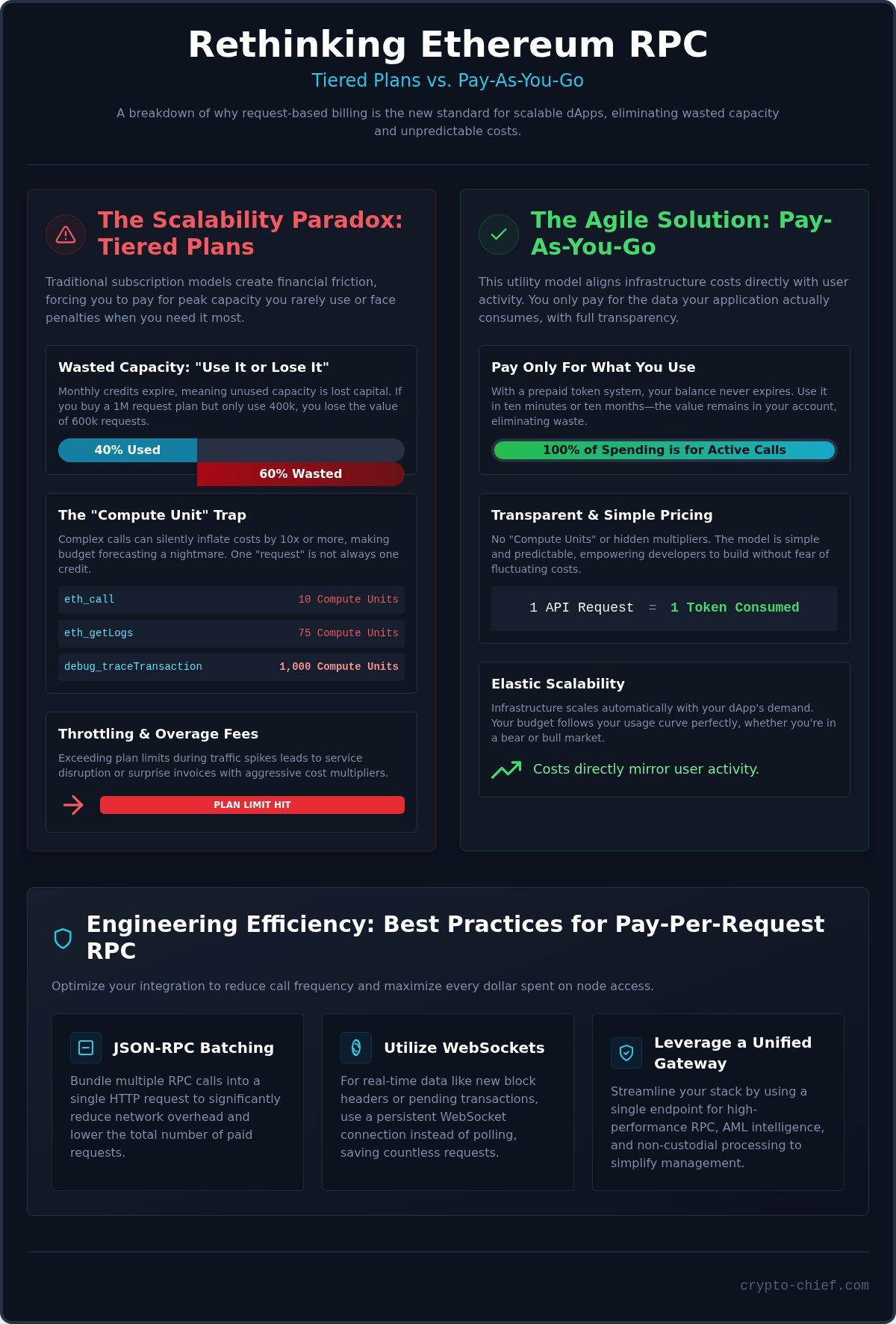
- Stop overpaying for idle capacity by understanding why fixed tiered models create financial friction during periods of market volatility.
- Discover how an ethereum pay as you go rpc model uses transparent, request-based billing to ensure you only pay for the data your application actually consumes.
- Learn to identify the "Compute Unit" trap where complex calls can silently inflate your infrastructure costs by up to ten times.
- Optimize your integration using JSON-RPC batching and WebSockets to reduce call frequency and maximize every dollar spent on node access.
- Streamline your stack by leveraging a unified gateway that combines high-performance Ethereum RPC with AML intelligence and non-custodial processing.
The Scalability Paradox: Why Tiered Ethereum RPC Plans Drain Your Budget
Traditional SaaS billing models are designed for predictable, linear growth. However, the Web3 ecosystem operates on a pulse of extreme volatility where traffic can surge or vanish in an instant. For architects building on Ethereum, tiered subscription plans often create a "scalability paradox" where you pay for peak capacity you rarely use, or face crippling penalties when you actually need it. This inefficiency is driving a fundamental shift in how 2026 developers approach node infrastructure. They are moving away from rigid monthly commitments toward a more logical ethereum pay as you go rpc model that treats data access as a utility rather than a subscription.
The core issue lies in the "use it or lose it" nature of monthly credits. If your application consumes 400,000 requests on a plan that provides one million, the remaining 600,000 credits represent lost capital that the provider keeps. This "dead capacity" cost acts as a silent drain on your budget. It punishes startups for being efficient and creates a financial ceiling that makes experimentation expensive. By adopting an ethereum pay as you go rpc framework, you align your infrastructure expenses directly with your active user base, ensuring that every dollar spent translates to a successful Remote Procedure Call (RPC).
The Problem with Monthly Subscription Tiers
Subscription tiers force developers into a reactive cycle. When a dApp suddenly goes viral, the friction of manual plan upgrades can lead to service throttling or complete downtime at the exact moment you need stability. Most traditional billing cycles lack the granular transparency required for modern financial auditing. You are often left guessing how many credits remain until the end of the month, making it nearly impossible to forecast costs during high-volume events like NFT mints or protocol launches. It's a rigid system that fails to accommodate the fluid nature of blockchain interactions.
The Burden of Overage Charges
Overage fees are the hidden tax of the tiered model. Once a limit is exceeded, many providers apply aggressive multipliers to the cost of every additional request. For example, complex methods like debug_traceTransaction can consume up to 1,000 credits per call, which can exhaust a standard developer quota in just 15,000 calls. Without a unified prepaid balance, these overages can lead to surprise invoices that disrupt your burn rate. Treating your infrastructure as a liquid asset through a prepaid system allows you to maintain control. You can view the technical documentation to see how a unified balance eliminates the risk of these sudden, unmanaged expenses.
Defining Ethereum Pay As You Go RPC: Transparent Utility Pricing
At its core, an ethereum pay as you go rpc model is a request-based billing architecture where you pay only for the interactions your application makes with the blockchain. Unlike traditional plans that expire at the end of a billing cycle, this model utilizes a prepaid token system. You fund your balance once, and those tokens remain available until they're consumed by active calls. It doesn't matter if you use them in ten minutes or ten months; the value stays within your account. This transparency is why the ethereum pay as you go rpc model is becoming the standard for modern decentralized applications that require both agility and fiscal responsibility.
One of the most significant advantages is the total elimination of "Compute Units" (CUs). In many legacy systems, a simple eth_call might cost 10 CUs while an eth_getLogs query costs 75, making budget forecasting a mathematical nightmare. We believe in structural simplicity. One request equals one token, regardless of the method's complexity. This approach empowers architects to build without fear of hidden multipliers or fluctuating costs. It supports lean MVPs that need to keep burn rates low, while providing the robust foundation required for massive enterprise workloads.
How Pay-Per-Call Infrastructure Works
A high-performance gateway sits at the center of this architecture, tracking usage in real-time while routing calls to global node clusters. This setup ensures sub-30ms routing for Ethereum mainnet and various L2s. You use a single API key for every method, from basic balance checks to complex event filtering. This unified approach simplifies infrastructure management and removes the friction of juggling multiple providers. If you're ready to transition to a more efficient stack, you can integrate our processing API to start building immediately.
Prepaid Balances vs. Post-Paid Invoicing
Security is paramount in Web3 infrastructure. By using non-custodial payment methods to fund your balance, you maintain total control over your capital without the friction of traditional post-paid invoicing. Developers can set automated low-balance alerts to prevent service interruptions during high-traffic periods. For a step-by-step guide on funding your account and generating keys, consult the Crypto Chief Documentation. This model turns infrastructure from a recurring liability into a manageable, utility-driven asset that scales exactly when you do.
Subscription vs. Pay-As-You-Go: A Cost-Performance Benchmarking
Benchmarking infrastructure costs requires looking past the flashy "starting at" prices advertised by legacy providers. While traditional platforms often present attractive entry tiers, the actual cost per million requests (PPM) fluctuates wildly based on your actual consumption. For instance, a developer on a $49 monthly plan using only 20% of their allocated 80 million credits is effectively paying five times the advertised rate. This inefficiency is exactly what an ethereum pay as you go rpc model eliminates by ensuring your capital only leaves your balance when a call is successfully executed.
Then there is the "Compute Unit" trap. In many ecosystems, simple methods are cheap, but data-heavy calls like eth_getLogs or debug_traceTransaction can consume hundreds or even thousands of credits per request. Research shows that Infura's debug_traceTransaction method consumes 1,000 credits per call; on a standard developer plan, just 15,000 of these calls would exhaust an entire daily quota. By contrast, a unified request model where one call equals one token provides a predictable ROI, especially as a dApp scales from 10,000 to 10 million requests. The cost-saving curve becomes steeper as your volume grows because you never pay for the "ghost" capacity of a higher tier.
The Effective Price Per Request (EPPR)
To find your true infrastructure cost, you must use the EPPR formula: (Monthly Subscription Fee / Actual Requests Consumed) + Total Overage Costs. In a hypothetical 2026 scenario, a startup switching to a pay-as-you-go model could reduce their overhead by 40% simply by eliminating unused tier capacity and avoiding aggressive overage multipliers. EPPR is the only metric that truly matters for Web3 CFOs who need to protect their runway while maintaining high-performance node access.
Performance Benchmarking: Latency and Uptime
A common misconception is that utility-based billing implies a lower priority in the routing engine. This isn't the case. High-performance gateways utilize global routing to maintain sub-30ms latency regardless of the billing model. Architects get full access to archive nodes without the tier-based restrictions that often gate historical data on subscription platforms. For those looking to optimize their cross-chain strategy, our Web3 RPC Gateway guide offers deeper technical insights into building resilient, multichain systems that prioritize both speed and structural integrity.
Engineering Efficiency: Best Practices for Pay-Per-Request RPC
Infrastructure as a utility requires a shift in developer mindset. When every call has a direct impact on your balance, efficiency becomes an engineering priority rather than an afterthought. Adopting an ethereum pay as you go rpc model encourages the use of advanced optimization techniques that subscription models often mask. By minimizing redundant data fetching, you preserve your prepaid balance while actually improving the performance of your dApp. This approach turns cost management into a technical challenge that rewards clean, optimized code.
Request Batching and Caching
Implementing JSON-RPC request batching is the most immediate way to consolidate traffic. Instead of sending ten individual requests to fetch token balances, you can bundle them into a single call. Multicall smart contracts are particularly effective here; they allow you to aggregate results from multiple contract queries into one RPC interaction. For developers ready to implement these patterns, we've provided a complete manual on RPC Request Batching for Cost Reduction. Caching static data, such as block headers or transaction receipts from finalized blocks, further reduces volume. Set a clear Time to Live (TTL) for non-finalized data to ensure accuracy while preventing unnecessary calls for information that hasn't changed.
Webhooks and Event Streaming
Active polling is a legacy habit that drains resources. Constant eth_getLogs calls to check for new events create a high-frequency overhead that is rarely necessary. Transitioning to passive listening via WebSockets (WSS) or EventStream webhooks allows your application to receive asynchronous state updates only when they occur. This shift from "pulling" to "pushing" data can significantly lower your request count. Our guide to real-time blockchain webhooks details how to set up these asynchronous listeners. By using EventStream, you ensure your dApp stays responsive without the financial friction of constant polling. If you want to see these efficiencies in action, explore our whitelabel solutions to build your own optimized infrastructure gateway.
Scaling with Crypto Chief’s Unified Ethereum RPC Gateway
Scaling a decentralized application involves more than just increasing request volume. It requires a cohesive infrastructure that handles data retrieval, regulatory compliance, and value transfer without multiplying your integration burden. While many providers offer isolated node access, the most efficient 2026 architects are choosing an ethereum pay as you go rpc gateway that consolidates these essential services. By moving away from siloed tools, you reduce the surface area for technical failure and ensure that your dApp remains lean as it expands across the Ethereum mainnet and high-performance L2s like Base, Arbitrum, and Polygon.
Managing multiple providers for disparate services is a form of technical debt that slows down development cycles. If you're forced to maintain separate integrations for node access, risk scoring, and payment processing, you spend more time on maintenance than on building core features. Our platform normalizes multichain data through a single interface, allowing you to focus on the user experience while we handle the background complexity. You can explore the Crypto Processing API to see how seamlessly data retrieval transitions into secure, non-custodial value transfer.
A Unified Developer Ecosystem
Modern Web3 development demands speed. When your RPC layer is unified with your processing logic, you eliminate the friction of cross-provider latency. This integrated approach allows for real-time state monitoring and immediate transaction execution within a single environment. Instead of managing three different API keys and billing cycles, you utilize a unified prepaid balance that powers your entire stack. It's a builder-centric model that respects your time and your budget, providing a stable foundation for everything from simple dApps to complex institutional platforms.
Compliance and Security at the Edge
Security in 2026 isn't just about uptime; it's about the integrity of the transactions passing through your gateway. Integrating AML Intelligence directly at the RPC layer allows you to screen addresses for illicit activity before they interact with your smart contracts. This proactive approach protects your protocol from regulatory friction and ensures that your ecosystem remains compliant without adding latency to the user journey. By combining these checks with a non-custodial architecture, you provide enterprise-grade security that respects the decentralized ethos of Web3. To begin building your scalable infrastructure, we recommend reviewing the Crypto Chief Docs for a comprehensive quickstart guide. This ensures your ethereum pay as you go rpc strategy is backed by a robust suite of tools designed for the modern builder.
Architecting for a Leaner Web3 Future
The transition from rigid subscriptions to utility-based billing is a fundamental shift in how we build on Ethereum. You've seen how tiered models create unnecessary financial friction and how optimization techniques like request batching can drastically extend your runway. By prioritizing an ethereum pay as you go rpc strategy, you move beyond the "Compute Unit" trap and align your infrastructure costs with actual user demand. This isn't just about saving money; it's about building a more resilient, responsive application that scales without the weight of wasted overhead or hidden multipliers.
Your foundation should be a silent, powerful partner that empowers your creative vision. We provide the structural integrity you need through a Unified Web3 Infrastructure that delivers Global Sub-30ms Latency and Transparent 1:1 Request Billing. It's time to stop paying for idle capacity and start investing in your project's growth. Start Building with Crypto Chief’s Pay-Per-Call RPC Gateway today. The tools are ready to support your next innovation. We're here to provide the stability you need to succeed in the evolving decentralized landscape.
Frequently Asked Questions
What is the main difference between pay-as-you-go and monthly RPC plans?
Monthly plans charge a fixed fee for a set credit volume that expires at the end of the billing cycle, whereas an ethereum pay as you go rpc model uses a prepaid token balance. This means you only pay for the calls you actually execute; your balance remains valid until consumed. It's a more efficient way to manage infrastructure costs for applications with volatile traffic patterns that don't fit into rigid monthly tiers.
Does pay-as-you-go RPC support Ethereum archive nodes?
Yes, our infrastructure provides comprehensive support for archive nodes, allowing you to query historical blockchain state without being restricted by subscription tiers. You can access the full history of the Ethereum mainnet for complex data analysis or auditing. This ensures that architects have the necessary data depth to build advanced DeFi protocols or analytics platforms without facing artificial barriers to entry or hidden multipliers for historical data.
How do I track my API request usage in real-time?
Usage is tracked in real-time through a centralized dashboard that monitors every interaction with the unified gateway. You can view granular metrics for each API key, enabling you to identify which methods are consuming the most tokens. This transparency allows for precise financial auditing and helps you optimize your application's request patterns. Real-time monitoring is essential for maintaining a predictable burn rate as your user base expands globally.
Can I use one prepaid balance for multiple blockchains like Ethereum and Polygon?
You can use a single prepaid balance to access all supported blockchains, including Ethereum, Polygon, and various Layer 2 solutions. This multichain approach eliminates the need to manage separate accounts or billing cycles for different networks. It simplifies your infrastructure stack by providing a unified gateway for all your Web3 data needs, ensuring a seamless experience for developers building cross-chain applications that require high uptime and structural integrity.
Are there limits on Requests Per Second (RPS) with pay-per-call models?
Our pay-per-call model is designed to handle high-throughput workloads, offering scalable Requests Per Second to accommodate traffic surges. Unlike tiered plans that may throttle your connection when you reach a limit, our global routing engine prioritizes uptime and performance. This ensures that your dApp remains responsive during viral growth events. Specific limits are managed at the infrastructure layer to maintain stability for all users while delivering elite, enterprise-ready service.
What happens if my prepaid token balance runs out mid-transaction?
If your prepaid token balance is exhausted, the gateway will return an error code and subsequent RPC calls will fail until the balance is replenished. To prevent service interruptions, you should implement automated low-balance alerts through the dashboard settings. This proactive monitoring ensures your application continues to function smoothly. Maintaining a buffer in your prepaid account is a best practice for mission-critical blockchain infrastructure that values logic and seamless delivery.
Is MEV protection included in Crypto Chief’s Ethereum RPC endpoints?
Our Ethereum RPC endpoints are optimized for high-performance and stability, serving as a reliable foundation for your transaction routing. While the focus is on global uptime and sub-30ms latency, our infrastructure acts as a silent partner to help you navigate the complexities of the network. This grounded approach ensures that your dApp's interactions with the mainnet are processed with the professional confidence required for professional developers and business architects.
How do I integrate the AML risk detection with my RPC calls?
Integrating AML Intelligence is a straightforward process through our Unified API, which allows you to scan addresses for risk at the RPC layer. You can programmatically check for illicit funds or sanctioned entities before processing a transaction or interacting with a user. This compliance-first approach protects your application from regulatory friction. By combining data retrieval with risk detection, you create a more secure and trustworthy ecosystem for your global user base.