
What if your dApp's success during the 2026 FIFA World Cup was decided not by your smart contract logic, but by the infrastructure you don't actually control? Most developers understand that relying on public endpoints is a high-risk strategy during peak fan-token volatility. You've likely experienced the friction of transaction failures or the headache of managing fragmented providers across Ethereum, BSC, and the Chiliz Chain. Selecting a high-performance chiliz rpc provider is no longer a secondary technical task; it's the foundation of a scalable user experience.
We understand that you need stability without the burden of hidden subscription tiers or unpredictable latency. This guide will help you master the technical landscape of Chiliz RPC infrastructure to ensure your application delivers elite fan engagement without rate-limit bottlenecks. You'll learn how to leverage the latest Prague hard fork features, implement pay-per-call pricing models for better cost predictability, and unify your access to the entire EVM ecosystem. We will examine the specific configurations required for Chiliz Chain Mainnet and the Spicy Testnet to keep your deployments resilient through 2026 and beyond.
Key Takeaways
- Learn why professional infrastructure is essential for navigating the high-volatility spikes inherent in fan-token launches throughout 2026.
- Evaluate the technical advantages of choosing a specialized chiliz rpc provider that supports native EVM standards and high-frequency WebSocket streaming.
- Eliminate hidden overhead by transitioning from rigid monthly subscription tiers to a transparent, pay-per-call pricing model.
- Identify the structural requirements for global scalability, focusing on low Time to First Byte and integrated AML intelligence for real-time risk detection.
- Streamline your development workflow by unifying Chiliz with other EVM chains through a single, high-performance API gateway.
Why Your Chiliz dApp Needs a Professional RPC Provider
An RPC (Remote Procedure Call) provider acts as the essential bridge between your application's front end and the Chiliz blockchain. Without this link, your dApp cannot communicate with the network, making it impossible to read fan-token balances or broadcast transactions. Since Chiliz is a blockchain platform designed specifically for the sports and entertainment industry, the infrastructure must handle unique, high-intensity traffic patterns. Selecting a dedicated chiliz rpc provider ensures that your dApp remains responsive even when the network experiences sudden spikes in activity. Standard operations like querying a user's balance or executing a smart contract to mint a collectible require a stable connection to a node. While public endpoints exist, they are often insufficient for production environments where performance is non-negotiable.
The Bottleneck: Rate Limits on Public Endpoints
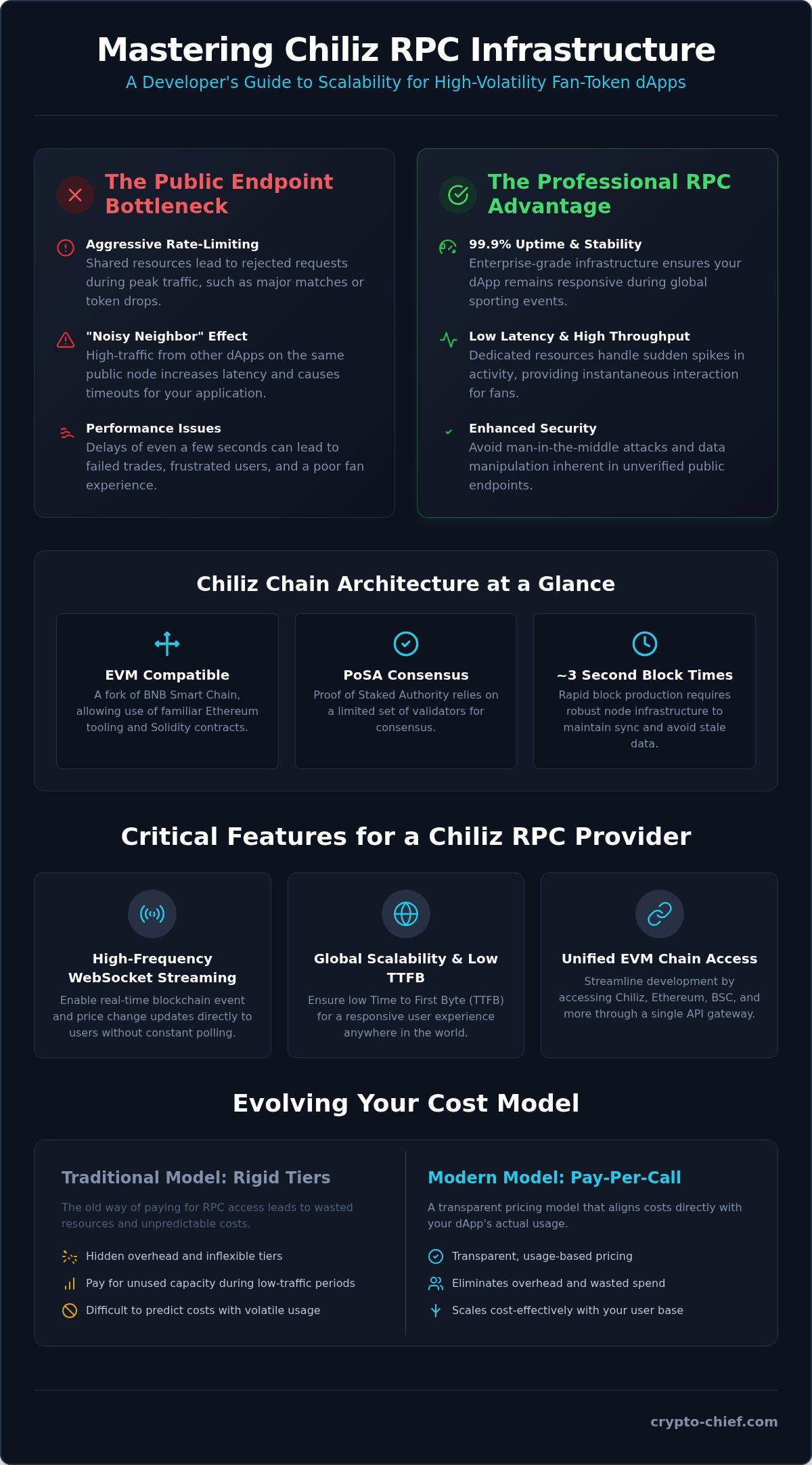
Public nodes are shared resources. When thousands of fans attempt to buy tokens during a major match or a high-profile drop, these endpoints often reach their capacity instantly. This leads to aggressive rate-limiting, where the provider rejects your requests to protect the network. Your application then has to implement "exponential backoff" strategies, which essentially means waiting longer between retries. In a fast-moving market, even a few seconds of delay can lead to failed trades and frustrated users.
The 'Noisy Neighbor' effect occurs when another developer's high-traffic application consumes the shared resources of a public node, causing your own dApp to suffer from increased latency and connection timeouts.
Production Requirements for 2026 Web3 Apps
By 2026, fan expectations have shifted toward instantaneous interaction. Enterprise-level platforms now require 99.9% uptime to maintain credibility during global sporting events. You can't afford to have your interface lag while a live match is happening. Real-time updates are equally critical. A professional chiliz rpc provider offers WebSocket (WSS) support, allowing your dApp to stream blockchain events and price changes directly to the user without constant polling. Security is the final pillar. Using unverified public endpoints exposes your application to man-in-the-middle attacks or data manipulation. Moving to a dedicated or high-performance gateway ensures that the data your users see is accurate and secure. For detailed implementation standards, you can refer to the technical documentation provided by infrastructure experts who specialize in high-availability systems.
Chiliz Chain Architecture: EVM Compatibility and RPC Standards
Chiliz Chain operates as a fork of the BNB Smart Chain (BSC), which inherently grants it full EVM compatibility. This architectural choice allows developers to deploy Solidity smart contracts and utilize familiar Ethereum tooling without significant modifications. However, the underlying Parlia Proof of Staked Authority (PoSA) consensus mechanism introduces specific considerations for block finality and node synchronization. Unlike pure Proof of Work, PoSA relies on a limited set of validators to achieve rapid block times, typically around three seconds. For a chiliz rpc provider, maintaining a consistent state with this high-frequency block production is a technical challenge that requires robust infrastructure. If a node falls out of sync by even a few blocks, your dApp may return stale data or fail to broadcast transactions during critical fan-token events.
Standard JSON-RPC Methods for Developers
Developers interacting with the Chiliz ecosystem rely on standard JSON-RPC methods to facilitate communication between the application and the ledger. The eth_call method is frequently used for read-only operations, such as checking fan-token balances or querying contract states without gas costs. For state-changing operations, eth_sendRawTransaction remains the primary vehicle for broadcasting signed trades to the network. While full nodes suffice for current state data, archive nodes are essential for developers performing historical analysis or building complex dashboards that track token movements over time. Integrating these endpoints into your workflow is seamless with libraries like Ethers.js or Web3.js, provided your chiliz rpc provider offers the low latency required for real-time responsiveness.
Testnet Connectivity: Spicy vs. Scoville
Before deploying to the Mainnet (Chain ID 88888), rigorous testing on the Spicy Testnet (Chain ID 88882) is a mandatory step for any production-grade application. The Spicy environment mirrors Mainnet conditions, allowing for smart contract auditing and UI stress testing without risking real capital. While the older Scoville testnet has largely been phased out, Spicy remains the definitive sandbox for the 2026 developer ecosystem. To begin building, you can obtain testnet CHZ through the Crypto Chief Faucet to cover gas fees during the development cycle. This ensures your logic is sound before you commit to a full-scale launch. If you require deeper technical insights into multichain integration, exploring our technical documentation can help bridge the gap between local development and global deployment.
Comparing RPC Provider Models: Pay-Per-Call vs. Dedicated Nodes
Choosing a chiliz rpc provider involves a strategic trade-off between granular control and operational simplicity. In the 2026 Web3 ecosystem, developers typically choose between three primary models: monthly subscription tiers, dedicated bare-metal nodes, or pay-per-call gateways. While monthly tiers are common, they often include hidden request caps that trigger aggressive throttling or unexpected overage fees during high-volatility events. Dedicated bare-metal nodes provide the highest possible throughput for enterprise-scale applications, yet they demand significant maintenance overhead and constant security patching. For most growing dApps, a shared private gateway or a pay-per-call model offers the most logical path forward by providing high performance without the hardware management burden.
The "Pay-as-you-go" approach has emerged as the industry standard for cost-efficiency. It eliminates the waste associated with paying for idle capacity during low-traffic periods between major sporting events. Instead of a flat fee, you pay only for the JSON-RPC requests your application actually executes. This transparency allows business architects to forecast infrastructure expenses with precision, ensuring that costs align perfectly with user acquisition and platform activity.
Cost Optimization with Pay-Per-Call
Prepaid API token balances offer a safeguard against the "bill shock" often associated with traditional cloud scaling. By maintaining a balance that reflects your expected usage, you maintain total control over your burn rate. This model scales linearly; as your fan base grows from 1,000 to 100,000 active users, your infrastructure costs follow a predictable trajectory. To further maximize efficiency, integrating RPC Request Batching for Cost Reduction allows your dApp to combine multiple data queries into a single network call. This technical optimization reduces the total number of requests processed by your chiliz rpc provider, directly lowering your operational expenses without sacrificing data accuracy.
Infrastructure Management: Outsourced vs. In-House
Running an in-house Chiliz node presents several hidden challenges that often outweigh the perceived benefits of total ownership. Beyond the initial server costs, you must account for specialized DevOps labor, high-speed bandwidth, and the massive storage requirements of an archive node. Managed providers solve these issues by utilizing edge computing to deliver superior global latency. By routing requests to the node geographically closest to the user, these services minimize the "Time to First Byte" (TTFB) for fans across different continents. Furthermore, a unified API gateway allows you to manage Chiliz, Ethereum, and BSC connections through a single interface. This reduces technical debt and allows your engineering team to focus on building engaging fan experiences rather than troubleshooting node synchronization issues.
Critical Features to Look for in a Chiliz RPC Provider
By 2026, the baseline for Web3 infrastructure has shifted from simple connectivity to integrated ecosystems. Selecting a chiliz rpc provider isn't just about finding an endpoint; it's about identifying the specific features that enable high-performance scaling. Production-grade dApps require more than raw node access to survive the volatility of global fan-token markets. You need a foundation that handles real-time data streaming and security screening before the data ever reaches your application logic. While many providers offer basic JSON-RPC support, elite services distinguish themselves through technical depth and structural integrity.
A high-performance gateway should prioritize these four pillars:
- WebSocket Support (WSS): Essential for live sports applications where polling introduces unacceptable delays in price updates or transaction confirmations.
- Global Node Distribution: Minimizing the distance between the user and the node to reduce 'Time to First Byte' (TTFB) across different continents.
- Data Normalization: Simplifying response formats so that Chiliz data integrates seamlessly with Ethereum or BSC logic in multichain environments.
- Integrated Security: Utilizing AML intelligence at the node level to provide real-time risk scoring for every incoming transaction.
Latency and Uptime Guarantees
Speed is a competitive advantage. Milliseconds are won at the edge of the network, where localized nodes process requests without the latency penalty of long-distance routing. When evaluating a chiliz rpc provider, examine their Service Level Agreements (SLAs) for specific uptime commitments during high-traffic windows. Enterprise builders can't risk downtime during a championship final or a major token drop. For a deeper look at how to structure your infrastructure for speed, consult our Web3 RPC Gateway: Architect’s Guide. This resource details the transition from centralized bottlenecks to distributed, high-availability clusters.
Developer Tools and Documentation
Operational visibility is critical for debugging and scaling. A robust developer portal should offer real-time request logs, allowing you to monitor usage patterns and identify potential bottlenecks instantly. Integrated webhooks further simplify transaction monitoring by pushing updates to your server the moment an on-chain event occurs. This reduces the need for constant polling and lowers your total API call volume. You can explore the full range of available methods and integration patterns in the Crypto Chief Documentation. If you're ready to deploy on a platform built for 2026 standards, you can start building today with our high-performance RPC gateway.
Integrating Chiliz with Crypto Chief’s Unified Infrastructure
Crypto Chief acts as the silent, high-performance engine behind the world's most resilient fan-token platforms. By choosing us as your chiliz rpc provider, you gain more than a simple entry point to the blockchain; you access a comprehensive ecosystem designed to handle the technical complexities of 2026’s Web3 market. Connecting your application is a methodical process that prioritizes stability. First, you obtain your unique API key through our developer portal. Next, you configure your environment to point toward the Chiliz Mainnet (Chain ID 88888) or the Spicy Testnet (Chain ID 88882). Finally, you integrate our unified endpoint into your provider logic, ensuring your dApp is ready to broadcast transactions with the sub-second latency required for live sports environments.
Beyond the Node: Unified API Benefits
Developers often struggle with provider fragmentation when managing assets across multiple chains. Crypto Chief solves this by normalizing data across Chiliz, Ethereum, and BSC, allowing you to use a consistent response format for all your queries. This structural harmony reduces integration time from weeks to just a few hours. When your application needs to handle high-volume payments, our Crypto Processing API provides a non-custodial gateway that works seamlessly alongside your RPC infrastructure. This all-in-one approach eliminates technical debt and ensures that your background processes are as efficient as your user-facing features. It's about building a cohesive narrative where every technical layer supports the same goal of elite performance.
Security and Compliance for Fan Tokens
The regulatory landscape of 2026 demands higher standards for transaction transparency and risk management. Following the joint guidance from the SEC and CFTC regarding fan tokens as digital collectibles, builders must ensure their ecosystems remain free from illicit activity. Our AML Intelligence tool allows you to trace funds and detect high-risk transactions directly at the node level. By embedding risk scoring into your workflow, you can secure your fan-token ecosystem without slowing down your development cycle. This proactive stance on compliance protects your brand and provides a reliable foundation for long-term growth in the sports-tech industry. Using a chiliz rpc provider that integrates security and performance ensures you're prepared for both the technical and legal requirements of the modern Web3 era.
Future-Proofing Your Fan Engagement Strategy
The technical landscape of 2026 demands infrastructure that is both agile and resilient. By prioritizing low-latency WebSocket support and transitioning to a transparent pay-per-call model, you eliminate the bottlenecks that traditionally plague high-traffic fan-token events. Selecting a professional chiliz rpc provider isn't merely a technical choice; it's a commitment to providing a seamless user experience that remains stable during the most volatile market conditions. We've explored how a unified approach to node management and integrated security protocols can reduce technical debt while ensuring global compliance. Your dApp deserves a foundation that scales as fast as the sports industry itself.
It's time to move beyond fragmented providers and unreliable public endpoints. You can start building on Chiliz with Crypto Chief's high-performance RPC Gateway to leverage a unified API for 20+ chains, pay-per-call pricing, and enterprise-grade AML integration. This single service removes the friction from your development workflow, allowing you to focus on creating world-class fan experiences. We're here to act as your silent partner in innovation. Let's build the future of SportFi together.
Frequently Asked Questions
What is a Chiliz RPC provider and why is it necessary?
A Chiliz RPC provider is a technical service that hosts nodes to facilitate communication between your application and the Chiliz blockchain. It's necessary because dApps cannot directly read or write to the ledger without an interface that translates JSON-RPC requests. By using a professional provider, you ensure that your fan-token platform maintains high uptime and consistent data synchronization, which is critical during high-traffic sports events where public endpoints often fail.
How do I find the Chiliz Mainnet RPC endpoint URL?
You can find the official Chiliz Mainnet RPC endpoint URL in the Chiliz technical documentation or through a specialized chiliz rpc provider like Crypto Chief. The Mainnet operates on Chain ID 88888. While public URLs are available for basic testing, production environments require a private, authenticated endpoint to avoid rate-limiting. Using a managed gateway ensures your endpoint remains stable and secure during peak periods of fan activity.
What is the difference between a public and a private Chiliz RPC?
The primary difference lies in resource allocation and reliability. Public RPCs are shared, free resources that often impose strict rate limits and suffer from connection timeouts during major events. In contrast, a private RPC provides an authenticated, high-performance connection with higher throughput and lower latency. Private gateways allow you to monitor request logs and ensure that your dApp's traffic is prioritized, preventing transaction failures when network demand spikes.
Can I use the same RPC provider for Chiliz and Ethereum?
Yes, you can use a single provider if they offer a unified Web3 infrastructure platform. Crypto Chief provides a multichain RPC gateway that supports Chiliz alongside Ethereum, BSC, and over 20 other blockchains. This unified approach simplifies your development stack by normalizing data formats and allowing you to manage multiple chain connections through one API key. It reduces technical debt and streamlines the process of building omnichain fan-token applications.
What are the rate limits for the Chiliz Spicy Testnet?
Rate limits for the Chiliz Spicy Testnet (Chain ID 88882) vary depending on your chosen chiliz rpc provider. Public endpoints typically limit users to a few requests per second, which can hinder automated smart contract auditing or stress testing. Managed providers often offer significantly higher limits or flexible pay-per-call models on the testnet. This allows developers to simulate production-level traffic and ensure their logic remains sound before deploying to the Mainnet.
How does pay-per-call pricing work for Web3 APIs?
Pay-per-call pricing works on a transparent, utility-based model where you only pay for the specific requests your application makes. Instead of rigid monthly subscription tiers, you purchase a prepaid API token balance. Each JSON-RPC call, AML check, or processing request deducts a small amount from this balance. This model allows costs to scale linearly with your actual user growth, eliminating the waste of paying for idle capacity during off-peak periods.
Is Chiliz EVM compatible for smart contract deployment?
Chiliz is fully EVM compatible because it's built as a fork of the BNB Smart Chain. This allows you to use standard Ethereum development tools, such as Hardhat, Foundry, and Solidity, to deploy smart contracts. Because it uses the Parlia PoSA consensus mechanism, it offers faster block times and lower gas fees than the Ethereum mainnet. This compatibility ensures that developers can easily migrate existing decentralized applications to the Chiliz ecosystem with minimal code changes.
What is an archive node and do I need one for my Chiliz dApp?
An archive node stores the entire history of the blockchain, including every state change since the genesis block. You need one if your dApp requires historical data analysis, such as tracking fan-token price movements over several years or auditing past transaction sequences. While full nodes are sufficient for checking current balances and broadcasting new trades, archive nodes are essential for building complex dashboards or analytics tools that require deep historical context.
Tags: chiliz rpc provider