
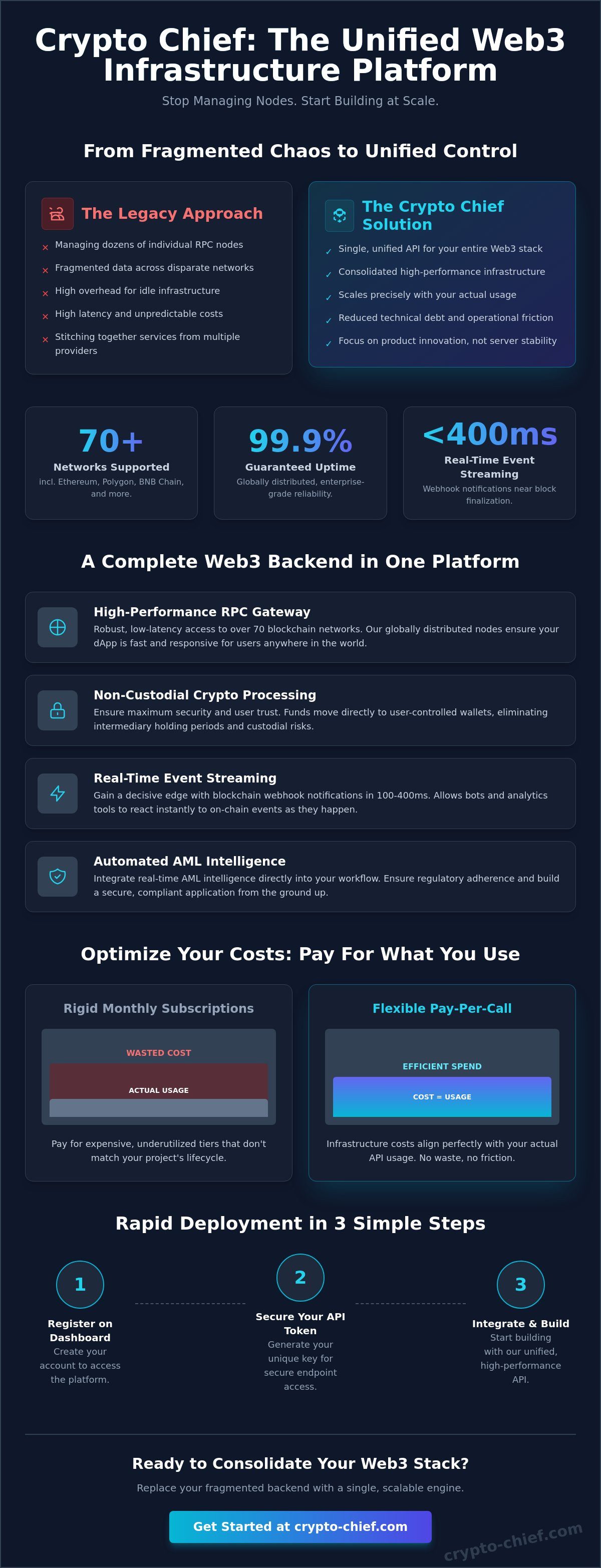
Maintaining individual RPC nodes for dozens of different blockchains is no longer a sign of technical maturity; it's a drain on your engineering resources and your bottom line. You've likely felt the friction of fragmented data across disparate networks and the recurring sting of high overhead for infrastructure that sits idle half the time. This Complete guide to Crypto Chief will show you how to consolidate your entire Web3 stack into a single, high-performance engine that scales precisely with your actual usage.
We'll demonstrate how to master a unified API that bridges over 70 networks, ensuring your developers spend less time on maintenance and more time on core logic. You'll learn to integrate non-custodial processing and real-time AML intelligence directly into your workflow while maintaining 99.9% uptime. By the end of this guide, you'll have the blueprint to replace expensive, underutilized tiers with a predictable, pay-per-call infrastructure that handles everything from sub-400ms event tracking to global compliance. It's time to stop managing nodes and start building at scale.
Key Takeaways
- Discover how to consolidate fragmented Web3 backend services into a single, high-performance infrastructure through this Complete guide to Crypto Chief.
- Learn to scale your dApp's throughput using a multichain RPC Gateway that handles high-volume transactions across 70+ networks with 99.9% uptime.
- Transition from rigid, expensive monthly subscriptions to a flexible pay-per-call model that aligns infrastructure costs with your actual API usage.
- Streamline your development workflow by integrating non-custodial crypto processing and automated AML intelligence directly into your existing environment.
- Follow a clear, step-by-step roadmap for rapid deployment, from initial dashboard registration to securing your first API token balance.
What is Crypto Chief? The Unified Web3 Infrastructure Platform
In the high-velocity Web3 environment of 2026, developers can't afford to waste cycles on the heavy lifting of backend maintenance. This Complete guide to Crypto Chief introduces a high-performance platform designed to serve as the structural backbone for decentralized applications. By providing a suite of multichain RPC nodes and unified APIs, it functions as a "silent partner" that handles the intricate logic of blockchain interaction. This allows your team to focus entirely on user experience and product innovation rather than server stability.
The platform is built on five core pillars: secure crypto processing, high-speed RPC access, data normalization across disparate chains, real-time event streaming, and AML intelligence. Why is this shift necessary now? In previous years, builders had to stitch together services from multiple fragmented providers, leading to high latency and unpredictable costs. 2026 demands a unified approach. Centralizing these tools reduces technical debt and eliminates the friction of managing dozens of individual node clusters. It's a grounded, utility-focused solution that emphasizes stability and performance over industry hype.
Breaking Down the Crypto Chief Ecosystem
The ecosystem is engineered for versatility and technical precision. At its heart lies the RPC Gateway, which supports over 70 networks, including Ethereum, Polygon, and BNB Smart Chain. Beyond mere connectivity, the platform offers non-custodial Crypto Processing, ensuring that funds move directly to user-controlled wallets without intermediary holding periods or custodial risks. For those requiring instant updates, the EventStream service delivers blockchain webhook notifications in real-time. This allows bots and analytics tools to react within 100 to 400 milliseconds of block finalization, providing a decisive edge in fast-moving markets.
The Shift Toward Infrastructure-as-a-Service (IaaS)
Moving to an IaaS model means you no longer need to be a DevOps specialist to run a global dApp. Crypto Chief manages the underlying hardware and network optimization, providing endpoints with a guaranteed 99.9% uptime. Whether your users are in Europe, Asia, or the Americas, the globally distributed infrastructure responds with consistent speed. By centralizing Web3 tools through a single, high-speed interface, the platform provides a level of structural integrity that legacy, fragmented setups simply cannot match. It's about building on a foundation that's already solved the hardest problems of scalability and logic, leaving you free to innovate at the application layer. This Complete guide to Crypto Chief will continue to explore how this efficiency translates into lower costs and higher performance for your project.
Core Services: From RPC Gateways to AML Intelligence
The architecture of a modern dApp relies on more than just basic connectivity; it requires a stack that handles data with surgical precision. This section of our Complete guide to Crypto Chief explores the specific tools that bridge the gap between raw blockchain data and actionable business logic. By centralizing these services, you eliminate the technical silos that typically slow down development cycles and inflate operational costs. It's a methodical approach to building that prioritizes structural integrity over experimental guesswork.
High-Performance RPC Gateway and Nodes
Reliable access to the ledger is the primary requirement for any Web3 project. The platform provides a robust gateway supporting major protocols like Ethereum, BNB Smart Chain, and Polygon. Global node distribution is critical here. By placing endpoints in proximity to your users, the platform minimizes request latency, ensuring that transactions are broadcast and data is retrieved in milliseconds. While dedicated nodes offer isolation, the shared gateway provides enterprise-grade performance at a fraction of the cost, handling high-volume requests without the maintenance burden of traditional clusters.
Non-Custodial Processing and AML Compliance
Security and regulatory adherence are no longer optional for serious builders. Implementing non-custodial crypto processing allows your business to accept payments while ensuring funds flow directly into your own infrastructure. You retain full control, removing the risk associated with third-party custodians. To complement this, the AML Intelligence API acts as a vigilant guardian. It automatically identifies high-risk addresses and traces fund origins, helping you prevent interaction with sanctioned wallets or illicit actors. This automation is essential for maintaining compliance without manually reviewing every transaction. You can register for an account to begin testing these security protocols in your own environment.
Beyond these pillars, the Unified API serves as a sophisticated translation layer. It normalizes data across different chains, so your frontend doesn't need unique logic for every new network you add. When you pair this with EventStream, you gain a real-time monitoring system that functions via webhooks. It sends instant alerts for smart contract events or specific wallet movements, allowing your application to respond to on-chain changes within 100 to 400 milliseconds of finalization. This Complete guide to Crypto Chief ensures you have the technical context needed to leverage these integrated services for maximum efficiency.
The Pay-Per-Call Model: Optimizing Your Web3 API Costs
Efficiency isn't just about writing clean code; it's about intelligent capital allocation. Most Web3 infrastructure providers follow a legacy SaaS billing structure that locks you into rigid monthly tiers. You pay for a set capacity, use a fraction of it, and lose the remainder at the end of the month. This Complete guide to Crypto Chief highlights a more logical, utility-based alternative. By utilizing a prepaid API token balance, you buy exactly what you need and use it on your own schedule. This system ensures your capital remains focused on product development rather than subsidizing a provider's idle server time.
Transparency is the cornerstone of this economic model. The platform provides real-time monitoring of token consumption, allowing you to see exactly which services are drawing from your balance at any given moment. This high-resolution data helps you identify inefficiencies in your application logic, such as redundant API calls or unoptimized event tracking. By treating infrastructure as a dynamic asset, you can adjust your burn rate based on actual user demand. It's a grounded approach that replaces guesswork with technical precision.
Prepaid Tokens vs. Monthly Subscriptions
The "unused capacity tax" is a significant hidden cost in the industry. Many RPC providers require you to commit to expensive monthly fees just to access higher rate limits, even if your traffic is intermittent. Crypto Chief eliminates this friction. Whether you are conducting 100 test calls or scaling to 1,000,000 production requests, your costs remain tied to your actual consumption. There are no sudden plan changes or forced upgrades when you hit a specific threshold. You manage your balance directly through the dashboard, providing a clear view of your remaining resources. This flexibility is vital for startups that need to scale rapidly without the burden of enterprise-tier overhead.
Cost Prediction and Budgeting
Predictability is essential for business architects and lead developers. You can consult the API documentation to understand the precise cost weight of each service, from basic RPC calls to advanced AML checks. This level of detail allows you to estimate your operational expenses with high accuracy before you even deploy. Unified billing further simplifies the process. Instead of managing separate invoices for Ethereum, Solana, and BNB Chain, all multichain interactions draw from a single token pool. This centralization reduces administrative overhead and makes it easier to track the ROI of individual dApp features. This Complete guide to Crypto Chief emphasizes that when infrastructure costs align with usage, the path to sustainable growth becomes much clearer.
How to Get Started: Integration and Setup Guide
Transitioning from the economic theory of pay-per-call models to a live, functional dApp requires a methodical approach. This Complete guide to Crypto Chief provides the technical roadmap for deploying your infrastructure with precision. By following a structured onboarding sequence, you can move from initial setup to production-ready status in under five minutes. It's a grounded process designed to eliminate the friction typically associated with multichain integration.
Your journey begins with account registration and a thorough overview of the centralized dashboard. Once your account is active, you'll need to secure your initial API token balance. This prepaid pool serves as the single source of truth for all your service interactions, whether you're querying the RPC Gateway or conducting AML checks. After funding your balance, you can generate specific API keys for each service. We recommend creating separate keys for processing, RPC access, and compliance to maintain a secure, modular architecture.
Before moving to production, you should validate your logic using the testnet faucet. This allows for risk-free testing of your request structures and error handling. The final step is deploying to production, where you'll benefit from global failover support. If a specific regional endpoint experiences high latency, the platform's distributed architecture automatically reroutes your traffic to the next available node, maintaining your application's structural integrity without manual intervention.
Developer-First Onboarding
Technical accessibility is a core pillar of the platform's philosophy. The documentation provides a library of quick-start code snippets that allow you to integrate high-speed endpoints into your environment immediately. It's vital to manage your credentials through environment variables rather than hardcoding them into your source files. This practice ensures your API keys remain secure while your application interacts with real-time blockchain webhooks. These webhooks allow your logic to react to on-chain events within 100 to 400 milliseconds, providing a seamless experience for your end users.
Testing and Validation
Reliability is built through rigorous verification. By utilizing faucets for integration testing, you can confirm that your dApp handles various chain responses correctly before real capital is involved. The dashboard provides detailed request logs, which are essential for debugging malformed queries or identifying latency bottlenecks. Best practices for modern builders include implementing exponential backoff for API rate limits, though the platform's high-performance engine is designed to handle enterprise-grade throughput without frequent throttling. Ready to scale your infrastructure? Create your developer account today and begin building on a stable foundation.
Why Crypto Chief is the Best Choice for Web3 Builders
Selecting an infrastructure partner is a strategic pivot point for any Web3 project. While legacy providers often trap developers in rigid, high-tier subscriptions that become prohibitively expensive as traffic grows, this Complete guide to Crypto Chief has shown a more scalable path. The platform prioritizes a developer-centric, non-custodial architecture, ensuring you retain total control over your funds without the success tax imposed by traditional SaaS models. It’s a grounded, stable solution for those who value technical autonomy and performance over industry hype.
The platform's 99.9% uptime isn't just a metric; it's a guarantee of structural integrity during volatile market conditions. When global traffic spikes occur, the distributed node network absorbs the load without requiring manual reconfiguration or emergency plan upgrades. This reliability allows your team to focus on the application layer while the backend remains a silent, powerful partner. By centralizing your multichain needs, you eliminate the friction of managing disparate service providers and reduce the technical debt that usually accumulates during rapid scaling.
Security and Privacy at the Core
Non-custodial processing is the foundation of decentralized security. By ensuring funds flow directly to your own infrastructure, you eliminate third-party risk and simplify compliance audits. The platform's handling of request metadata ensures that your business intelligence remains private, building a transparent relationship with your users through verifiable on-chain interactions. This builder-centric ethos suggests that the platform is run by people who understand the practical challenges of the field, offering a steady, knowledgeable guide for your most sensitive operations.
Future-Proofing Your Application
The Web3 landscape is constantly evolving, with new Layer 2 and Layer 1 networks emerging every quarter. A unified partner allows you to expand into these new ecosystems without the friction of integrating a new provider. By leveraging AML Intelligence, you stay ahead of global regulatory shifts while maintaining a lean, high-performance stack. This Complete guide to Crypto Chief concludes that for builders focused on long-term sustainability, a utility-based engine is the only logical choice for the 2026 landscape. It's about building on a foundation that's already solved the hardest problems of scalability and logic.
Building the Future of Decentralized Infrastructure
The era of managing fragmented, high-cost RPC clusters is ending. This Complete guide to Crypto Chief has detailed how a unified, developer-centric platform can transform your operational efficiency. By centralizing your multichain interactions through a single API and leveraging a non-custodial architecture, you maintain total control over your assets while eliminating the technical debt of legacy systems.
You've seen how the pay-per-call model and prepaid API tokens provide the granular cost control necessary for sustainable growth. With support for over 70 protocols and enterprise-grade performance, your application is no longer limited by the rigid constraints of traditional tiered subscriptions. It's time to stop troubleshooting infrastructure and start delivering high-performance logic to your global users.
Start building with Crypto Chief's pay-per-call API today. The tools for global scale are at your fingertips, and we're ready to act as your silent, powerful partner in the decentralized space. Your next big innovation deserves a foundation that is as stable as it is scalable.
Frequently Asked Questions
What is the pay-per-call pricing model used by Crypto Chief?
Crypto Chief utilizes a utility-based pricing system where users only pay for the specific API calls they execute. Instead of fixed monthly tiers, you purchase a prepaid token balance that draws down as you interact with the RPC Gateway or Unified API. This model eliminates the cost of unused capacity and allows your infrastructure expenses to scale perfectly with your actual traffic.
Is Crypto Chief a custodial or non-custodial service provider?
The platform is strictly a non-custodial service provider. This means you maintain exclusive control over your private keys and merchant funds at all times. By acting as a technical bridge rather than a financial intermediary, the infrastructure ensures that your security remains decentralized and your assets aren't at risk of custodial failure.
Which blockchains are supported by the Crypto Chief RPC Gateway?
The RPC Gateway supports more than 70 different blockchains, providing a massive reach for multichain developers. Major networks including Ethereum, BNB Chain, Polygon, Solana, Tron, TON, and Bitcoin are fully integrated. This extensive support allows you to manage diverse assets through a single, high-performance interface without switching providers.
How do I integrate the Crypto Processing API into my website?
Integration involves generating an API key from your dashboard and connecting it to your backend using our standardized endpoints. You'll use webhooks to receive real-time payment confirmations, which ensures your application logic updates immediately upon transaction finalization. This Complete guide to Crypto Chief recommends testing your flow on a testnet before moving to live production.
Can I use Crypto Chief for AML compliance and risk assessment?
Yes, the AML Intelligence API is designed specifically for real-time risk detection and compliance. It automatically scans addresses for links to sanctioned entities or illicit activity, providing a risk score that helps you decide whether to proceed with a transaction. This tool is essential for builders who need to meet global regulatory standards without manual oversight.
What happens if my API token balance runs out?
If your token balance reaches zero, API requests will be paused until you replenish your account. To prevent service interruptions, the dashboard provides real-time monitoring and low-balance alerts. You can instantly purchase additional tokens to keep your dApp's infrastructure running smoothly during periods of high demand.
Does Crypto Chief offer real-time transaction monitoring?
Real-time monitoring is delivered through the EventStream service, which uses webhooks to push data directly to your application. This service captures smart contract events and wallet movements within 100 to 400 milliseconds of block finalization. It's a powerful tool for developers building trading bots, analytics dashboards, or instant notification systems.
How does the Unified API simplify multichain data retrieval?
The Unified API normalizes on-chain data into a consistent format, regardless of the underlying blockchain's specific architecture. This means your frontend doesn't need custom logic for every new network you add. Using this Complete guide to Crypto Chief as a reference, you can streamline your codebase and reduce the technical debt associated with multichain development.