
The era of the heavy enterprise compliance contract is ending, replaced by the need for surgical, API-first precision. Choosing between elliptic vs aml intelligence isn't just about comparing feature lists; it's about deciding whether your dApp should be built around a legacy fortress or a high-performance engine. You've likely felt the friction of high entry barriers and the relentless drain of alert fatigue from false positives that slow your deployment to a crawl. It's frustrating to watch your development velocity stall because your compliance stack can't keep pace with your RPC infrastructure.
This technical deep-dive compares enterprise-grade blockchain analytics with the agile, developer-centric approach of modern AML intelligence. You'll learn how to achieve real-time risk scoring for every transaction without the burden of an annual contract or complex implementation. We examine the mechanics of tracing funds across multiple chains and detail how a scalable, pay-per-call model integrates into your existing workflow. By the end of this analysis, you'll have a clear framework for selecting a partner that supports global reach and structural integrity for the 2026 regulatory environment.
Key Takeaways
- Understand why static blacklists are obsolete in 2026 and how behavioral heuristics provide superior, real-time transaction monitoring for modern dApps.
- Evaluate the structural differences between elliptic vs aml intelligence to determine if a legacy enterprise contract or a flexible, developer-centric API fits your scaling needs.
- Discover how machine learning identifies complex money laundering patterns, such as peeling chains, across diverse multichain environments to prevent illicit fund movement.
- Learn to automate risk management workflows using event-driven webhooks and high-performance RPC infrastructure instead of inefficient manual polling.
- Explore the advantages of a pay-per-call model that allows builders to deploy institutional-grade security without the overhead of heavy internal implementation.
The Evolution of Blockchain Compliance: Why Static Risk Lists Fail in 2026
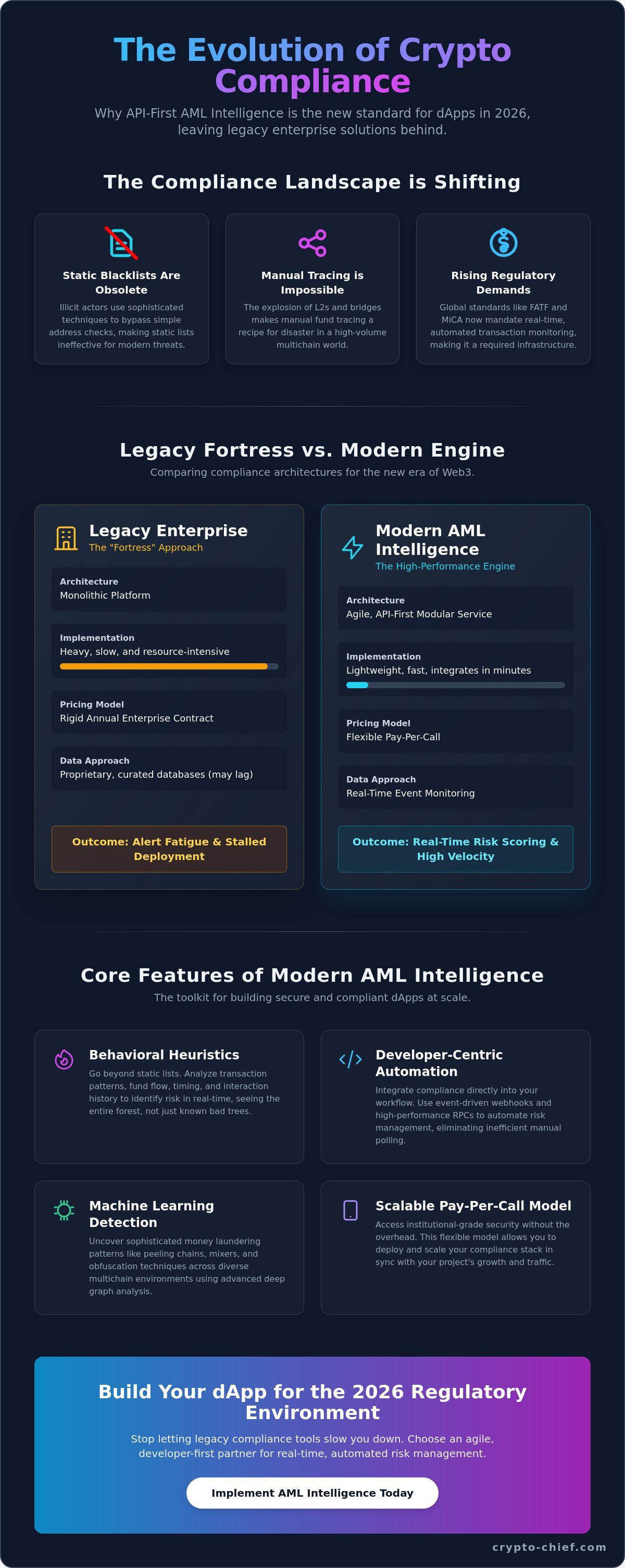
Static blacklists are a relic of the past. In 2026, illicit actors use sophisticated techniques that bypass simple address checks, requiring a more nuanced approach to security. Modern compliance requires behavioral heuristics that analyze transaction patterns rather than just static identities. This is where the debate of elliptic vs aml intelligence becomes critical for architects. While legacy tools often focus on known bad actors, modern intelligence identifies risk through anomalies in flow, timing, and interaction history. It's about seeing the forest, not just the trees.
Effective risk scoring depends on deep graph analysis to pierce the veil of pseudonymity. Public ledgers are transparent, yet their complexity grows with every new protocol. By utilizing advanced blockchain analysis, platforms can trace the origin of funds through hundreds of intermediate hops. This shift from reactive reporting to real-time, automated transaction monitoring is no longer optional. Global standards like FATF and MiCA have transformed these technical capabilities into mandatory infrastructure requirements for any serious Web3 project. Projects that fail to automate these checks risk heavy fines and operational shutdowns in an increasingly regulated market.
The Problem with Manual Compliance in a Multichain World
The explosion of Layer 2 solutions and sidechains has fractured the landscape of fund tracing. Tracing a single asset across multiple bridges and protocols manually is a recipe for disaster. Manual verification is impossible when dealing with high-volume dApps processing thousands of events per second. You need a system that scales with your traffic and understands the nuances of cross-chain movement. Automated AML Intelligence is a real-time risk assessment engine for blockchain event streaming. It ensures that every deposit and withdrawal is screened against current risk data without human intervention, maintaining your platform's integrity at scale.
Regulatory Pressure vs. Technical Feasibility
Balancing user privacy with the Travel Rule and KYC requirements is a constant challenge for developers. You shouldn't have to build these complex bridges yourself. Infrastructure providers now bridge the gap between raw on-chain data and actionable risk scores by delivering pre-filtered intelligence. This allows you to maintain compliance without compromising the user experience or slowing down your release cycle. When evaluating elliptic vs aml intelligence for your stack, consider how each handles the pressure of evolving global mandates. It's about finding a partner that handles the heavy lifting of data aggregation. For a deeper look at these mechanics, review our Crypto Transaction Risk Assessment Guide. By offloading the complexity of risk scoring, you can focus on building the core features of your dApp while remaining audit-ready.
Elliptic vs. AML Intelligence: Comparing Compliance Architectures
The architectural divide between legacy incumbents and modern utilities defines the current state of blockchain security. When evaluating elliptic vs aml intelligence, you're essentially choosing between a traditional enterprise software model and an agile, API-first infrastructure. Elliptic has long been the standard for Tier-1 financial institutions, offering a suite of tools designed for deep forensic investigations and banking-grade reporting. However, this legacy approach often comes with a "heavy implementation" hurdle. Deploying such a system typically requires significant internal resources, long sales cycles, and a rigid integration process that can stall a fast-moving development team.
Modern AML intelligence operates as a modular service rather than a monolithic platform. It's designed to sit directly alongside your RPC nodes, functioning as a silent partner that scores risk in the background. While legacy providers rely heavily on proprietary, curated databases that may lag behind the latest on-chain movements, modern solutions prioritize real-time event monitoring. The Bank for International Settlements highlights the increasing need for sophisticated anti-money laundering compliance for cryptoassets to mitigate the risks posed by decentralized protocols. By choosing an infrastructure that mirrors the speed of the blockchain itself, you ensure that your risk assessments are based on the most current data available.
Enterprise Contracts vs. Pay-Per-Call Flexibility
The business models of these two approaches couldn't be more different. Enterprise providers generally demand annual contracts with high minimum monthly commitments, which can create a prohibitive barrier to entry for startups. In contrast, Crypto Chief utilizes a "pre-paid token" model for its AML services. This pay-per-call flexibility allows developers to scale from a minimal viable product to a global enterprise without being locked into expensive, underutilized capacity. It's a logical choice for builders who value capital efficiency. If you're looking to secure your protocol without the overhead of an enterprise sales process, you can start with integrated AML intelligence today.
Technical Depth: From Wallet Profiling to Transaction Tracing
Both platforms excel at entity resolution, which is the process of connecting anonymous wallet addresses to real-world actors like exchanges or darknet markets. The real differentiator lies in the depth of transaction tracing. For effective risk management, you must determine how many "hops" back your assessment should go. Tracing funds through three or four layers of transactions is often necessary to identify sophisticated laundering patterns. Accuracy across multiple networks is also paramount. Modern compliance stacks must provide consistent, high-fidelity data across a broad range of assets, including Ethereum, BNB Chain, Polygon, and Tron, to ensure no blind spots remain in your monitoring strategy.
Data Quality and Multichain Risk Detection Capabilities
Data integrity is the bedrock of any compliance strategy. When comparing elliptic vs aml intelligence, the primary technical differentiator is how each engine handles the raw volatility of on-chain data. Legacy providers often rely on curated, proprietary databases that, while extensive, can suffer from periodic lag during high network congestion. Modern AML intelligence utilizes machine learning to identify sophisticated money laundering patterns like "peeling chains" in real-time. This proactive approach allows developers to map a complex risk landscape that includes sanctioned entities, darknet markets, and privacy mixers with high-fidelity accuracy.
Reliable multichain coverage is no longer limited to Ethereum. Your infrastructure must provide consistent risk detection across non-EVM chains like Bitcoin and TON to ensure global structural integrity. Compliance for non-custodial processing depends on low-latency scoring; a delay of even a few seconds can disrupt a seamless user experience or lead to the processing of illicit funds. Adhering to FinCEN's Regulations requires a robust system that stays ahead of evolving obfuscation techniques. For startups, the cost-to-compliance ratio is a vital metric. While enterprises might absorb the high overhead of legacy data curation, agile builders require a high-performance engine that offers institutional-grade security on a scalable, utility-based budget.
Identifying High-Risk Transaction Patterns
Exposure to mixers like Tornado Cash creates immediate red flags for wallet risk scores. It's not just about direct interaction. Understanding indirect exposure is critical for automated compliance workflows, as funds often move through multiple hops before reaching your dApp. You need to distinguish between a user who accidentally received tainted funds and a professional launderer. Our Blockchain Analytics API for AML provides the granular data necessary to make these distinctions without manual intervention. By automating this logic, you remove the friction of false positives that often plague less sophisticated systems.
Unified Data Normalization for Compliance
Building separate compliance logic for every chain you support is inefficient and prone to error. A Unified API simplifies risk detection by normalizing multichain data into a single, consistent format. This structural consistency ensures that your risk scoring remains identical whether the transaction occurs on Polygon or BNB Smart Chain. Data normalization prevents the creation of compliance silos in multichain applications, allowing your security team to monitor the entire ecosystem through a single pane of glass. This unified approach maintains uptime and logic across disparate protocols, ensuring your platform remains a stable foundation for global finance.
Developer Experience (DX): Integration Workflows and API Performance
Success in the Web3 space is often measured by development velocity. When weighing elliptic vs aml intelligence, the developer experience (DX) serves as a major deciding factor for technical architects. Traditional enterprise solutions frequently rely on static PDF integration guides and manual onboarding processes that can take weeks to navigate. In contrast, modern AML intelligence is built on a foundation of interactive API docs that allow for immediate testing and deployment. This accessibility drastically reduces the "Time to First Risk Score," enabling a developer to move from initial registration to a production-ready environment in hours rather than months.
Performance at scale is equally critical. A compliance stack must handle thousands of concurrent risk checks without hitting rate-limiting bottlenecks that could paralyze your application. While legacy systems often struggle with high-frequency transaction volumes during periods of network congestion, agile API utilities are engineered for high-performance throughput. This ensures that your transaction flow remains fluid and compliant, regardless of market volatility. By prioritizing a developer-centric workflow, you eliminate the friction that typically accompanies institutional-grade security. It's about empowering the builder to focus on core logic rather than infrastructure maintenance.
Automating the Alert Queue
Moving from polling to event-driven compliance is the only way to scale modern dApps effectively. Utilizing EventStream allows you to trigger AML checks automatically on every incoming transaction via webhooks. This setup ensures that your system reacts instantly to new on-chain events without the overhead of constant API requests. You can set custom risk thresholds to minimize false positives, ensuring that only high-risk activities flag your attention. For "gray area" transactions that fall just outside your automated parameters, a well-defined workflow for manual review provides the final layer of defense without slowing down legitimate users.
The Infrastructure Advantage: Integrated RPC and AML
Latency is the enemy of a good user experience. Bundling RPC Gateway services with AML intelligence creates a streamlined transaction flow that reduces round-trip times. When your node provider and compliance engine live in the same ecosystem, you eliminate the need to coordinate between multiple API providers to maintain a compliant flow. Consider a non-custodial payment gateway processing Ethereum and Bitcoin payments securely. By integrating these services, the gateway can verify the source of funds and broadcast the transaction through a single, secure pipeline. This unified approach provides a significant structural advantage over fragmented legacy stacks.
Ready to streamline your compliance workflow? Create a free account to access our high-performance AML Intelligence API and start scoring transactions in minutes.
Implementing Crypto Chief’s AML Intelligence: Scalable Risk Management
Deploying a robust compliance stack shouldn't act as a blockade to your development cycle. When deciding between elliptic vs aml intelligence, the final metric for many Web3 architects is the ease of execution and long-term scalability. Crypto Chief provides a unified, high-performance infrastructure that treats compliance as a core component of the tech stack rather than an afterthought. By integrating AML intelligence directly into your existing workflow, you ensure that every transaction is screened against the most current risk data without sacrificing the performance of your dApp.
The pay-per-call model is a fundamental shift in how security is consumed. It empowers builders to implement institutional-grade security on a startup budget, eliminating the need for the six-figure annual commitments often required by legacy providers. This modular approach allows you to future-proof your compliance strategy as regulations like MiCA and the GENIUS Act evolve. You can swap or upgrade individual components of your stack without a complete overhaul. It's a strategy designed for the 2026 regulatory environment, where agility and precision are the primary drivers of success. By offloading the complexity of data normalization and risk scoring to a specialized engine, you maintain the structural integrity required for global operations.
Why Builders Choose Crypto Chief over Legacy Providers
The primary advantage lies in the synergy of a single high-performance service. While legacy incumbents focus almost exclusively on large-scale banking institutions, Crypto Chief understands the practical challenges of the developer market. You benefit from a unified ecosystem where your RPC Gateway, AML Intelligence, and EventStream work in concert. This integration provides global uptime and low-latency performance, which are the foundations of any enterprise-ready dApp. Our "silent partner" philosophy ensures we remove technical friction in the background. You focus on building innovative features while we handle the heavy lifting of real-time risk management.
Getting Started with Automated Risk Scoring
Moving from a manual process to automated risk scoring is a straightforward transition. You can go from registration to your first API call in just a few minutes. We've designed our environment to be as accessible as possible for builders of all sizes. You can leverage our faucet and various testnet environments to conduct risk-free integration testing before going live. This ensures your thresholds and webhook triggers are perfectly tuned for your specific use case.
- Create your account and generate a secure API key.
- Select the target chains from our RPC Gateway list.
- Configure your risk scoring parameters via our Unified API documentation.
- Test your integration using testnet assets to ensure seamless event-driven alerts.
Don't let legacy hurdles slow your growth. Strengthen your dApp’s compliance with Crypto Chief’s AML Intelligence today.
Future-Proofing Your Compliance Architecture
Mastering the complex landscape of 2026 requires a shift from reactive security to proactive, real-time intelligence. You've seen how behavioral heuristics and deep graph analysis outperform static blacklists in a multichain environment. The decision between elliptic vs aml intelligence comes down to your project's need for speed, scalability, and technical flexibility. By choosing an API-first approach, you eliminate the implementation hurdles of legacy systems and gain a silent, powerful partner for your growth.
Building on a unified Web3 infrastructure platform ensures that your RPC nodes and compliance tools work in perfect synchronization. This structural integrity is backed by global multichain support and a transparent pay-per-call billing model that respects your capital efficiency. You don't have to compromise between institutional-grade security and developer velocity. Focus on your core innovation while maintaining a stable, compliant foundation that scales with your ambition. Integrate AML Intelligence into your dApp now and build with the confidence of an industry leader. The tools for global reach are ready when you are.
Frequently Asked Questions
What is the primary difference between Elliptic and Crypto Chief’s AML Intelligence?
The core distinction lies in the delivery model and target audience. Elliptic provides a legacy enterprise platform designed for deep forensics and institutional reporting, often requiring annual contracts. Crypto Chief offers a modular, API-first utility built for developers who need high-performance, real-time risk scoring. When comparing elliptic vs aml intelligence, builders usually favor the latter for its lack of heavy implementation hurdles and its agile, pay-per-call billing structure.
Can I use AML Intelligence for non-custodial payment processing?
Yes, the service is specifically engineered for non-custodial environments. It allows you to screen incoming wallet addresses or outgoing transactions for risk without ever taking custody of the user's funds. By integrating the API into your payment gateway, you can automatically block or flag tainted assets before they interact with your smart contracts, maintaining compliance while preserving the decentralized nature of your application.
Does pay-per-call pricing provide the same level of security as a monthly subscription?
The security and data quality are identical regardless of the billing model. Pay-per-call pricing simply democratizes access to institutional-grade security by removing the need for high monthly minimums. You receive the same machine-learning-driven risk scores and behavioral heuristics used by larger entities. This model ensures that startups can maintain the same structural integrity as enterprises without overpaying for unused capacity during their early growth phases.
Which blockchains are supported for automated risk detection?
The platform provides extensive multichain coverage across both EVM and non-EVM ecosystems. Supported networks include Ethereum, BNB Smart Chain, Polygon, and Tron, as well as Bitcoin and TON. This broad reach ensures that your compliance logic remains consistent across the most active protocols in the industry. The Unified API normalizes data from these disparate chains into a single format, preventing the need for custom code for every individual network.
How do I integrate AML risk scoring into my existing RPC setup?
Integration is achieved through a simple API call that sits parallel to your RPC requests. You can trigger a risk check whenever your node detects a new transaction event. For a more automated workflow, you can use EventStream to receive webhooks that push risk data directly to your backend. This eliminates the need for manual polling and ensures that your system reacts to high-risk events with minimal latency, keeping your infrastructure lean and efficient.
Is Crypto Chief’s AML Intelligence compliant with MiCA regulations?
The service provides the technical data required to satisfy the risk-based approach mandated by MiCA and other global frameworks. It identifies sanctioned entities, mixers, and high-risk clusters, allowing you to perform the necessary due diligence on crypto-asset transfers. While the platform provides the intelligence, your project remains responsible for implementing the specific internal policies required by your local regulator. It acts as the engine that powers your regulatory compliance program.
What happens if a transaction is flagged as high-risk by the API?
The API returns a detailed risk score and a set of category flags, such as "Darknet Market" or "Mixer Interaction." Your application logic then determines the outcome based on your custom thresholds. You can choose to automatically reject the transaction, freeze the user's local account for manual review, or simply log the event for your compliance team. This flexibility allows you to minimize false positives while maintaining a robust defense against illicit activity.
Can I test the AML Intelligence API before committing funds?
Testing is available immediately upon registration through our developer sandbox. You can use our faucet and testnet environments to simulate high-risk transactions and verify your webhook triggers without any financial risk. This allow you to refine your risk parameters and ensure the integration is seamless before moving to a production environment. It's a builder-centric approach that prioritizes stability and performance from the first line of code.