
What if the 99.9% uptime guarantee you're paying for is actually the single biggest risk to your dApp’s survival in 2026? You've likely felt the sting of revenue loss when your supposed high availability rpc nodes fail to deliver during peak congestion, or the friction caused by inconsistent data from out-of-sync endpoints. It's frustrating to invest in expensive "pro" tiers that lack the structural integrity your users demand. We understand that as an architect, you need a foundation that's both elite in its performance and logical in its delivery.
This guide provides the technical blueprint to master resilient node architecture, ensuring your infrastructure remains responsive and cost-efficient under any load. You'll learn how to eliminate downtime by leveraging a unified RPC Gateway and real-time EventStream, moving away from rigid subscriptions toward a scalable pay-per-call model. We'll detail the exact steps to build a global, low-latency network that integrates AML Intelligence directly into your workflow, providing a seamless experience for your users and a predictable bottom line for your business.
Key Takeaways
- Understand why 99.99% uptime has become the non-negotiable benchmark for Web3 infrastructure in 2026 to prevent catastrophic revenue loss.
- Master the architecture of high availability rpc nodes by deploying node clustering and failover protocols that maintain data consistency during chain reorgs.
- Evaluate the total cost of ownership by contrasting the heavy DevOps overhead of self-hosted clusters with the efficiency of pay-per-call managed gateways.
- Implement a dual-layer resilience strategy that combines a globally redundant primary gateway with sophisticated client-side failover logic for zero-downtime performance.
- Streamline your development stack by integrating RPC, AML Intelligence, and real-time EventStream through a single, high-performance multichain interface.
The Architecture of High Availability RPC Nodes in 2026
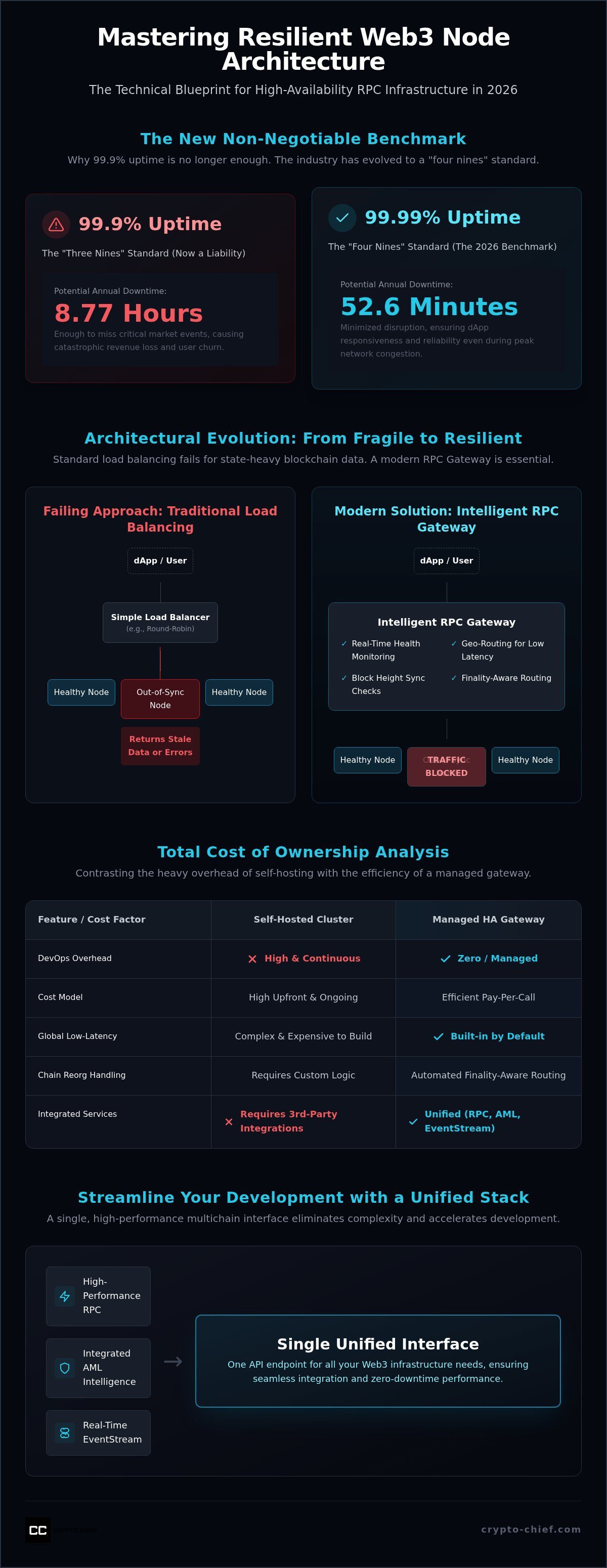
In the context of decentralized applications, high availability represents the structural resilience of the infrastructure layer. While standard private or public endpoints often rely on a single server or a basic failover, high availability rpc nodes operate as a sophisticated cluster of redundant instances. By 2026, the industry has shifted from the "three nines" (99.9%) to the "four nines" (99.99%) standard. This evolution is driven by the rise of high-frequency DeFi and high-throughput chains like TON or Celestia, where even a few minutes of downtime results in massive slippage or missed liquidations. Traditional providers often struggle with the rapid state changes and block production speeds of these newer networks, making a robust architectural approach essential for maintaining a competitive edge in a saturated market.
Why Traditional Load Balancing Fails for Web3
Standard load balancing, such as round-robin DNS, works for static websites but fails for state-heavy blockchain data. If a load balancer routes a request to a node that is even three blocks behind the tip, the dApp may return "stale" data to the user, causing transaction failures or incorrect balance displays. Intelligent request routing must account for block height and synchronization status in real-time. High-performance RPC gateways solve this by monitoring the health of every node in the cluster, ensuring that requests only reach fully synced instances. Geo-routing further optimizes this by directing traffic to the closest geographic region, which is critical for maintaining low latency across a global user base. It's the difference between a responsive interface and a lagging, unusable application that frustrates your core audience.
The Consequences of Low Availability
Poor availability isn't just a technical glitch; it's a financial liability. When an RPC endpoint returns "Error 429" or "Node Out of Sync" during a market surge, users lose the ability to swap assets or protect their positions. This leads to immediate churn and long-term brand damage. High Availability is a structural commitment to redundancy across multiple geographic regions. Beyond the financial impact, inconsistent data returns can cause logic errors in smart contract interactions, leading to unpredictable dApp behavior. In a competitive Web3 market, reliability is your most valuable feature. Builders need infrastructure that acts as a silent partner, handling the complexity of global uptime while they focus on their core product logic.
Engineering Redundancy: How High Availability RPCs Handle Chain Reorgs
True redundancy requires more than just a backup server. It involves active-active clustering where high availability rpc nodes continuously synchronize with the network tip. When a node falls behind or loses consensus, the system must automatically divert traffic to healthy peers without dropping a single packet. This real-time health monitoring prevents the "stale data" trap where a lagging node returns block heights that no longer exist on the canonical chain. It's a silent, background process that ensures your dApp never presents a fragmented reality to its users.
Failover protocols must be instantaneous. By using sophisticated load balancers that perform deep-packet inspection of RPC responses, architects can filter out inconsistent results before they reach the client side. This ensures that your dApp remains a reliable source of truth, even during periods of extreme network volatility. If you're looking to simplify this complexity, you can explore how a managed RPC Gateway handles these transitions seamlessly.
Solving the Chain Reorganization Problem
Chain reorganizations occur when the network discards a previously accepted block in favor of a longer or more weighted chain. For developers, this creates a "flip-flop" effect in data that can break application logic. High availability rpc nodes mitigate this through finality-aware routing. This logic prioritizes nodes that have reached a specific confirmation depth or follow the canonical state signals. Crypto Chief ensures your RPC calls always return the canonical state by managing this logic across its entire cluster, shielding your code from the messiness of low-level chain forks.
Latency Optimization Through Edge Computing
Uptime is meaningless if the response time is too high. Deploying nodes at the network edge minimizes the physical distance between the user and the data, reducing the "time-to-first-byte" significantly. While HTTP/2 is excellent for standard request-response cycles due to its multiplexing capabilities, WebSockets remain the gold standard for persistent, low-latency connections required by real-time dashboards. Whether you're building on Ethereum or scaling on TON, maintaining a single, high-performance framework across all chains removes the friction of managing disparate infrastructure providers. This unified approach allows you to focus on your product while the background engine handles the global reach.
Managed HA vs. Self-Hosted: A Cost and Performance Comparison
Deciding between building or buying your infrastructure is a pivotal choice for any Web3 architect. While self-hosting offers total control, the hidden financial and operational burdens often outweigh the benefits for scaling dApps. To maintain high availability rpc nodes, you must account for hardware costs, egress fees, and the substantial human capital required for 24/7 maintenance. Many teams find that the complexity of managing global redundancy quickly shifts focus away from their core product development.
The TCO of Self-Hosted RPC Infrastructure
Engineering overhead is often the most significant silent cost. Achieving the "four nines" standard requires a dedicated DevOps rotation capable of resolving node desynchronization or hardware failures at any hour. Beyond salaries, the egress fees charged by major cloud providers for blockchain data can be unpredictable and punitive. If your internal team spends more time debugging peer-to-peer connectivity than shipping features, it's time to explore our RPC Gateway for a managed, high-performance alternative. Outsourcing this complexity allows you to leverage a global engine that's already optimized for structural integrity and speed.
Pay-Per-Call: The Modern Standard for 2026
Traditional monthly subscription tiers often result in a "usage gap." You end up paying for a "Pro" tier with a high request ceiling, yet much of that capacity goes unused during periods of low network activity. In 2026, the pay-per-call model has emerged as the most logical solution for variable workloads. By using prepaid API tokens, you only pay for the exact resources your dApp consumes. This model eliminates the dead-weight costs associated with rigid plans and scales effortlessly with actual user demand. When combined with techniques like RPC request batching, your infrastructure becomes a lean, high-performance asset rather than a growing liability.
When evaluating providers, scrutinize the Service Level Agreement (SLA) for precision. A true high-availability contract should define uptime based on successful request delivery rather than mere server "up" status. Look for guarantees that cover both latency thresholds and data consistency across all supported regions. A reliable partner doesn't just provide an endpoint; they provide a guarantee that your dApp remains online and responsive regardless of global traffic spikes. Optimizing high availability rpc nodes for enterprise scale requires a shift from fixed overhead to a model that respects your actual usage data.
Strategic Implementation: Designing for Zero-Downtime Web3 Apps
Implementing a zero-downtime strategy is a methodical process that begins with your primary infrastructure choice. You need a partner that provides high availability rpc nodes with a proven track record of global redundancy. This selection acts as your first line of defense, but true resilience requires additional layers of logic within your application's middleware. By combining a reliable gateway with sophisticated client-side handling, you create a system that's virtually immune to isolated network failures.
- Primary Gateway Selection: Choose a provider that unifies access across multiple regions to ensure structural integrity.
- Client-Side Logic: Build retry mechanisms that trigger immediately upon detecting a timeout or malformed response.
- Real-Time Analytics: Use monitoring tools to track the response times and success rates of every RPC call to identify bottlenecks early.
- WebSocket Integration: Leverage persistent streams for mission-critical events, such as liquidation triggers, that require instant notification.
Multi-Provider Fallback Strategies
Configuring your dApp to switch providers in under 100ms is essential for maintaining a seamless user experience during a primary outage. A Unified API simplifies this by abstracting the differences between chain-specific implementations, allowing for smooth multi-chain fallbacks without rewriting your core logic. Automated failover logic should prioritize latency and block height over simple connectivity. This ensures that your backup doesn't just connect, but actually provides the most recent and fastest data available to your users.
Security and Compliance in HA Environments
High availability must coexist with rigorous compliance standards to protect your platform's longevity. Integrating AML risk detection into your high availability rpc nodes workflow allows you to screen transactions without introducing significant latency. This is particularly vital for non-custodial processing, which must remain active and compliant even during network upgrades or hard forks. You can learn how AML Intelligence integrates with your RPC calls to maintain a secure environment without sacrificing performance. Maintaining this balance ensures that your dApp isn't just online, but also operates within the necessary regulatory frameworks of 2026.
Ready to build a resilient dApp on a foundation of logic and uptime? Register your account today to access our high-performance RPC Gateway and start scaling with confidence.
Scaling with Crypto Chief: High-Performance RPC Without the Overhead
Offloading the complexities of high availability rpc nodes allows your team to focus exclusively on product innovation and user experience. Crypto Chief provides an enterprise-ready foundation that removes the friction of manual server management and continuous node synchronization. By utilizing a globally distributed network, we deliver the structural integrity required for the most demanding dApps without the internal DevOps burden. You don't need to build the engine; you just need to drive it. Logic and uptime are the true drivers of Web3 success.
Unified Infrastructure for Global dApps
Managing multiple chains often leads to provider sprawl and fragmented application logic. Our RPC Gateway simplifies this by offering a single, high-performance endpoint for Ethereum, BNB Smart Chain, Polygon, and TON. This unified approach ensures that your high availability rpc nodes remain consistent across every supported network. When you combine this with our real-time EventStream, your user interface becomes more responsive, reacting to on-chain changes the moment they occur. You can Register for high availability RPC access today and move from setup to your first HA call in minutes. Scale with confidence.
The Pay-Per-Call Advantage for Enterprise
Fixed monthly costs are often inefficient for growing businesses with variable traffic. Our pay-per-call model provides a logical alternative, allowing for transparent budgeting through prepaid token balances. You won't have to worry about the "usage gap" or paying for capacity that sits idle during off-peak hours. This model scales with your actual usage, providing elite performance that remains cost-effective as you expand your user base. If your project has specific volume requirements or requires a tailored approach, Contact our team for a custom high-availability setup to discuss your specific architecture.
Reliability shouldn't be a luxury. By integrating RPC, AML Intelligence, and EventStream into a single, cohesive stack, we provide a high-performance engine that acts as your silent, powerful partner. It's a sophisticated solution designed by builders who understand the practical challenges of the field. Our platform ensures your dApp remains online, responsive, and secure, regardless of the network load or global traffic spikes. Choose a partner that values stability as much as you do.
Future-Proofing Your Web3 Infrastructure
Building for the decentralized future requires a shift from reactive maintenance to proactive architectural integrity. We've explored how the transition to a 99.99% uptime standard and the adoption of pay-per-call models are redefining what it means to be a professional developer in 2026. By offloading the burden of node clustering and synchronization to a dedicated gateway, you reclaim the time needed to refine your dApp’s core logic and user experience. Logic and performance now dictate that high availability rpc nodes should be accessible, scalable, and financially transparent.
The era of overpaying for rigid subscription tiers is over. With support for over 10 major blockchains and a commitment to structural stability, the right infrastructure partner acts as a silent engine for your global reach. It's time to stop fighting your infrastructure and start building on a foundation that understands the practical challenges of the field. Your users deserve a responsive, always-on interface, and you deserve a partner that provides it without the DevOps headache.
Ready to eliminate downtime and optimize your overhead? Deploy High Availability RPC Nodes with Crypto Chief today and experience the efficiency of a 99.99% uptime guarantee combined with pay-per-call flexibility. Your most ambitious builds are finally supported by the reliability they require.
Frequently Asked Questions
What makes an RPC node "high availability" compared to a standard node?
An RPC node achieves high availability through a redundant cluster architecture that eliminates single points of failure. While a standard node operates as an isolated instance, high availability rpc nodes utilize intelligent load balancers to route traffic only to healthy, fully synchronized peers. This structural commitment ensures that if one instance fails or falls behind the network tip, your requests are seamlessly redirected without interrupting the user experience or returning stale data.
How does Crypto Chief handle chain reorganizations in its RPC gateway?
Crypto Chief manages chain reorganizations by implementing finality-aware routing within its RPC Gateway. The system continuously monitors every node for consensus alignment, ensuring that requests only reach instances following the canonical chain. By filtering out data from discarded blocks, the gateway prevents the "flip-flop" effect often seen during network volatility. This logic provides a stable, reliable state for your dApp's critical smart contract interactions and ensures data consistency across all calls.
Does high availability eliminate the need for a backup RPC provider?
While a high-availability setup provides a 99.99% uptime benchmark, elite architects often maintain a secondary provider for extreme resilience. High availability significantly reduces the likelihood of failure, but client-side failover logic acts as a final safety net during unprecedented network-wide events. Combining a robust primary gateway with a lightweight backup ensures your application remains online and responsive under the most strenuous conditions imaginable across the global Web3 landscape.
Can I use high availability RPC nodes for Solana and TON workloads?
High-performance clusters are essential for managing the high throughput and rapid block times of networks like TON. High availability rpc nodes are specifically designed to handle the intense data demands of these modern chains, where latency and synchronization are paramount. Our gateway supports major blockchains, including Ethereum, BNB, and Polygon, providing a unified infrastructure that remains stable regardless of which chain your dApp prioritizes for its users and developers.
How does pay-per-call pricing work for high availability clusters?
Pay-per-call pricing utilizes a prepaid token system where you only pay for the specific resources your dApp consumes. Unlike traditional monthly tiers that charge for a fixed capacity you might not use, this model aligns your costs directly with actual network activity. It's a logical, transparent approach that eliminates the "usage gap" and provides predictable scaling for enterprise-grade workloads without the burden of expensive, underutilized subscriptions that fail to guarantee performance.
What is the typical latency for a globally distributed HA RPC network?
Typical latency for a globally distributed network is optimized through geo-routing and edge computing to remain well below 100 milliseconds. By directing requests to the nearest geographic cluster, the system minimizes the physical distance data must travel. This reduction in "time-to-first-byte" is critical for real-time applications and DeFi dashboards that require immediate feedback. Performance remains consistent across all regions, providing a seamless experience for your global user base without regional bottlenecks.
Is there a limit to the number of requests I can make to an HA endpoint?
There are no rigid limits on the number of requests you can make to a high-availability endpoint when using a pay-per-call model. The infrastructure is built to scale elastically with your demand, provided your prepaid token balance is maintained. This flexibility allows your dApp to handle sudden traffic spikes during market volatility or product launches without encountering the "Error 429" rate limits that often plague traditional, tiered subscription plans during peak congestion.
How do I monitor the health and sync status of my RPC nodes?
Managed RPC gateways handle the complex task of health and sync monitoring internally so you don't have to. You can typically track performance, success rates, and latency through real-time analytics dashboards provided by your infrastructure partner. This offloads the 24/7 DevOps burden of checking node block heights and peer connectivity, allowing your team to focus on building features while the background engine ensures the structural integrity and logic of your network access.