
Relying on traditional polling to monitor smart contract events in 2026 is a legacy approach that actively drains your development resources. As the industry moves away from hosted platforms like OpenZeppelin Defender toward modular, open-source architectures, the margin for error in your data pipeline has vanished. You've likely experienced the mounting costs of frequent RPC calls, or the critical failure of a missed event during a period of network congestion. These aren't just technical hurdles; they're structural risks to your application's reliability and your project's bottom line.
We understand that building a resilient monitoring stack shouldn't feel like a constant battle against infrastructure instability. This guide provides the technical blueprint to master high-performance strategies that capture real-time blockchain data with absolute precision. You'll learn how to implement low-latency event notifications, reduce your operational overhead, and transition to predictable pricing models. We're moving beyond simple scripts to explore event streaming and unified gateways that ensure your dApp scales as fast as the market demands.
Key Takeaways
- Understand how Solidity-level logs function as the essential asynchronous communication bridge between on-chain execution and your off-chain application logic.
- Learn to monitor smart contract events with technical precision by identifying Keccak-256 hashed topics and accurately decoding data payloads via the ABI.
- Compare the high infrastructure overhead of legacy RPC polling against the low-latency efficiency of real-time event streaming and Webhooks.
- Master a robust implementation workflow that ensures data normalization and reliability across diverse blockchain networks like Ethereum, Polygon, and BNB Smart Chain.
- Discover how to scale your monitoring infrastructure without the maintenance burden by utilizing high-performance solutions like EventStream.
Understanding Smart Contract Events as Web3 Data Triggers
Events are the nervous system of any decentralized application. While smart contracts execute logic in an isolated, deterministic environment, they require a reliable mechanism to signal their actions to the outside world. Solidity-level logs, commonly referred to as events, serve this exact purpose by emitting data during transaction execution. They don't just record history; they act as the primary asynchronous communication layer that connects on-chain state changes to your off-chain infrastructure. To effectively monitor smart contract events, developers must treat these logs as mission-critical triggers rather than simple diagnostic output.
Traditional methods of checking state variables are computationally expensive and slow. Events solve this by allowing your application to listen for specific occurrences, such as a token transfer or a vault liquidation, without scanning the entire blockchain state at every block. This architectural choice is essential for maintaining synchronized databases, sending push notifications, or updating complex front-end dashboards in real time. By decoupling the blockchain's execution from the application's reaction, you create a more resilient and scalable system.
The Role of Solidity Logs in dApp Architecture
The efficiency of events stems from how the Ethereum Virtual Machine (EVM) handles data. When a contract triggers an event, it utilizes the LOG opcode to store information within transaction receipts. This data is not accessible by other smart contracts, which makes it significantly cheaper in terms of gas compared to persistent state storage. Instead of being written to the global state tree, these logs are indexed via a bloom filter. This probabilistic data structure allows nodes to quickly identify blocks containing relevant logs, providing a high-performance path for indexing services to retrieve historical or live data without the overhead of ephemeral state lookups.
Why Real-Time Monitoring is Critical for 2026 dApps
The standard for dApp performance has shifted. In 2026, users expect sub-second responsiveness that mirrors centralized fintech platforms. If a DeFi protocol fails to update a price feed or a liquidation event instantly, it risks losing both capital and user trust. Beyond performance, regulatory landscapes have evolved. Integrating AML Intelligence directly into your monitoring workflow allows for automated compliance checks the moment a transaction is finalized. By choosing to monitor smart contract events with high-precision tools, you eliminate the friction of manual verification and ensure your platform remains secure, compliant, and responsive in a high-velocity environment.
The Technical Mechanics of On-Chain Event Logs
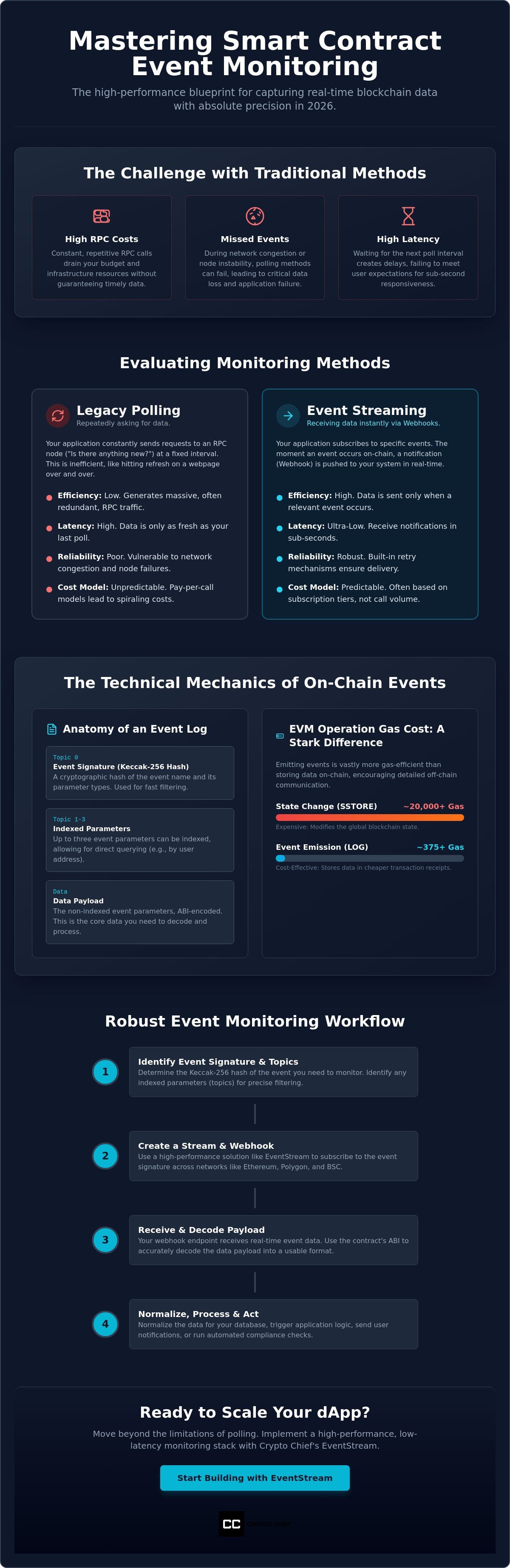
Precision is the hallmark of professional blockchain engineering. To effectively monitor smart contract events, you must first deconstruct the anatomy of a log entry. Every event consists of a name, a signature, and a data payload. The signature is a cryptographic fingerprint generated by hashing the event name and its parameter types using the Keccak-256 algorithm. This 32-byte hash, typically found in Topic 0 of a transaction receipt, allows indexers to identify which event was triggered without executing the contract code again. Understanding how smart contracts work at this fundamental level reveals why event logs are the most efficient way to extract data from the Ethereum Virtual Machine (EVM).
Efficiency also extends to the economic model of the blockchain. Emitting an event is significantly cheaper than updating a contract's state variables. While a persistent state change using SSTORE can cost 20,000 gas or more, the LOG opcode starts at a base cost of 375 gas, with an additional 8 gas charged per byte of data. This cost-effective structure encourages developers to broadcast detailed activity without bloating the global state. For teams building production-grade dApps, our RPC Gateway provides the high-throughput access required to capture these broadcasts with minimal latency.
Indexed vs. Non-Indexed Parameters (Topics)
The strategic use of indexed parameters, known as topics, is what separates basic scripts from high-performance indexers. You can mark up to three parameters as indexed in a Solidity event. These parameters are not stored in the data section of the log; instead, they're included in the block's bloom filter. This allows for near-instant filtering. If you search for a specific user's transfers, an indexer can skip thousands of irrelevant transactions by checking the bloom filter first. Non-indexed parameters are grouped into a single data blob, which is cheaper to emit but requires the full ABI to decode, making them ideal for large payloads that don't require direct searching.
Decoding Log Data with the Contract ABI
Raw logs are merely hexadecimal strings. Translating these strings into human-readable JSON requires the Application Binary Interface (ABI), which acts as a map for the data payload. Modern libraries like Ethers.js use this map to parse the hex blob back into typed values. Challenges arise with anonymous events, which omit the Topic 0 signature hash and make identification impossible without context. Maintaining strict ABI versioning is also vital. If a contract is upgraded but your listener uses an outdated ABI, your decoding logic will fail, leading to data corruption in your off-chain databases.
Evaluating Monitoring Methods: Polling vs. Event Streaming
Choosing the right architecture to monitor smart contract events defines the scalability and cost-efficiency of your decentralized application. Developers typically choose between two distinct methodologies: traditional pull-based polling and modern push-based event streaming. While polling is the standard entry point for many projects, it often becomes a bottleneck as transaction volume increases. High-performance systems require a shift toward streaming to maintain sub-second responsiveness and predictable infrastructure costs.
The primary difference lies in the direction of data flow. Polling requires your application to actively request updates, whereas streaming pushes data to your infrastructure the moment it's confirmed on-chain. For enterprise-grade reliability, our RPC Gateway supports the high-throughput requirements of polling, but many builders find that a transition to specialized streaming services is necessary to eliminate the friction of manual state synchronization.
The Inefficiency of Traditional RPC Polling
Polling relies on repeated calls to the eth_getLogs method. This approach suffers from the "empty request" problem, where your application pays for API calls even when no new events have occurred. During quiet periods, these redundant requests consume rate limits and credits without delivering value. Conversely, during periods of high network activity, polling intervals may cause significant latency. If you poll every 15 seconds but a block is produced every 12 seconds, your application is perpetually behind the live state of the chain. This lag is unacceptable for DeFi protocols or automated arbitrage bots that depend on absolute timing.
Webhooks and Real-Time Event Streaming
Event streaming, often implemented via Webhooks, reverses the responsibility of data delivery. Instead of your server asking for updates, a provider like EventStream pushes a JSON payload directly to your endpoint as soon as a matching log is detected. This eliminates the need to maintain persistent, fragile WebSocket connections that often drop during network instability. To successfully monitor smart contract events using this method, your consumer must be designed for resilience. Implementing robust retry logic and idempotency is vital. Since webhooks may occasionally deliver the same event twice due to network retries, your database logic must ensure that processing an event multiple times doesn't result in inconsistent states.
- Latency: Streaming offers near-instant delivery compared to the interval-based delays of polling.
- Resource Usage: Webhooks reduce server CPU and memory load by removing the need for constant request loops.
- Cost Predictability: You only pay for the data you actually receive, avoiding the wasted overhead of empty polling requests.
Step-by-Step: Implementing a Robust Event Monitoring Workflow
Moving from conceptual understanding to a production-ready implementation requires a methodical approach. You begin by identifying the target smart contract address and the specific event signature you wish to track. This signature is the Keccak-256 hash of the event's name and its argument types. Without this fingerprint, your listener cannot distinguish between various on-chain actions. Once you have the signature, you must obtain the contract’s ABI. The ABI serves as the translation layer, allowing your application to parse raw hexadecimal logs into structured, human-readable data objects.
The next phase involves bootstrapping your system with historical data. You'll need to query past blocks to ensure your off-chain database is synchronized with the current state of the ledger. To do this efficiently, set up a high-performance Web3 RPC Gateway. This gateway provides the throughput necessary to handle deep-block queries without the rate-limiting bottlenecks common in public infrastructure. After the historical sync is complete, you can transition to a webhook listener for real-time updates. This ensures your application receives immediate POST requests whenever a new event is emitted, removing the need for constant polling.
Security is the final, non-negotiable step. Never trust a webhook payload blindly. Implement a verification step by re-querying the transaction hash against your trusted RPC provider to confirm the log’s authenticity. This prevents spoofing attacks where a malicious actor might send a fake webhook to trigger unauthorized actions in your backend. When you monitor smart contract events with this level of rigor, you create a system that is both performant and resilient against external threats.
Defining Your Event Filters and Topics
A well-constructed filter object is the foundation of efficient data retrieval. When you monitor smart contract events, you can define specific topic arrays to narrow your search. Topic 0 is always reserved for the event signature, while Topics 1 through 3 contain indexed parameters. You can filter for multiple events simultaneously by passing an array of signature hashes in the Topic 0 position. This reduces API overhead by consolidating multiple listeners into a single stream. Wildcards can also be used by passing a null value in a topic array, allowing you to capture all events of a certain type regardless of the indexed parameter value.
Handling Chain Reorgs and Finality
Blockchains are probabilistic systems where the most recent blocks are subject to change. If you act on an unconfirmed event, you risk processing data from a block that is later discarded during a chain reorganization. To avoid false positives, your workflow should wait for a specific number of confirmations based on the network’s average finality time. Robust event streams often include a "removed" flag in their payload. If this flag is true, it indicates that the event was part of a discarded branch, and your application should roll back any state changes associated with that transaction.
For developers ready to deploy their first high-performance monitoring stack, our RPC Gateway offers the stability and speed required for enterprise-grade data capture.
Scaling Event Monitoring with Crypto Chief’s EventStream
Scaling your infrastructure to monitor smart contract events across a fragmented ecosystem shouldn't require an army of DevOps engineers. As your project matures, the technical debt of maintaining individual listeners for every chain becomes a significant friction point. Crypto Chief’s EventStream is engineered to remove this burden. It provides a robust, globally distributed webhook network that acts as a silent partner in your growth. By offloading the complexity of log capture to our high-performance backbone, you ensure that your application remains responsive even during extreme network volatility.
The true power of this system lies in its native integration with Crypto Processing. For platforms managing high-volume payment tracking, the ability to receive instant notifications for on-chain transfers is a competitive necessity. You don't just get raw data; you get a reliable foundation for automated transaction reconciliation. Our globally distributed RPC nodes guarantee the lowest possible latency, ensuring that your backend receives confirmation the moment a block is finalized. It's a high-performance engine designed for builders who value uptime and logic over flashy marketing claims.
Unified Multichain Monitoring
In 2026, the multichain reality is undeniable. EventStream offers unified access to over 10 chains, including Ethereum, BNB Smart Chain, and Polygon. Instead of wrestling with the specific implementation quirks of each network, you interact with a single, normalized API format. This standardization dramatically reduces development time and minimizes the risk of chain-specific bugs. Whether you're building on the Ethereum RPC or scaling via the Polygon RPC, the experience remains consistent and professional.
Cost Efficiency via Pay-Per-Call Pricing
Predictability is essential for business architects. Our pricing model eliminates the need for expensive, tiered monthly subscriptions that charge for capacity you don't use. You only pay for the data you actually consume. This allows you to scale your monitoring efforts up or down with total flexibility. Pre-paid API tokens provide budgeting transparency for enterprise dev teams, ensuring that costs are always aligned with actual usage. It's a pragmatic approach to infrastructure that respects your resources while providing elite capabilities and humble service.
Architecting for Scalability and Precision
Building a resilient dApp requires more than just smart contract logic; it demands a high-performance data pipeline that bridges the gap between the blockchain and your users. You've seen how the shift from legacy polling to real-time event streaming reduces infrastructure overhead while ensuring sub-second responsiveness. By mastering the technical mechanics of indexed topics and ABI decoding, you position your application to handle the complexities of a multichain future without compromising on data integrity or cost-efficiency.
Reliable data shouldn't be a luxury. As you move to monitor smart contract events at scale, having a partner that understands the practical challenges of the field is vital. With our global high-performance RPC gateway and multichain support for over 10 blockchains, you can maintain absolute visibility across the entire ecosystem. Our pay-per-call pricing model ensures that your costs stay aligned with your growth, providing the transparency enterprise teams need to scale with confidence. Stop fighting your infrastructure and start focusing on your core product. Start monitoring events with Crypto Chief’s EventStream today and build with the stability your users deserve. The future of decentralized data is active, precise, and ready for you to lead.
Frequently Asked Questions
What is the difference between an event and a transaction log?
An event is a high-level Solidity abstraction that developers define in their code, while a transaction log is the underlying data structure stored within the blockchain's receipt. When an event is triggered, the EVM generates a log entry containing the event signature and its parameters. You can think of the event as the declaration and the log as the persistent, verifiable record of that declaration's execution on-chain.
Can I monitor smart contract events without a full node?
Yes, you can access blockchain data without the overhead of maintaining a full node by utilizing an external RPC gateway or a specialized data streaming service. Maintaining a local node requires significant hardware resources and constant maintenance. Most modern dApps use high-performance infrastructure providers to receive real-time event streams via Webhooks, which removes the friction of local data management and improves system reliability.
How do I filter for specific parameters in a smart contract event?
To effectively monitor smart contract events with precision, you must define a filter object that targets the contract address and specific topic arrays. In Solidity, only parameters marked as "indexed" are stored as topics, allowing you to search for precise values like a specific sender address or a unique token ID. Non-indexed parameters are grouped into the log's data field and cannot be used for direct filtering.
What happens to event monitoring during a blockchain reorganization?
During a reorganization, events from a discarded branch may be invalidated or "removed" from the ledger. High-quality monitoring tools handle this by including a "removed" flag in their data payloads to notify your application when an event is no longer part of the canonical chain. It's a standard professional practice to wait for a specific number of block confirmations before treating an event as finalized and permanent.
Are smart contract events permanent and immutable?
Events are permanent and immutable once the block containing them achieves finality on the blockchain. While they are stored in transaction receipts rather than the contract's state, they remain a verifiable part of the chain's historical record. However, you should remember that unlike state variables, events are not directly accessible by other smart contracts during execution; they are designed purely for off-chain communication.
How much does it cost to monitor blockchain events at scale?
The cost to monitor smart contract events at scale depends on your monitoring strategy and the volume of data your application requires. Legacy polling methods often incur higher costs due to redundant RPC calls that return no data. Professional services typically utilize a pay-per-call or credit-based pricing model, which allows you to pay only for the events your system actually processes while providing better budgeting transparency for enterprise teams.
Why are some event parameters labeled as "indexed" in Solidity?
The "indexed" keyword instructs the EVM to store a parameter as a topic rather than as part of the general data payload. This allows the blockchain's bloom filter to quickly identify logs containing those specific values without scanning the entire data blob. You can define up to three indexed parameters per event, which is the essential mechanism for building high-performance indexers that can filter millions of transactions instantly.