
Is your dApp's responsiveness being throttled by the very infrastructure meant to support it? In a landscape where the Polygon network now supports up to 5,000 payments per second as of mid-2026, relying on traditional polling methods is no longer a viable strategy for competitive builds. You've likely experienced the frustration of high latency from block explorers or the sudden instability of RPC connections when network traffic surges. To effectively monitor polygon events real time, you must transition from a reactive pull model to a proactive, push-based architecture.
We recognize that managing complex WebSocket states and the heavy overhead of constant polling can drain both your development time and your operational budget. This guide provides a professional roadmap to mastering the technical architecture required for live data streaming. You'll learn how to eliminate latency, simplify your backend requirements, and utilize high-performance tools like EventStream to ensure your application remains performant. We'll examine the shift toward specialized infrastructure that allows you to focus on core logic while maintaining the structural integrity your project demands.
Key Takeaways
- Transition from outdated polling to push-based streaming to achieve the sub-second latency required for 2026 DeFi and gaming applications.
- Master the technical architecture needed to monitor polygon events real time using high-performance RPC Gateways and optimized JSON-RPC calls.
- Reduce operational overhead by adopting a pay-per-call model, eliminating the high costs and maintenance burdens associated with self-managed validator nodes.
- Implement a streamlined 5-step deployment process, from acquiring your smart contract ABI to integrating specialized event-streaming endpoints.
- Scale your dApp infrastructure with global, enterprise-grade tools like EventStream to ensure reliable data delivery during high-traffic network periods.
Why Real-Time Polygon Event Monitoring is Critical for dApps
Polygon event monitoring is the systematic process of capturing smart contract logs the moment they are emitted on the blockchain. These logs, or events, serve as the primary communication channel between on-chain logic and off-chain systems. In a high-throughput environment like Polygon, which surpassed 7.8 billion cumulative transactions by July 2026, the ability to monitor polygon events real time is a structural requirement for any production-grade application.
The demand for sub-second latency is driven by the specific needs of modern Web3 sectors. In DeFi, a delay of even a few seconds can result in failed liquidations or outdated price feeds that expose protocols to arbitrage. NFT platforms require immediate confirmation to update user interfaces during high-velocity mints, while gaming environments depend on instant state synchronization to maintain immersion. This shift toward "Event Sourcing" allows developers to treat the blockchain as a definitive, chronological ledger of truth that triggers backend logic automatically.
Transitioning from a reactive "Pull" paradigm to a proactive "Push" model is essential for scaling. While polling was once the standard, it's no longer sufficient for the 5,000 payments per second that the Polygon network now supports as of June 2026. Developers need a silent partner that handles the heavy lifting of infrastructure so they can focus on building user value.
The Limitations of Traditional RPC Polling
Polling relies on a backend service repeatedly executing eth_getLogs requests via a standard Polygon RPC endpoint. This method is inherently inefficient for several reasons:
- Bandwidth Waste: Constant requests consume significant resources and processing power, even when no new events have occurred.
- Cost Inefficiency: High-frequency polling leads to massive RPC call volumes, which can quickly drain operational budgets.
- Data Gaps: There's a persistent risk of missing events that occur between polling intervals, especially during periods of high network congestion.
With Polygon's rapid block times and the Ithaca hard fork's improvements to block producer failover, polling simply cannot scale to meet the demands of enterprise applications that require 100% data integrity.
Push-Based Architecture: Webhooks and WebSockets
To overcome these hurdles, sophisticated developers are adopting push-based architectures to monitor polygon events real time. This approach streams data directly to your infrastructure, removing the need for repetitive inquiries.
Webhooks are the preferred choice for server-to-server communication. They offer a reliable, asynchronous way to receive notifications without maintaining a persistent connection. When an event triggers, a service like EventStream sends an HTTP POST request to your endpoint, ensuring your database stays synchronized with the chain without manual intervention.
WebSockets are better suited for front-end updates. They maintain a persistent, two-way connection that allows for the instantaneous delivery of data to the client browser. Choosing the right transport layer depends on whether you're performing background data normalization or providing a live, interactive UI experience for your users.
Technical Methods to Monitor Polygon Events
Accessing on-chain data on the Polygon network is not a one-size-fits-all endeavor. Developers generally choose between three primary methods based on their specific latency requirements and infrastructure budget. The first involves direct JSON-RPC calls via an RPC Gateway. This is the baseline for many projects, yet it relies on polling which can be inefficient for high-volume dApps. The second method utilizes persistent WebSocket (WSS) connections for a continuous data flow, providing a lower-latency alternative. Finally, the most scalable approach for enterprise applications involves leveraging managed EventStream services that push data directly to your backend infrastructure.
Each method offers a different balance of control and convenience. Direct RPC calls are excellent for simple, stateless queries where immediate updates aren't vital. WebSockets provide a significant step up in speed, allowing for bi-directional communication. However, for those building at scale, managed solutions remove the operational burden of maintaining node health. This ensures your team stays focused on product innovation rather than infrastructure maintenance.
Configuring WebSocket Connections
Establishing a persistent wss:// connection to a high-performance Polygon node is a fundamental step to monitor polygon events real time. Unlike standard HTTP requests that close after every exchange, WebSockets remain open to stream logs the moment they are mined into a block. You must implement sophisticated logic to handle connection drops, which frequently occur during periods of high network congestion or node maintenance. Developers should also utilize granular filtering by contract address and topic hashes, typically the Keccak-256 hash of the event signature, to ensure the stream only contains relevant data and doesn't overwhelm your processing logic.
Managed Webhook Services vs. Self-Hosted Listeners
While self-hosting a listener script might appear cost-effective, the total cost of ownership tells a different story. A dedicated full node for private RPC access can cost approximately $320 per month in 2026, and that excludes the engineering hours spent maintaining uptime and debugging connection issues. Managed webhook services remove this friction by handling node failovers and block reorgs automatically. These services act as a silent partner, ensuring that your application logic receives normalized data without the burden of managing raw blockchain state. For enterprise dApps, push-based webhooks represent the gold standard because they decouple blockchain monitoring from your primary application logic. If you're ready to optimize your stack, you can register for an account to explore these high-performance tools.
Cost Analysis: Managed Event Streams vs. Self-Managed Nodes
When you choose to monitor polygon events real time, the financial implications of your infrastructure choice are as significant as the technical ones. Analyzing the Total Cost of Ownership (TCO) for blockchain monitoring reveals a stark contrast between self-managed infrastructure and managed services. Operating a dedicated full node for private RPC access costs approximately $320 per month in hardware and hosting alone. However, this figure ignores the "hidden" costs: DevOps engineering hours required for maintenance, the price of data egress, and the constant need for manual updates following network upgrades like the Ithaca hard fork.
The pay-per-call model offers a decisive advantage for developers who value capital efficiency. Traditional monthly subscription tiers often force you to pay for a fixed capacity you may never fully utilize. In contrast, Web3 API pay-per-call pricing ensures you only pay for the specific events your application consumes. This model eliminates the financial waste of idle infrastructure and provides a predictable cost structure that scales directly with your dApp's actual usage and transaction volume.
The Efficiency of Prepaid API Tokens
Prepaid token balances provide a layer of financial control that monthly recurring bills cannot match. By utilizing a tokenized system, you remove the risk of unexpected overage charges that often plague high-traffic projects. This approach is particularly effective for high-volume event monitoring where traffic spikes are common. You can allocate a specific budget to your monitoring needs, allowing your infrastructure to act as a silent, powerful partner that supports your growth without creating a variable overhead that threatens your margins. This predictable spending model allows you to scale your budget alongside your user base with surgical precision.
Reducing Overhead with Unified APIs
Integrating a Unified Web3 Developer Platform further reduces operational overhead by normalizing data across multiple chains. Instead of managing separate logic for Polygon, Ethereum, or BNB Smart Chain, you utilize a single, consistent interface that simplifies your backend architecture and reduces integration time. This structural integrity ensures that your developers spend less time on data normalization and more time on core product features. Aggregating multiple event filters into a single batch request reduces the total number of billed calls and minimizes the computational load on your local processing environment. This streamlined approach to monitor polygon events real time ensures your dApp remains lean, fast, and cost-effective as it grows.
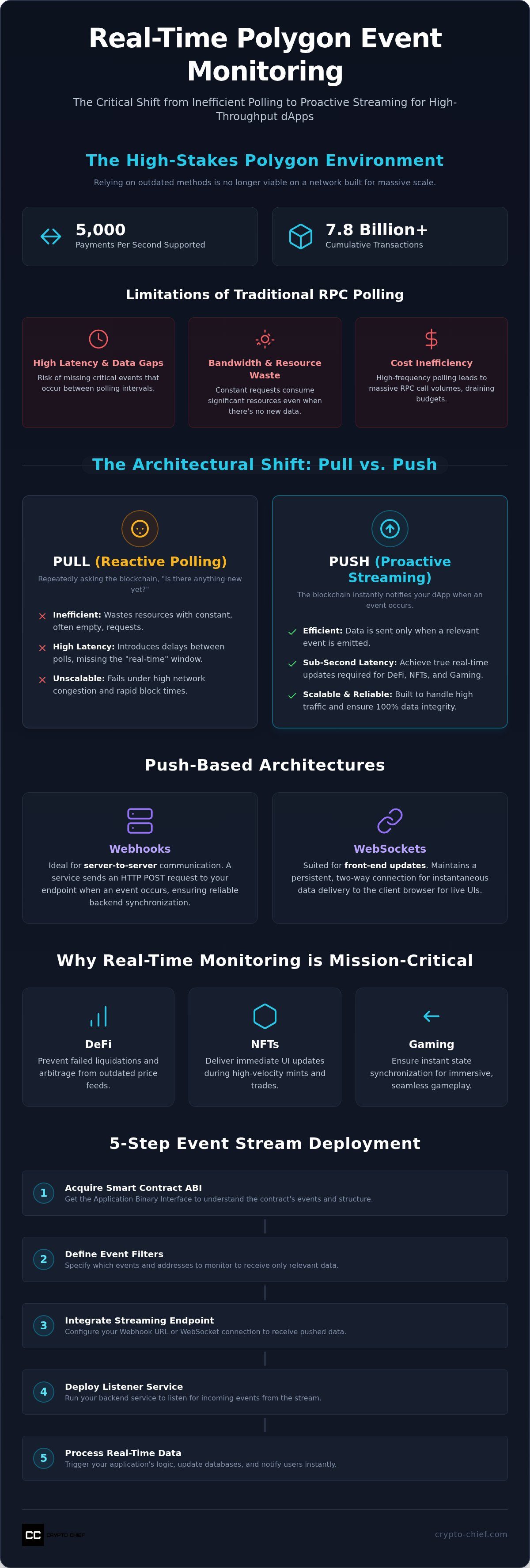
How to Set Up a Polygon Event Stream in 5 Steps
Establishing a professional infrastructure to monitor polygon events real time requires a methodical approach that prioritizes data integrity and security. Before initiating the setup, ensure you have your target smart contract address and its Application Binary Interface (ABI) available. These components are essential for identifying and decoding the specific logs your application needs to process. Follow these five steps to deploy a robust event-streaming solution.
- Step 1: Obtain your endpoint. Secure a high-performance Polygon RPC endpoint from Crypto Chief to serve as your gateway to the network's state.
- Step 2: Define event filters. Use your contract ABI to select the specific events you wish to track, such as
TransferorMint, and map them to their corresponding contract addresses. - Step 3: Configure destination URL. Specify the webhook delivery address where the EventStream service will push real-time data packets for your backend to ingest.
- Step 4: Implement HMAC verification. Set up Hash-based Message Authentication Code (HMAC) signatures to ensure every incoming notification is authentic and untampered.
- Step 5: Execute testnet validation. Deploy your stream on the Polygon Amoy testnet first to verify that your handling logic accounts for potential block reorgs or network latency.
By following this structured workflow, you transform the complex task of blockchain listening into a manageable, scalable pipeline. This allows your team to focus on the application's unique value proposition while the underlying infrastructure handles the heavy lifting of data delivery.
Filtering and Topic Hashing
To successfully monitor polygon events real time, you must understand how to generate topic hashes from function signatures. A topic hash is the Keccak-256 result of the event name and its parameter types, such as Transfer(address,address,uint256). Utilizing indexed parameters, known as topics, allows you to narrow your monitoring to specific senders or recipients, significantly reducing the volume of irrelevant data your server must process. If your dApp interacts with a factory contract, you can aggregate multiple contract addresses into a single stream for unified management.
Security and Verification
Security is a non-negotiable aspect of Web3 backend architecture. You must verify the source of every webhook notification to prevent injection attacks or spoofed data from affecting your application state. Implementing strict rate limiting protects your infrastructure from unexpected event spikes during periods of extreme network volatility. For projects requiring enhanced compliance, integrating AML Intelligence allows you to flag risky transactions or sanctioned addresses in the same millisecond the event is detected. To secure your infrastructure today, create a developer account and begin building on a foundation of professional-grade tools.
In the unfortunate event that assets are compromised despite these precautions, professional intervention becomes necessary. Forensic firms such as Prime Asset Recovery specialize in tracing and recovering stolen digital assets, utilizing blockchain data to assist victims of cryptocurrency fraud.
Scaling Your Polygon dApp with Crypto Chief EventStream
Scaling a decentralized application requires more than just a functional connection; it demands a high-performance engine that remains resilient under extreme load. Crypto Chief acts as your silent, powerful partner, providing the structural integrity needed to monitor polygon events real time at an enterprise scale. By leveraging a global RPC network, our infrastructure removes the friction of managing raw data, allowing you to focus on the creative aspects of your project while we handle the background complexity.
Integrating real-time monitoring with our non-custodial Crypto Processing API enables a fully automated workflow for financial applications. This synergy allows your backend to detect specific smart contract events and initiate secondary processing actions without human intervention. For developers currently in the prototyping stage, our Polygon Faucet offers a frictionless way to acquire testnet tokens, ensuring you can stress-test your event-handling logic on the Amoy network before deploying to the production environment.
Enterprise-Grade Reliability
Our platform is engineered for 99.9% uptime, utilizing a global node distribution that minimizes latency for users regardless of their location. Polygon PoS is known for occasional chain splits and block reorgs, which can disrupt standard listeners and cause data inconsistencies. EventStream handles these network fluctuations automatically, ensuring that your application only processes finalized data. If a webhook delivery fails due to a temporary issue on your server, our detailed logging and automated retry mechanisms ensure that no critical event is lost in transit.
Get Started with Real-Time Monitoring
Transitioning to a professional monitoring solution is a decisive step toward long-term scalability. We invite you to create a developer account today and experience the stability of a managed event-streaming service. Our comprehensive Technical Documentation provides deep integration guides, code snippets, and best practices to accelerate your deployment. Startups can particularly benefit from our pay-per-call model, which allows you to bootstrap with minimal overhead and scale your infrastructure costs in direct proportion to your success.
Future-Proof Your Polygon Infrastructure
Mastering the technical architecture to monitor polygon events real time is no longer just a competitive advantage; it's a requirement for any dApp aiming for enterprise-grade performance in 2026. You've seen how shifting from inefficient polling to push-based streaming reduces latency while simplifying your backend. By adopting a pay-per-call model, you eliminate the overhead of idle infrastructure and ensure your costs scale directly with your success. This transition allows your team to focus on core product innovation rather than the maintenance of low-level data pipelines.
Whether you're normalizing data through a Unified Multichain API or leveraging a global RPC node network for sub-second delivery, the right foundation provides the structural integrity your users expect. Secure your project's stability and join the ranks of developers prioritizing scalability and capital efficiency. Start Monitoring Polygon Events with Crypto Chief today and build with the confidence of a professional partner by your side. We're excited to see how you leverage these high-performance tools to build the next generation of decentralized finance and gaming.
Frequently Asked Questions
What is the difference between Polygon PoS and Polygon zkEVM monitoring?
The primary difference lies in the finality mechanisms and underlying node architecture. Polygon PoS utilizes a checkpoint-based system that settles on Ethereum, while zkEVM relies on zero-knowledge proofs for validity. While both use standard JSON-RPC interfaces, your monitoring logic must account for the different confirmation thresholds required to ensure an event is truly finalized on each respective chain.
Can I monitor multiple smart contracts with a single Polygon webhook?
You can aggregate multiple contract addresses within a single EventStream configuration to streamline your data ingestion. This approach allows you to receive a unified feed for related contracts, such as a primary token and its associated staking pool. It significantly simplifies your backend architecture by reducing the number of active listeners your infrastructure must maintain and manage simultaneously.
How does the pay-per-call model work for real-time event streaming?
The pay-per-call model ensures you only pay for the specific events that match your defined filters and are successfully delivered to your endpoint. Instead of a flat monthly subscription for idle capacity, you utilize prepaid token balances. These balances decrease in direct proportion to your actual data consumption, providing a transparent and capital-efficient way to scale your application's monitoring needs.
What happens if my server is down when an event is sent?
Our infrastructure utilizes automated retry mechanisms that attempt to redeliver event notifications over a specific timeframe if your server fails to respond. You can also access detailed delivery logs to identify any failed attempts during your downtime. This ensures you can manually resynchronize your application state once your backend is back online, maintaining total data integrity for your users.
How do I secure my webhook endpoint from unauthorized requests?
Implementing HMAC signature verification is the most effective way to secure your endpoint against unauthorized requests. By validating the signature included in the request header against your unique secret key, you ensure the data originated from our platform. This prevents spoofing attacks and ensures your backend only processes authentic blockchain logs that have been verified by our system.
Is it better to use WebSockets or Webhooks for a Polygon-based NFT marketplace?
Webhooks are generally the superior choice for marketplace backends because they offer better reliability and easier horizontal scaling. While WebSockets are ideal for instantaneous UI updates, Webhooks provide a more robust architecture to monitor polygon events real time for permanent database records. This push-based method ensures your sales data and ownership records stay synchronized without the overhead of maintaining persistent socket connections.
How do I handle Polygon network reorgs in my monitoring logic?
Handling reorgs requires waiting for a specific number of block confirmations before treating an event as immutable. Managed services like EventStream simplify this by only triggering notifications once a block reaches the required depth on the Polygon PoS network. This structural safeguard protects your application from processing events that might be rolled back due to temporary chain splits or minor network reorganizations.
Can I filter Polygon events by specific wallet addresses?
You can filter events by wallet addresses if those addresses are stored within the smart contract’s indexed parameters, also known as topics. This functionality allows you to monitor polygon events real time for specific user activities, such as tracking large transfers from whale wallets. By filtering at the infrastructure level, you reduce the computational load on your backend by only receiving the most relevant data.