
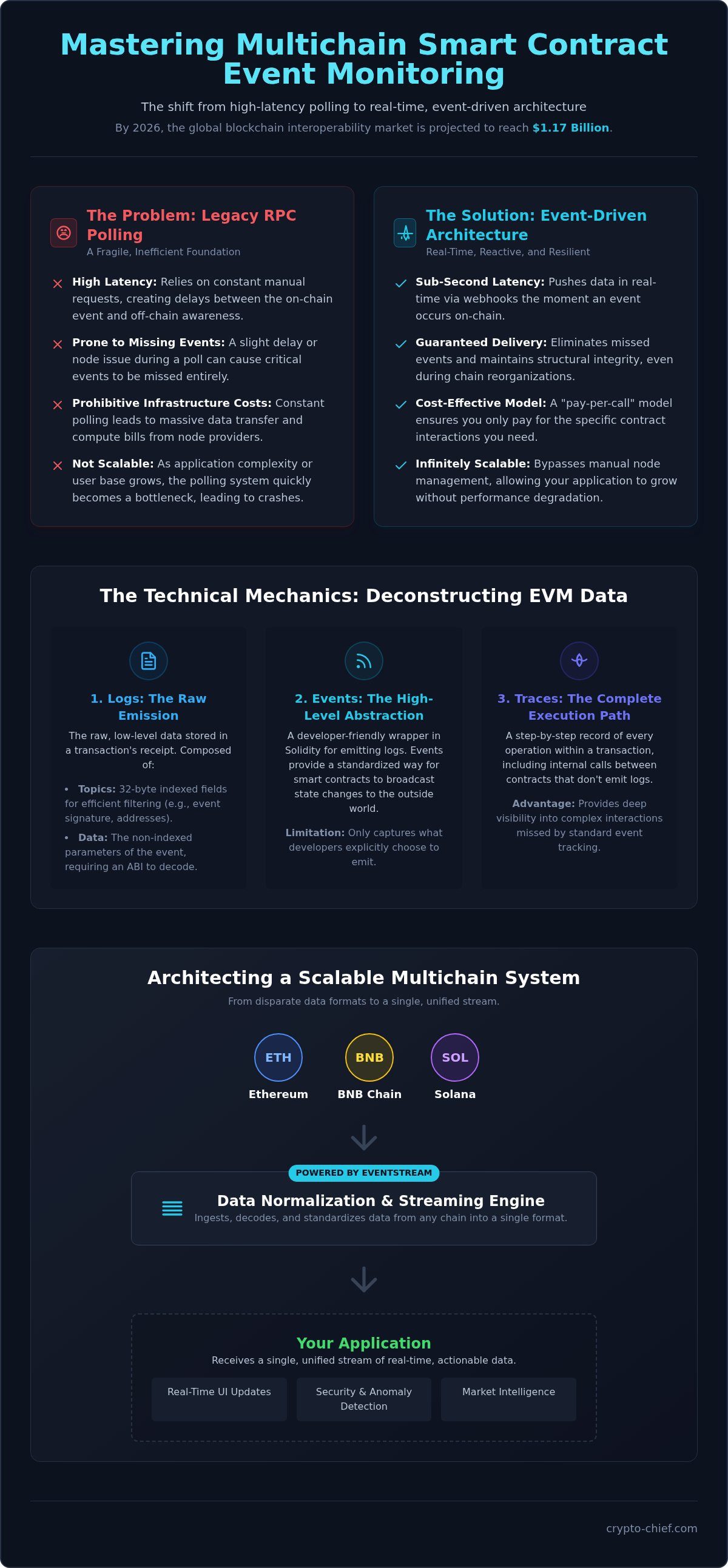
By 2026, the global blockchain interoperability market is projected to reach $1.17 billion, signaling a massive shift in how decentralized data is handled. Traditional RPC polling is no longer viable. Relying on constant manual requests creates a fragile foundation that often results in missing events or prohibitive infrastructure bills. Elite performance now requires a reactive, event-driven architecture built on sophisticated multichain smart contract event monitoring.
You likely agree that managing disparate data formats across Ethereum, BNB, and Solana is a logistical burden. You need to monitor events across chains without crashing nodes or overpaying for data. This guide promises to help you master the technical frameworks required for production-grade efficiency. We'll map the transition from high-latency polling to real-time streaming. By maintaining system stability, we'll explore how to normalize data across networks and implement cost-effective tracking via a pay-per-call model. Tools like EventStream eliminate manual node management to provide a blueprint for a low-latency setup that scales with structural integrity.
Key Takeaways
- Transition from legacy RPC polling to reactive, event-driven architectures to eliminate latency and reduce infrastructure overhead.
- Master the EVM log structure, including topics and indexed data, to extract precise smart contract state changes across diverse networks.
- Implement multichain smart contract event monitoring by normalizing data from Ethereum, BNB, and Solana into a single, unified stream.
- Scale your tracking capabilities using EventStream to bypass manual node management and maintain structural integrity during chain reorganizations.
- Optimize operational costs with a pay-per-call model that ensures you only invest in the specific contract interactions your application requires.
What Are Smart Contract Interactions and Why Track Them?
Every action on a modern blockchain is an interaction. These interactions are categorized as either state-changing transactions, which modify the ledger and require gas, or read-only calls, which query the current state without altering it. In the early days of Web3, tracking was simple because most activity consisted of basic EOA-to-EOA transfers. Today, the landscape has shifted toward complex DeFi and NFT logic where a single user action might trigger a cascade of automated protocols. Understanding these movements is no longer optional; it's the foundation of the reactive Web3 ecosystem in 2026. As decentralized ecosystems expand, multichain smart contract event monitoring has become the invisible engine powering the next generation of financial and social applications.
EOA vs. Contract Accounts: The Source of Interaction
To monitor a network effectively, you must understand where the data originates. An Externally Owned Account (EOA) is controlled by a private key, usually held by a human user or a bot. These accounts initiate the execution process by sending a transaction to a contract address. A Smart contract is essentially self-executing code that resides at a specific address on the blockchain. While EOAs start the chain reaction, much of the actual logic happens through contract-to-contract interactions, often called internal transactions. These nested calls represent the true complexity of modern dApps. Tracking them is notoriously difficult because they don't always appear in standard block explorers. Developers often find that monitoring top-level transactions isn't enough; they need deep visibility into the traces of execution. Tracking these nested interactions often requires a high-performance RPC Gateway capable of deep transaction tracing to ensure no state change is missed.
The Business Case for Real-Time Interaction Monitoring
Data is only as valuable as the speed at which you can act upon it. Modern dApps use interaction data to update UI states instantly, ensuring a user doesn't have to wait or refresh their page to see a successful swap or a minted NFT. Beyond the user experience, monitoring plays a critical role in security and market intelligence. Protocols use these streams to identify whale movements, track large liquidations, or detect protocol exploits before they drain a pool. In 2026, enterprise-grade applications require sub-second latency to remain competitive. If your monitoring system lags behind the network's state, you're effectively flying blind. Efficient multichain smart contract event monitoring allows businesses to normalize this data across diverse environments, turning raw logs into actionable business logic without the overhead of maintaining individual node clusters for every chain.
The Technical Mechanics: Logs, Events, and Traces
To implement effective multichain smart contract event monitoring, you must first deconstruct how the Ethereum Virtual Machine (EVM) handles data emission. When a smart contract function executes, it can trigger "Logs" that are stored in the block's receipt. These logs consist of two primary components: Topics and Data. Log Topics are 32-byte hex strings used for filtering events within the EVM's bloom filter system, with the first topic typically representing the signature of the event itself. While the "Data" field contains the non-indexed parameters of the event, "Topics" allow for efficient searching through indexed parameters like sender addresses or token IDs. Deterministic execution is a core requirement for Blockchain Technology for Government, and it's this same predictability that allows logs to serve as a reliable source of truth for off-chain applications.
Solidity "Events" act as the high-level abstraction for these logs. When you define an event in your code, you're essentially creating a standardized way for your application to broadcast state changes. However, logs only capture what the developer explicitly chose to emit. If a contract interaction triggers a series of internal calls that don't emit logs, standard event tracking will miss those movements. This is where "Traces" become essential. Unlike standard logs, traces provide a step-by-step record of the entire execution path, offering visibility into internal transactions and state changes that remain hidden from basic receipt queries.
Decoding Event Logs: From Hex to Human-Readable
Raw blockchain data is rarely useful in its native hexadecimal format. To make sense of it, you need the Application Binary Interface (ABI), which acts as a map for decoding hex strings into human-readable values. The challenge arises with unverified contracts or proxy patterns where the ABI might be missing or obscured. Tracking across multiple networks compounds this difficulty, as each chain may have different verification standards. Utilizing a Unified API can significantly streamline this process by providing pre-decoded data across diverse networks, allowing you to focus on logic rather than manual parsing. If you're building a cross-chain dashboard, exploring a high-performance RPC Gateway can simplify this data extraction.
Internal Transactions: Seeing the Full Execution Path
Standard getTransactionReceipt calls are often insufficient for modern DeFi monitoring because they ignore the complexity of nested contract logic. To see the full execution path, including internal transfers of ETH or tokens, you must utilize specialized RPC methods like debug_traceTransaction or trace_filter. These methods require significant infrastructure overhead, often necessitating the use of archive nodes that store the full history of the blockchain's state. For many developers, the cost of maintaining these nodes is prohibitive. Instead of managing heavy infrastructure, many teams now rely on external providers to supply these traces, ensuring they capture every internal movement without the burden of running a full-scale node cluster.
Tracking Methods: RPC Polling vs. Real-Time Webhooks
Choosing an architecture for multichain smart contract event monitoring is a decision that dictates your platform’s long-term viability. For years, the industry relied on RPC polling, a method where an application repeatedly sends eth_getLogs requests to a node to check for new data. While functional for low-traffic dApps, this approach is fundamentally inefficient for modern, high-fidelity protocols. Academic research like Monitoring the Future of Smart Contracts highlights that the technical need for monitoring has evolved into a requirement for high-fidelity, low-latency data streams. Developers are now moving toward stateful WebSockets (WSS) and serverless Webhooks to maintain persistent connections without the overhead of repetitive, redundant requests.
WebSockets offer a continuous pipe for data, yet they require your backend to manage persistent connections, which can be resource-intensive and fragile during network instability. In contrast, Webhooks offer a push-based model that triggers only when an event occurs. This distinction is critical when you're balancing the need for real-time responsiveness against the complexity of maintaining a global infrastructure. By shifting to a reactive model, you ensure your application remains synchronized with the blockchain state without exhausting your server resources on idle connections.
The Hidden Costs of RPC Polling at Scale
The financial reality of RPC polling often reveals itself too late. When you poll a node every few seconds, you're frequently paying for "empty" responses that contain no new events. This waste scales linearly with the number of contracts and chains you track, leading to significant overhead. Fixed-tier node subscriptions often force you into high monthly costs regardless of your actual usage. Transitioning to a pay-per-call model ensures you only invest in the data you successfully retrieve. If you're looking to optimize your existing setup, you can explore RPC Request Batching for Cost Reduction to mitigate these unnecessary expenses and improve your overall tracking reliability. Rate limits and latency spikes in standard polling architectures further degrade the user experience, making a more efficient approach essential for production-grade dApps.
Why Webhooks are the Future of Interaction Tracking
Webhooks represent the most scalable approach to event tracking in 2026. Instead of your server constantly asking if something happened, a webhook service pushes a notification to your endpoint the moment a specific event is detected. This serverless architecture eliminates the need for persistent server connections, which are often prone to dropping during high network congestion. Advanced services handle complex blockchain edge cases, such as chain reorganizations and block confirmations, automatically. By offloading this logic to specialized infrastructure, you can scale to thousands of monitored addresses without increasing your internal infrastructure complexity. This shift allows your team to focus on building features while the background engine ensures data integrity across every chain you support.
Architecting a Scalable Multichain Tracking System
Building a robust infrastructure for multichain smart contract event monitoring requires more than just a connection to a node. It demands a sophisticated architectural approach that can ingest, filter, and normalize data from diverse environments like Ethereum, BNB Smart Chain, and Polygon. To ensure production-grade efficiency, developers must implement advanced filtering logic that tracks specific contract addresses, event signatures, or even granular parameters within the data payload. This precision prevents your system from being overwhelmed by irrelevant noise while ensuring you never miss a critical state change. Relying on a single RPC provider is a risk most enterprises can't afford; instead, building redundancy through multiple high-performance gateways ensures that your monitoring remains online even if a specific node cluster experiences downtime. Data integrity also requires your system to handle chain reorganizations, which can retroactively change the state of a block. A resilient architecture must distinguish between unconfirmed and finalized states, ensuring that your application logic only triggers on data that has reached sufficient network consensus.
Multichain Data Normalization
The primary challenge in cross-chain architecture is the lack of a standard format. While EVM chains share similarities, non-EVM networks like Solana or TON utilize entirely different transaction models and event structures. A scalable system must map these disparate formats into a single, unified JSON schema. This normalization allows your frontend or database to process events without needing network-specific logic for every chain. Consistent timestamping and block numbering are equally vital, as they allow you to reconstruct a chronological timeline of events across the entire Web3 ecosystem. By using a Unified API, you can offload this complex mapping to a background engine, allowing your team to focus on the business logic that drives your application.
Security and Compliance in Interaction Tracking
In 2026, tracking is no longer just about functionality; it's about institutional-grade security and regulatory compliance. As the EU’s MiCA and U.S. regulations increase scrutiny on secondary market activity, integrating risk detection into your event stream is mandatory. You can utilize the Crypto AML Risk Detection API to automatically score interactions involving high-risk smart contracts or flagged addresses. This proactive approach ensures your dApp remains compliant while protecting users from interacting with malicious protocols. Beyond compliance, you must protect your own tracking endpoints from spoofing and DDoS attacks. Implementing signature verification for every incoming webhook ensures that the data you're processing is authentic and originates from your trusted infrastructure provider. If you're ready to move beyond manual polling and build a truly resilient system, you can start building with EventStream today.
Optimizing Your Workflow with Crypto Chief Infrastructure
Efficient multichain smart contract event monitoring requires a shift from manual maintenance to automated, reliable streaming. Crypto Chief acts as your silent, powerful partner by removing the burden of manual node management. Instead of configuring individual clusters for every network, you gain unified access to Ethereum, Tron, and TON via a single high-performance gateway. This centralized approach ensures structural integrity while allowing your team to focus on building features rather than debugging connectivity. By utilizing our pay-per-call model, you eliminate the waste associated with fixed-tier subscriptions, paying only for the specific smart contract interactions you actually track. It's an elite service that remains practical for creators at any scale.
Consider a real-world scenario: setting up a webhook for a USDT transfer event. With our infrastructure, you can transition from a blank configuration to a live data stream in under five minutes. You don't need to write complex listeners or manage persistent WebSocket connections. You simply define the contract address and the event signature, and our engine handles the rest. This speed doesn't come at the cost of reliability; our system is built to handle high-throughput events without dropping packets or increasing latency, even during periods of intense network activity.
EventStream: Real-Time Blockchain Event Streaming
EventStream is the cornerstone of modern multichain smart contract event monitoring, designed for developers who value uptime and logic over infrastructure management. It allows you to configure webhooks for specific smart contract methods with zero code, turning complex blockchain logs into clean, actionable JSON payloads. For a deeper technical exploration of these capabilities, you can read our guide on Real-Time Blockchain Webhooks. This service is optimized to process thousands of events per second, ensuring that your application remains responsive regardless of the volume of on-chain activity. By offloading the heavy lifting to a specialized streaming engine, you ensure that your monitoring remains robust and low-latency across all supported chains.
Getting Started with Global RPC Infrastructure
Latency is the enemy of a great user experience. To minimize delays, you can select region-optimized nodes that place your application as close to the blockchain network as possible. Whether you're integrating Ethereum RPC Nodes or tracking activity on emerging networks, our global reach provides the stability you need. Our infrastructure is built by people who understand the practical challenges of the field, offering a high-performance engine that is both elite in its capabilities and humble in its service-oriented delivery. If you're ready to stop polling and start streaming, you can register for a Crypto Chief account and begin tracking your first events today.
Mastering the Future of Event-Driven Infrastructure
The shift toward a reactive, event-driven architecture is no longer a luxury for Web3 developers; it's a requirement for those building resilient, production-grade applications. By mastering the nuances of EVM logs and moving beyond the inefficiencies of manual RPC polling, you position your project for long-term scalability. A robust approach to multichain smart contract event monitoring ensures that your dApp remains responsive and compliant regardless of network congestion or cross-chain complexity. You've seen how normalizing data across diverse environments like Ethereum, BNB, and Solana removes the friction of fragmented infrastructure.
Now is the time to replace fragile polling loops with a high-performance engine that scales with your growth. You can leverage EventStream webhooks for real-time tracking, access 10+ chains through a Unified Multichain API, and optimize your overhead with pay-per-call pricing that eliminates wasted compute. Build your multichain tracking system with Crypto Chief today. The tools are ready to support your vision. We're here to ensure your foundation remains unshakable as you build the next generation of decentralized finance.
Frequently Asked Questions
What is the difference between an Ethereum transaction and a smart contract interaction?
An Ethereum transaction is the high-level message sent from an Externally Owned Account to the network. A smart contract interaction is the specific execution of logic that happens when that transaction targets a contract address. While all interactions are contained within transactions, not all transactions involve contracts. Simple transfers just update balances; interactions trigger complex functions like liquidity provisioning or governance voting, which emit specific logs for your backend to capture.
How can I track smart contract events across multiple chains simultaneously?
To track events across multiple chains simultaneously, you should implement a unified infrastructure layer that abstracts the differences between networks. Effective multichain smart contract event monitoring relies on a centralized dashboard or API that aggregates logs from Ethereum, BNB, and Polygon into a single JSON schema. This approach eliminates the need to maintain separate node connections and prevents your development team from writing unique parsing logic for every individual blockchain you support.
What are internal transactions and why are they harder to monitor?
Internal transactions represent the code execution that occurs when one smart contract calls another. They are significantly harder to monitor because they don't exist as independent records on the ledger. Unlike standard transactions that appear in a block's transaction list, internal movements are only visible through the execution trace. To capture these, you must use specialized RPC methods or archive nodes that record every step of the virtual machine's processing path.
How do webhooks improve the efficiency of smart contract monitoring compared to polling?
Webhooks improve efficiency by shifting the responsibility of data detection to your infrastructure provider. Instead of your server repeatedly asking a node for new logs, the provider pushes the data to your endpoint the moment an event is confirmed. This removes the "empty request" waste common in polling architectures, where you pay for requests that return no data. It's a serverless, reactive model that reduces your internal compute overhead and minimizes network latency.
What happens to my tracked interactions during a blockchain re-org?
When a blockchain reorganization occurs, blocks that were previously considered part of the main chain are replaced by a longer chain. Any interactions tracked within those discarded blocks are effectively invalidated. Professional monitoring services handle this by tracking the block height and providing automated re-org alerts. This allows your application to wait for a specific number of confirmations or revert state changes, ensuring your internal database always reflects the final, canonical state of the network.
Do I need a full archive node to track historical contract interactions?
You don't necessarily need to run a full archive node yourself, but you do need access to one if you require historical data. Standard nodes often prune state data to save space, which prevents them from providing traces or state lookups for older blocks. Most developers prefer to use a high-performance RPC Gateway that provides archive-level data through a managed service. This gives you the full history of contract interactions without the massive storage and maintenance costs.
How does pay-per-call pricing reduce costs for event monitoring?
Pay-per-call pricing reduces costs by aligning your infrastructure expenses with your actual application usage. In a traditional subscription model, you might pay a high monthly fee for a fixed capacity you don't fully utilize. With a pay-per-call model, you only invest in the specific requests or event streams your dApp generates. This is particularly beneficial for multichain smart contract event monitoring, where traffic can be unpredictable or concentrated on specific high-value contract interactions.
Can I filter smart contract events by specific parameters like wallet address or amount?
You can filter events using indexed parameters, such as a sender's address or a specific recipient, which are stored as topics in the EVM log. Advanced monitoring platforms also support filtering by non-indexed data within the log payload. This allows you to set specific thresholds, such as only receiving a webhook when a transfer exceeds a certain amount. Precise filtering ensures your backend only processes relevant interactions, significantly reducing your internal data processing and storage requirements.