
Building a dApp on the assumption that a simple loop can catch every smart contract event is a recipe for silent failure. As the industry matures in 2026, the complexity of a multi-chain ecosystem demands more than just basic connectivity; it requires a sophisticated blockchain event tracking api strategy that treats data integrity as a first-class citizen. You've likely experienced the frustration of missing a critical transaction due to network latency, or perhaps you've watched your infrastructure costs balloon because of incessant RPC polling. It's a common struggle for developers who are trying to balance real-time user experiences with the technical volatility of chain reorganizations. We believe your primary focus should be on building innovative features, not managing the friction of background infrastructure.
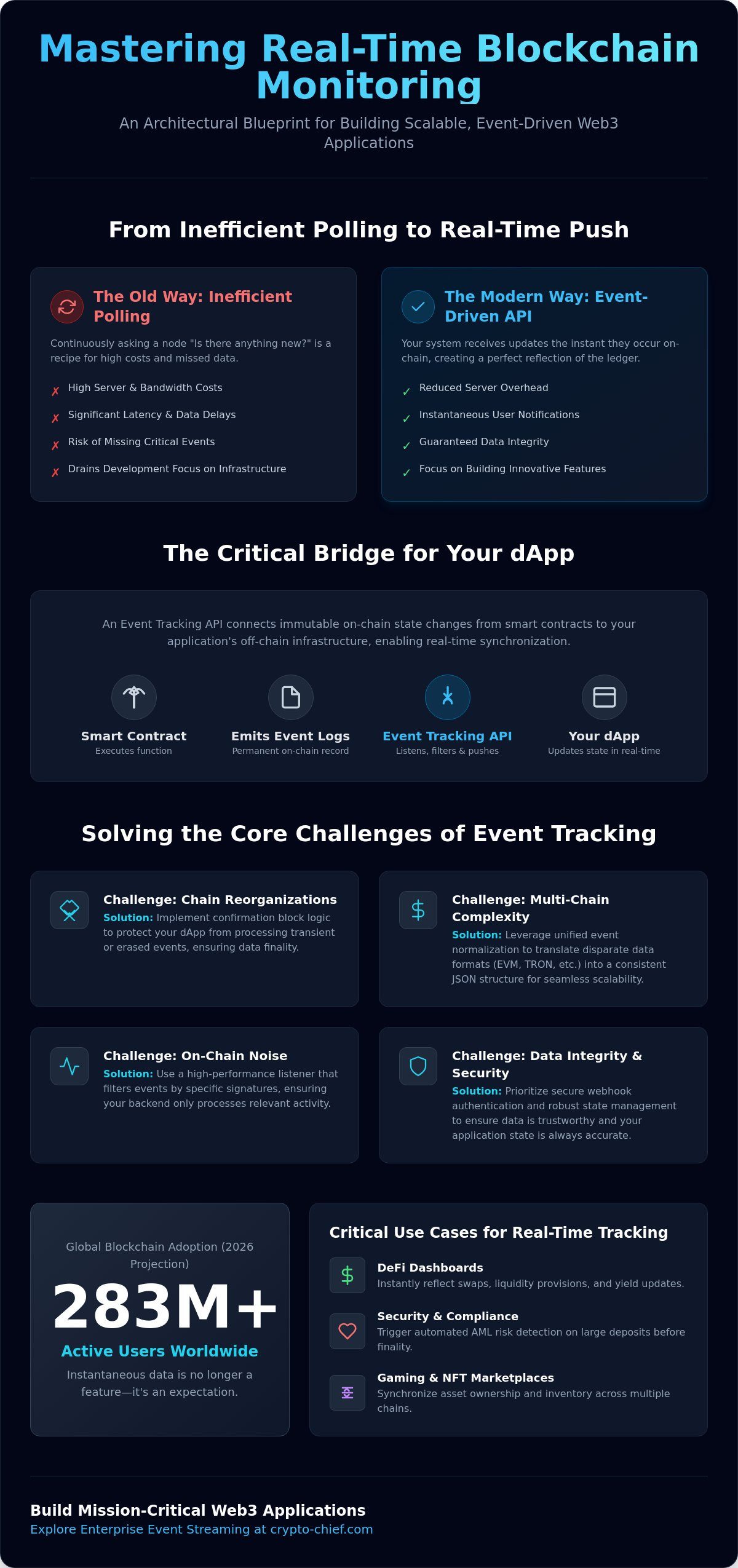
This article provides the definitive architectural template for mastering real-time blockchain monitoring through a scalable, event-driven lens. You'll learn how to transition from inefficient polling to a robust framework that reduces server overhead and ensures your users receive notifications the instant activity happens on-chain. We'll explore how to handle reorgs gracefully while structuring your backend to perform reliably as global adoption reaches over 283 million users worldwide. By the end of this guide, you will have a structural blueprint designed to support mission-critical Web3 applications with absolute precision.
Key Takeaways
- Understand how a blockchain event tracking api serves as the critical bridge between immutable smart contract logs and your application’s off-chain state.
- Learn to implement a high-performance listener layer that filters specific event signatures, ensuring your backend only processes relevant on-chain activity.
- Master a structural template for designing event-driven Web3 applications that prioritize data integrity through secure webhook authentication and robust state management.
- Resolve the complexities of chain reorganizations by implementing confirmation block logic, protecting your dApp from processing transient or erased events.
- Streamline your multi-chain operations by leveraging unified event normalization, which reduces technical friction and allows for seamless scalability across different networks.
What is a Blockchain Event Tracking API?
A blockchain event tracking api functions as the essential architectural bridge that connects immutable on-chain state changes to your application's off-chain infrastructure. In the traditional web world, you might rely on direct database triggers; however, blockchain environments require a more nuanced approach. When a smart contract executes a function, it emits logs that serve as a permanent record of that activity. These logs aren't just data points. They are the heartbeat of your decentralized application, signaling everything from token transfers to complex governance votes.
Historically, developers relied on manual JSON-RPC polling, where a server repeatedly asks a node for new information. This "pull" method is notoriously inefficient. It consumes excessive bandwidth and introduces significant latency. Modern Web3 development has shifted toward a "push" model rooted in Event-Driven Architecture. Instead of asking for updates, your system receives them the moment they occur. This transition minimizes server overhead and ensures your database remains a perfect reflection of the ledger. It's about moving from a reactive stance to a proactive, streamlined system.
The Anatomy of a Blockchain Event
Every event consists of two primary components: topics and data. Topics are indexed parameters, limited to four per event, which allow for high-speed searching and filtering. The data payload contains the unindexed, complex details of the transaction. To handle this volume without crashing, nodes use a "Log Bloom" filter. This probabilistic data structure allows a node to quickly determine if a block contains relevant events without scanning every single transaction. It's a vital optimization for any scalable blockchain event tracking api that needs to parse millions of logs in seconds.
Why Real-Time Tracking Matters in 2026
The demand for instantaneous data has never been higher as global blockchain adoption nears 4% of the population. In DeFi, users expect their dashboards to update the second a swap completes. Beyond the UI, real-time tracking is a security necessity. For instance, triggering an automated crypto AML risk detection api during a large deposit can prevent illicit funds from entering your ecosystem before the transaction is even finalized. Additionally, as gaming and NFT marketplaces expand across multiple chains, synchronizing inventory requires a reliable stream of events to maintain a unified user experience across disparate networks. It ensures that a sword sold on one chain isn't still listed as available on another.
How Blockchain Event Tracking APIs Work
The operational core of a blockchain event tracking api resides in its listener layer, a high-performance component that maintains a constant connection to the blockchain's head. This layer functions as a dedicated observer, watching the tip of the chain for every newly minted block. Unlike manual polling, which often misses data during spikes in network activity, this persistent connection ensures that every transaction is analyzed the moment it achieves inclusion in a block. It's a precise, non-stop process that forms the foundation of any reliable monitoring system.
Once a block is identified, the API initiates a rigorous filtering process to isolate relevant data from the immense volume of on-chain noise. Most basic node providers return raw, unformatted hex strings that vary significantly between networks like Ethereum, BNB Smart Chain, or TRON. This is where a unified blockchain api becomes indispensable. It acts as a translation layer, normalizing disparate data formats into a consistent JSON structure. This normalization allows your application to scale across multiple networks without the need to rewrite your parsing logic for every unique virtual machine environment. For developers seeking to bypass the complexity of manual data normalization, exploring a professional RPC gateway can significantly accelerate the deployment of these monitoring layers.
Webhooks vs. WebSockets: Choosing the Right Stream
The notification layer determines how that filtered data reaches your server. Webhooks utilize standard HTTP POST requests to deliver payloads to your specified endpoint. They are the preferred choice for asynchronous tasks, such as updating a database or triggering a server-side email notification. Because they don't require a persistent open connection on your server, they are highly resource-efficient for high-volume applications. In contrast, WebSockets provide a full-duplex communication channel. This is the gold standard for real-time trading dashboards and DeFi frontends where every millisecond of latency directly impacts the user's decision-making process. Many enterprise-grade applications adopt a hybrid approach, using WebSockets for the UI and Webhooks for backend record-keeping.
The Filtering Mechanism
Efficiency in event tracking is achieved through tiered filtering logic. You can configure your stream based on three primary criteria:
- Address-based filtering: This monitors every action associated with a specific smart contract address, which is essential for tracking all activity within a specific dApp.
- Topic-based filtering: This narrows the focus to specific event signatures, such as "Transfer," "Mint," or "Swap," allowing you to ignore irrelevant contract calls.
- Parameter-based filtering: This offers the highest level of precision by watching for specific values within the event logs, such as transactions involving a particular wallet address or amounts exceeding a certain threshold.
Architectural Template: Designing an Event-Driven Web3 App
Designing a production-grade Web3 application requires moving beyond simple scripts into a resilient, multi-layered architecture. While a blockchain event tracking api provides the raw data stream, your backend must be engineered to handle that data with surgical precision. This template outlines a five-step progression to ensure your system remains stable, secure, and perfectly synchronized with the ledger.
Step 1-2: Defining the Scope and Security
Everything begins with identifying the critical state changes within your smart contract logic. You shouldn't track every minor log; instead, focus on events that fundamentally alter your application's state, such as treasury allocations or ownership transfers. Once identified, you must define dedicated webhook endpoints for different event categories to keep your logic modular and easy to debug. This separation allows you to scale specific listeners independently as transaction volume grows.
Security is paramount here. You should never trust a webhook payload without verifying the signature provided in the header. A webhook signature is a cryptographic proof of origin. By validating this signature against your secret key, you ensure that the incoming data actually originated from your provider and hasn't been intercepted or forged by a malicious actor. It's a non-negotiable step for maintaining the integrity of your off-chain database.
Step 3-5: Building for Scalability
During periods of intense market volatility or high-profile NFT mints, the volume of incoming events can spike dramatically. To prevent your server from being overwhelmed, implement a queueing system like Redis to ingest these payloads immediately. This allows your application to process events at its own pace without dropping packets during peak traffic. It transforms a potentially chaotic burst of data into a manageable, steady stream.
Once the data is in your queue, use idempotent processing logic to handle each event. This ensures that if the same webhook is delivered twice, your database only records the change once, preventing duplicate entries and financial discrepancies. Finally, create a reconciliation worker that uses reliable web3 rpc endpoints to cross-reference event data against the chain's current state. This extra layer of verification confirms that the event wasn't part of an orphaned block before you map it to your internal database schema. By integrating a blockchain event tracking api into this structured template, you transform a volatile data stream into a reliable foundation for your business logic.
Solving the Core Challenges of Event Tracking
The most elegant architecture fails if it ignores the inherent volatility of distributed ledgers. While the previously discussed template provides a structural foundation, real-world implementation must account for the chaotic nature of decentralized networks. The primary concern for any developer using a blockchain event tracking api is the threat of data inconsistency. You aren't just capturing logs; you're managing a live, shifting state where yesterday's "final" transaction might be today's orphaned block. Addressing these challenges head-on is what separates a fragile prototype from an enterprise-grade application.
Reliability in this context means accepting that the network is never 100% certain until sufficient time has passed. This leads to the concept of confirmation blocks, which act as a buffer against chain instability. By waiting for a specific number of subsequent blocks to be mined, you significantly reduce the risk of acting on data that the network later discards. It's a trade-off between speed and finality. While a DeFi dashboard might show "unconfirmed" status immediately, your backend shouldn't trigger a high-value shipment or a permanent database update until that confirmation threshold is met. This disciplined approach ensures your internal state remains a mirror of the canonical chain, not a transient fork.
Managing Chain Reorganizations (Reorgs)
Chain reorganizations occur when two miners produce blocks nearly simultaneously, forcing the network to eventually choose one path and discard the other. If your system captures an event from the discarded path, that event effectively never happened. To solve this, your database must support a dual-status tracking system. Flag incoming events as "Pending" or "Unconfirmed" the moment they arrive. Only after the network reaches a specific depth should you promote them to "Confirmed."
Implementing a rollback mechanism is equally vital. If your listener detects a change in the block hash for a height you've already processed, your system must be capable of rewinding its state. The required depth varies by network. For instance, Ethereum typically requires 12 to 64 confirmations for high security, whereas Polygon might require a higher threshold due to its frequent, shallow reorgs. Matching your threshold to the specific security profile of the network is a critical optimization for any blockchain event tracking api strategy.
Ensuring Data Integrity and Delivery
Delivery failure is another silent killer of dApp performance. Most professional providers offer an "At-Least-Once" delivery guarantee, which means they will keep trying to send a webhook until your server acknowledges receipt. This is why the deduplication logic mentioned in our architectural template is non-negotiable. You must also implement active health checks and heartbeat monitors to ensure your event listeners haven't stalled. If your system detects a gap in block numbers, it should automatically trigger a resync to pull any missed data. For a deep dive into implementing these reliability standards, you can review our technical documentation to see how enterprise systems maintain 99.9% uptime. To ensure your application stays synchronized across all conditions, consider upgrading to a high-performance RPC gateway today.
Leveraging Crypto Chief for Enterprise Event Streaming
Crypto Chief EventStream acts as the high-performance engine for the architectural template we've outlined. It provides a robust, enterprise-ready infrastructure that removes the friction of maintaining your own node clusters. By shifting the heavy lifting of block monitoring and filtering to our global engine, you can focus on building user-centric features. Our system is designed for stability and performance, ensuring that your blockchain event tracking api remains operational even during periods of extreme network congestion.
Scaling a Web3 application often comes with unpredictable costs, especially when relying on legacy polling methods. We address this through a transparent pay-per-call pricing model that allows your infrastructure costs to align perfectly with your actual usage. This ensures you aren't overpaying for idle capacity during quiet periods, yet you maintain the ability to scale instantly when transaction volume surges. For businesses managing high-volume financial flows, our EventStream integrates directly with Crypto Processing to provide automated payment notifications that trigger business logic the moment a transaction achieves finality.
Unified Multichain Support
The modern Web3 ecosystem is inherently multi-chain, yet managing unique logic for every network is a significant drain on resources. EventStream offers simultaneous monitoring across Ethereum, BNB Smart Chain, and Polygon through a single interface. By providing standardized JSON responses, we eliminate the need for your team to write and maintain chain-specific parsers. A unified blockchain event tracking api reduces developer overhead by approximately 70%; this allows your engineering team to deploy cross-chain features in a fraction of the time it would take to build native integrations for each network.
Getting Started with EventStream
Deploying your first event listener shouldn't be a multi-week engineering project. You can register your account and configure your first webhook in just a few minutes. Once your endpoint is active, you'll have immediate access to real-time crypto transaction alerts, allowing your application to react to on-chain events with millisecond precision. Whether you're building a DeFi dashboard, an NFT marketplace, or an enterprise supply chain tracker, our infrastructure provides the structural integrity your project demands. Start tracking blockchain events with Crypto Chief today.
Future-Proof Your Web3 Architecture
Mastering the nuances of a blockchain event tracking api is no longer an optional skill for developers; it's the foundation of a resilient, user-centric dApp. We've explored how transitioning from inefficient polling to a push-based model reduces latency while ensuring your off-chain database remains perfectly synchronized with the ledger. By implementing a structural template that accounts for chain reorganizations and cryptographic security, you protect your application from the technical volatility inherent in decentralized networks. This disciplined approach ensures that your system remains a reliable source of truth for your users.
Scalability shouldn't come at the cost of architectural complexity. Our platform provides the global infrastructure needed to normalize data across multiple chains, allowing you to deploy faster without managing fragmented codebases. With pay-per-call pricing for maximum cost efficiency and an enterprise-grade global RPC gateway, you gain elite performance from a single, unified source. It's about building smarter, not harder.
Take the next step in your development journey by integrating a system designed for the rigorous demands of 2026. Stream Real-Time Blockchain Events with Crypto Chief and build with the confidence of a partner who has already solved the hardest problems for you. Your vision deserves a foundation that never wavers.
Frequently Asked Questions
What is the difference between an event and a log in blockchain?
An event is a high-level abstraction defined in your smart contract code, while a log is the actual data entry stored on the blockchain. When your contract triggers an event, the Ethereum Virtual Machine generates a log entry. These logs are accessible off-chain but can't be read by smart contracts themselves. This distinction is vital for understanding how data moves from the execution layer to your application's monitoring system.
How do webhooks handle blockchain reorganizations (reorgs)?
Webhooks handle reorgs through updated status payloads delivered to your endpoint. If a block is orphaned, a sophisticated provider sends a "reorg" notification to inform your system that a specific event is no longer valid. This allows your backend to trigger rollback logic immediately. Relying on a system that tracks these state changes automatically prevents your database from becoming out of sync with the canonical chain.
Can I track events on multiple blockchains with a single API?
You can certainly monitor multiple networks through a single blockchain event tracking api. This unified approach normalizes data from disparate chains like Ethereum, BNB Smart Chain, and Polygon into a consistent JSON format. It removes the need to build custom parsers for every individual network you support. Using a single interface simplifies your codebase and reduces the maintenance burden as your application expands into new ecosystems.
Why should I use an event tracking API instead of polling an RPC node?
Implementing a blockchain event tracking api instead of polling ensures that you don't waste resources on empty requests. Polling requires your server to make constant requests, which wastes bandwidth and often misses events during periods of high congestion. An event-driven API pushes data to you the moment it's confirmed. This reduces server overhead and ensures your users receive notifications with the lowest possible latency.
What is a "topic" in a smart contract event log?
A topic is an indexed parameter within a log that allows for high-speed searching and filtering. Every event log can have up to four topics. The first topic is usually the hash of the event name and its input types. The remaining three are reserved for indexed arguments, such as sender or receiver addresses. This structure enables nodes to quickly find specific transactions without scanning the entire block's data.
How do I secure my webhook endpoint from unauthorized requests?
Secure your endpoint by validating the cryptographic signature sent with each request. Your provider typically signs the payload using a secret key that only you and the provider know. When a webhook arrives, you hash the body and compare it to the signature in the header. If they don't match, you should reject the request. This prevents "replay attacks" and unauthorized data injection into your system.
Is it possible to track events for any smart contract, or only ones I own?
You can track events for any smart contract deployed on a supported blockchain. Since all transaction logs are public data, you aren't limited to contracts you've authored or deployed yourself. This is particularly useful for building analytics tools, block explorers, or monitoring competitor activity in the DeFi space. You simply need the contract address and the ABI of the events you wish to monitor.
What is the latency for real-time blockchain event notifications?
Latency for notifications is generally measured in milliseconds after a block is mined. Most professional providers deliver webhooks within 200 to 500 milliseconds of block inclusion at the node level. However, the total "real-world" latency also depends on your server's geographical location and the specific network's block time. For mission-critical applications, choosing a provider with a global node network is essential to minimize these delays.