
By 2026, compliance is no longer a manual hurdle at the end of a development cycle; it has become a core infrastructure primitive that determines whether your Web3 application thrives or fails under regulatory scrutiny. Most developers face a frustrating choice between exorbitant monthly retainers for legacy tools and the technical debt of building custom monitoring for every new chain. You shouldn't have to sacrifice your project's latency or your budget to maintain a secure environment. Integrating a real-time aml transaction monitoring api should be as seamless as calling an RPC node, providing instant intelligence without the friction of slow response times or complex data silos.
We understand that your focus belongs on building innovative features, not on managing the intricacies of global risk data. This guide provides a technical roadmap to embedding high-performance AML intelligence directly into your application's logic. You'll learn how to automate 'go/no-go' decisioning for transactions across multiple blockchains and utilize a predictable pay-per-call model that scales with your growth. We'll examine the transition from batch-processing to real-time streaming, ensuring your compliance stack is as agile and global as the decentralized networks you support.
Key Takeaways
- Modernize your compliance stack by shifting from T+1 batch reporting to millisecond-latency risk assessment, identifying high-risk activity before transactions are finalized.
- Simplify your development workflow by integrating a high-performance real-time aml transaction monitoring api to automate decision logic across multiple blockchains simultaneously.
- Optimize your operational budget with a pay-per-call pricing model that eliminates heavy monthly retainers and aligns compliance expenses with real-time transaction revenue.
- Enhance your security posture by utilizing unified AML Intelligence to detect complex patterns such as high-velocity smurfing and mixer activity through a single API gateway.
Why Real-Time AML Transaction Monitoring is Vital for Web3 in 2026
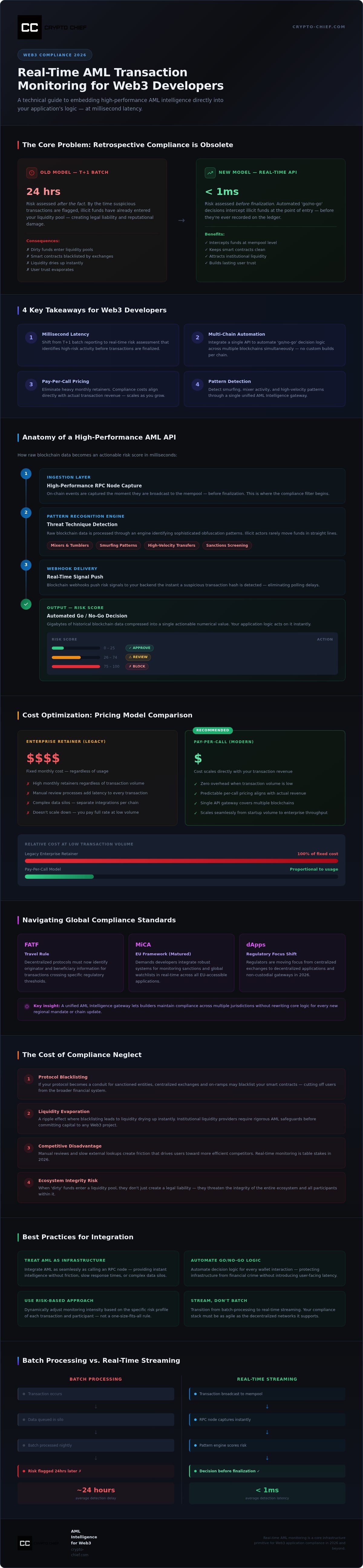
The era of retrospective compliance has ended. In the high-velocity environment of 2026, the traditional T+1 batch reporting model, where risks are assessed 24 hours after the fact, is no longer sufficient for decentralized protocols. Developers must now implement a real-time aml transaction monitoring api to identify and intercept illicit funds at the point of entry. This shift toward millisecond-latency risk assessment isn't just a technical preference; it's a requirement for protocol survival as regulators move their focus from centralized exchanges to decentralized applications (dApps) and non-custodial gateways. When 'dirty' funds enter a liquidity pool, they don't just create a legal liability; they threaten the integrity of the entire ecosystem. Automated risk scoring acts as a silent guardian, ensuring that every transaction meets your platform's safety thresholds before it's ever recorded on the ledger.
Maintaining global uptime while managing risk requires a system that functions as fast as the blockchains it monitors. If your application relies on manual reviews or slow external lookups, you risk creating friction that drives users toward more efficient competitors. High-performance intelligence allows you to automate the 'go/no-go' logic for every wallet interaction, protecting your infrastructure from being used as a tool for financial crime. This proactive stance is essential for securing partnerships with institutional liquidity providers who demand rigorous anti-money laundering (AML) safeguards before committing capital to any Web3 project.
Navigating Global Compliance Standards
Adhering to global standards requires more than a checkbox approach. The FATF Travel Rule now places significant pressure on decentralized protocols to identify originator and beneficiary information for transactions that cross specific regulatory thresholds. Regional frameworks like MiCA have matured, demanding that developers integrate robust systems for monitoring sanctions and global watchlists in real-time. By leveraging a unified AML Intelligence gateway, builders can maintain compliance across multiple jurisdictions without rewriting their core logic for every new regional mandate or chain update.
The Cost of Compliance Neglect
Ignoring the source of funds carries severe operational consequences that go beyond simple fines. If your protocol becomes a known conduit for sanctioned entities, centralized exchanges and on-ramps may blacklist your smart contracts, effectively cutting off your users from the broader financial system. This creates a ripple effect where liquidity dries up and user trust evaporates instantly. A risk-based approach is the industry standard for 2026 that requires protocols to dynamically adjust their monitoring intensity based on the specific risk profile of each transaction and participant.
Anatomy of a High-Performance AML Intelligence API
A sophisticated real-time aml transaction monitoring api functions as a high-speed filtration system for your protocol's liquidity. It begins at the ingestion layer, where high-performance RPC nodes capture on-chain events the moment they are broadcast to the mempool. This raw data is essentially noise until it's processed through a pattern recognition engine designed to identify sophisticated obfuscation techniques. Modern illicit actors rarely move funds in straight lines; they utilize mixers, tumblers, and high-velocity 'smurfing' patterns to hide the origin of capital. Your API must be capable of deconstructing these complex maneuvers in milliseconds, ensuring that the latency added to the user experience is virtually imperceptible.
The final output of this technical stack is a risk score. This translates gigabytes of historical blockchain data into a single, actionable numerical value that your application's logic can use to trigger automated 'go/no-go' decisions. To achieve this level of responsiveness, the intelligence engine should integrate seamlessly with real-time blockchain webhooks. These webhooks act as instant messengers, pushing risk signals to your backend the second a suspicious transaction hash is detected. If you're looking to fortify your stack, exploring a unified AML Intelligence gateway is the most efficient way to achieve this level of structural integrity.
From Raw Data to Risk Signals
Transforming raw hashes into risk signals requires deep tracing capabilities that follow funds through multiple hops and across disparate chains. Effective APIs map wallet addresses to a massive database of known entities, such as centralized exchanges, darknet markets, or sanctioned services. This process relies on strict data normalization; it ensures that a risk signal on Ethereum is interpreted with the same precision as one on Polygon or BNB Chain. Aligning your monitoring with FATF virtual asset AML guidelines requires this level of multichain visibility to prevent regulatory arbitrage.
Heuristics vs. AI-Driven Analysis
High-performance monitoring utilizes a hybrid approach to detection. Heuristics provide immediate, rule-based 'red flag' detection for binary risks, such as direct interaction with a sanctioned country's wallet. AI-driven analysis takes this further by identifying anomalous behaviors that don't fit a static rule but suggest illicit intent. This dual-layer strategy is vital for balancing precision and recall. It allows developers to catch sophisticated threats while minimizing the false positives that can frustrate legitimate users in high-volume applications. It's about building a system that's both an elite gatekeeper and a practical tool for growth.
Cost Optimization: Pay-Per-Call vs. Enterprise Retainers
For early-stage dApps, the traditional compliance pricing model is a structural trap. Legacy AML vendors lock teams into monthly retainers that are priced for enterprise transaction volumes, regardless of whether your protocol is processing ten transactions or ten thousand. You're effectively paying for capacity you haven't earned yet, which creates a direct conflict between your compliance budget and your runway. Adhering to FinCEN virtual currency AML compliance guidance is a non-negotiable obligation, but the mechanism for meeting that obligation shouldn't consume a disproportionate share of your operating capital before product-market fit is even established.
The pay-per-call model resolves this misalignment at its root. Instead of a fixed overhead commitment, your compliance costs become a variable line item that moves in direct proportion to your transaction revenue. When your volume grows, your spend scales accordingly. When activity is low, your burn rate reflects that reality. This structural alignment is what makes a real-time aml transaction monitoring api built on consumption-based pricing a fundamentally different financial instrument than a legacy retainer agreement.
Eliminating Infrastructure Over-Provisioning
Tiered monthly plans carry a hidden cost that rarely appears in vendor proposals: unused capacity. When you purchase a tier that supports a ceiling you haven't reached, you're subsidizing the vendor's infrastructure, not your own growth. A granular, per-call billing structure keeps your microservice architecture lean by default. Scaling from a few hundred requests to millions doesn't require renegotiating a contract or upgrading a plan; the infrastructure absorbs the volume, and your invoice reflects only what you consumed. This is the same operational philosophy that has made pay as you go RPC nodes the standard for Web3 infrastructure, and it applies with equal force to compliance tooling.
The Pay-Per-Call Advantage
Consumption-based pricing delivers three concrete operational benefits that fixed retainers cannot replicate:
- Transparency: Every compliance check carries a known, discrete cost. Your finance team can attribute AML expenditure directly to transaction volume, making unit economics legible from day one.
- Flexibility: You pay only for the chains and detection features your application actually uses. If your protocol operates on Ethereum and Polygon but not BNB Chain, your invoice reflects that scope precisely.
- Predictability: Managing a prepaid token balance gives your team a clear consumption dashboard, eliminating surprise invoices at the end of a billing cycle.
The token-based API model is the most efficient way to manage Web3 compliance overhead, converting an unpredictable fixed liability into a measurable, controllable variable cost. For teams building on AML Intelligence, this means the compliance layer functions as a silent, proportional partner rather than a fixed anchor on your balance sheet.
Best Practices for Integrating AML into Your Workflow
A clean integration architecture separates protocols that scale from those that accumulate technical debt. The four-step workflow below gives your team a repeatable, audit-ready pattern for embedding compliance logic directly into your transaction pipeline, without blocking user experience or creating fragile single points of failure.
Step 1: Ingest the transaction hash. The moment a user initiates a transaction, your backend captures the raw hash via the Crypto Processing API. This is your entry point. Rather than waiting for block confirmation, you intercept the event at broadcast, giving your compliance layer the maximum available window to act before finality.
Step 2: Query the AML Intelligence endpoint. Pass the hash and the associated wallet address to the AML Intelligence endpoint. The response returns a normalized risk score derived from entity mapping, behavioral heuristics, and cross-chain tracing. This single call replaces what would otherwise require multiple data sources, custom parsers, and separate vendor contracts.
Step 3: Execute 'Freeze or Flow' logic. Your application reads the score against thresholds you define based on your platform's risk appetite. A clean score releases the transaction automatically. A high-risk score triggers an immediate hold. Scores in the intermediate range, your 'yellow' flags, route to a manual review queue. This tiered decisioning keeps your false-positive rate manageable while ensuring that genuinely suspicious activity never slips through unexamined.
Step 4: Log the audit trail. Every check, its timestamp, the score returned, and the decision executed, gets written to your Unified API record. This non-custodial log is your evidentiary foundation for any regulatory review. It proves that your real-time aml transaction monitoring api integration was active, functioning, and producing documented decisions at the moment each transaction was processed.
Managing Latency in Real-Time Flows
Blocking synchronous calls are the wrong architecture for high-volume environments. Asynchronous webhooks decouple the risk check from the user-facing response, so your interface confirms receipt instantly while the compliance decision resolves in the background. Pair this with RPC request batching to consolidate multiple address lookups into a single network round-trip, and implement a short-lived cache for frequently checked addresses. Wallets that transact repeatedly within a session don't need a fresh API call on every interaction; a cached result with a defined TTL reduces latency and conserves your token balance simultaneously.
Building an Audit-Ready System
Regulatory defensibility requires more than clean logs. Your system should automate the generation of Suspicious Activity Reports for any transaction that crosses your high-risk threshold, pre-populating the relevant fields from the data already captured during the check. Yellow-flag cases need a direct integration with your case management tooling so analysts receive structured context, not raw hashes. Crucially, the compliance record must remain non-custodial; you're logging decision metadata, not storing private user data, which keeps your architecture aligned with privacy frameworks without sacrificing the audit trail regulators expect.
Ready to implement this workflow without rebuilding your infrastructure? Create your account and connect your first AML Intelligence call in minutes.
Scaling with Crypto Chief's Unified AML Intelligence
Most compliance tools operate in isolation. They monitor transactions, return a score, and stop there, leaving your team to manually reconcile that data with your payment processing layer, your RPC infrastructure, and your audit logs. Crypto Chief's AML Intelligence breaks that pattern by functioning as a native component of a unified Web3 stack rather than a bolted-on silo. Every risk signal, every entity lookup, and every cross-chain trace resolves through a single high-performance gateway that connects directly to the same infrastructure your application already uses for processing and node access.
Multichain coverage is built into the architecture by default. Whether your protocol operates on Ethereum, BNB Smart Chain, Polygon, or a combination of networks, the AML Intelligence module applies consistent risk scoring logic across each chain without requiring separate vendor relationships or custom parsers for each network. Your decisioning logic stays clean. One integration handles the full scope of your multichain exposure, and the risk signals it returns are normalized so that a flagged address on one network carries the same interpretive weight as one identified on another.
Deep-dive funds tracing becomes structurally simpler when AML Intelligence integrates directly with your RPC nodes. Rather than routing transaction data through an external intermediary, the monitoring layer sits close to the source, reducing the number of network hops between raw on-chain events and actionable risk signals. That proximity is what makes a real-time aml transaction monitoring api genuinely real-time rather than near-real-time with an asterisk attached.
Unifying Payments and Compliance
Combining the Crypto Processing API with AML Intelligence through a single provider compresses your integration timeline considerably. Every incoming payment routed through the processing layer can be screened before it settles, without requiring a separate authentication handshake, a second SDK, or a parallel data pipeline. The compliance check and the payment confirmation share the same infrastructure context, which means your audit trail is already unified before you write a single logging function. This is how you eliminate the fragmentation that turns compliance into technical debt.
Reliability and Global Uptime
Real-time compliance only works if the infrastructure behind it is consistently available. A risk check that times out during peak volume isn't a minor inconvenience; it's a gap in your audit record and a potential regulatory exposure. Crypto Chief's global infrastructure network is engineered to keep API call latency low regardless of where your users transact, ensuring that your real-time aml transaction monitoring api layer performs with the same reliability as the rest of your Web3 stack. Compliance doesn't get a maintenance window. Your infrastructure shouldn't either.
Start building your compliant dApp today with Crypto Chief and connect AML Intelligence to your existing infrastructure in a single session.
Build Compliant, Build Fast
The gap between protocols that scale and those that stall in 2026 comes down to infrastructure decisions made early. Embedding a real-time aml transaction monitoring api into your transaction pipeline isn't a compliance checkbox; it's a structural advantage that protects your liquidity, satisfies institutional partners, and keeps your audit trail defensible without slowing your users down.
Three principles carry forward from everything covered here. First, real-time risk scoring at the mempool level is the only architecture that matches the speed of modern decentralized networks. Second, consumption-based pricing keeps your compliance costs proportional to your actual growth rather than anchored to a fixed retainer you haven't earned yet. Third, unified multichain coverage through a single gateway eliminates the fragmentation that quietly becomes technical debt.
Crypto Chief's AML Intelligence delivers all three: pay-per-call pricing with no monthly retainers, normalized risk signals across Ethereum, BNB Smart Chain, Polygon, and beyond, and enterprise-grade uptime engineered for the demands of global Web3 infrastructure. Your compliance layer should work as hard as the rest of your stack. Scale your compliance with Crypto Chief's Pay-Per-Call AML API and start building with confidence from day one.
Frequently Asked Questions
What is the difference between AML screening and transaction monitoring?
AML screening is a point-in-time check that compares a wallet address or entity against sanctions lists and known watchlists before a relationship is established. Transaction monitoring is an ongoing process that analyzes behavioral patterns across the full lifecycle of activity, flagging anomalies like sudden volume spikes or structuring patterns that screening alone would miss. You need both working in tandem for a defensible compliance posture.
Screening catches known bad actors at the door. Monitoring catches unknown ones as they operate. A real-time AML transaction monitoring API handles both functions within a single call, returning entity-level risk data alongside behavioral signals derived from live on-chain activity.
Does a real-time AML API work for non-custodial wallets?
Yes. A real-time AML transaction monitoring API analyzes the wallet address and its associated transaction history regardless of whether the wallet is custodial or non-custodial. The API doesn't require custody of funds to assess risk; it reads publicly available on-chain data, traces fund flows through multiple hops, and maps addresses against known entity databases. Custody status is irrelevant to the detection logic.
This is particularly relevant for dApp developers who interact with self-custodied wallets by default. The compliance check operates at the protocol layer, not the wallet layer, so your integration works uniformly across every wallet type your users connect.
How much does a real-time AML transaction monitoring API cost?
Pricing structures vary across providers, so you should evaluate any vendor's specific rate card directly rather than relying on industry averages. What matters architecturally is the pricing model itself. Crypto Chief's AML Intelligence uses a pay-per-call structure backed by prepaid token balances, meaning your compliance expenditure tracks your actual transaction volume rather than a fixed monthly commitment. There are no retainers to negotiate and no unused capacity to subsidize.
This consumption-based approach is the most cost-transparent model available. Your finance team can attribute every compliance expense directly to a discrete API call, making unit economics straightforward from the first transaction you process.
Can I use an AML API for multiple blockchains at once?
A well-architected AML API handles multichain coverage through a single integration point. Crypto Chief's AML Intelligence applies consistent risk scoring logic across Ethereum, BNB Smart Chain, Polygon, and additional networks without requiring separate vendor relationships or custom parsers for each chain. Risk signals are normalized across networks, so a flagged address carries equivalent interpretive weight regardless of which chain the activity originated on.
This unified approach eliminates the fragmentation that comes from stitching together chain-specific monitoring tools. One authenticated connection covers your full multichain exposure, and your decisioning logic stays clean and maintainable as you expand to new networks.
What happens if a transaction is flagged as high-risk?
Your application's response to a high-risk flag is determined by the threshold logic you define, not by the API itself. A score above your configured ceiling triggers an automatic hold, preventing the transaction from proceeding until a human analyst reviews it or your system resolves it programmatically. Intermediate scores route to a manual review queue. Clean scores release the transaction without any user-facing friction. The API returns the signal; your business logic executes the decision.
Every flagged transaction, its score, timestamp, and the decision your system executed, gets written to your audit log. This creates the evidentiary record regulators expect to see during a compliance review, proving that your monitoring layer was active and producing documented outcomes at the moment each transaction was processed.
Is an AML API enough to be fully compliant with the Travel Rule?
No, and it's important to be direct about this. The FATF Travel Rule requires protocols to collect and transmit originator and beneficiary information for transactions above defined thresholds, which involves data exchange obligations that go beyond risk scoring. An AML API is a critical component of a compliant stack, but it addresses the risk assessment layer rather than the data transmission requirements that the Travel Rule specifically mandates.
Think of AML monitoring as a necessary foundation, not the complete structure. You'll need to assess your specific jurisdictional obligations and consult qualified legal counsel to determine the full scope of Travel Rule compliance requirements for your protocol's operating model.
How fast is the response time for a real-time AML check?
Response time depends on the provider's infrastructure architecture, but a genuinely real-time system returns a risk score in milliseconds, not seconds. The key architectural factor is proximity: when the monitoring layer sits close to the RPC node infrastructure rather than routing through a separate intermediary, the number of network hops between a raw on-chain event and an actionable risk signal is minimized. That proximity is what separates genuinely real-time performance from systems that are technically near-real-time.
For high-volume applications, asynchronous webhook delivery further reduces perceived latency by decoupling the risk check from the user-facing response. Your interface confirms receipt instantly while the compliance decision resolves in the background, keeping the user experience smooth regardless of check volume.