
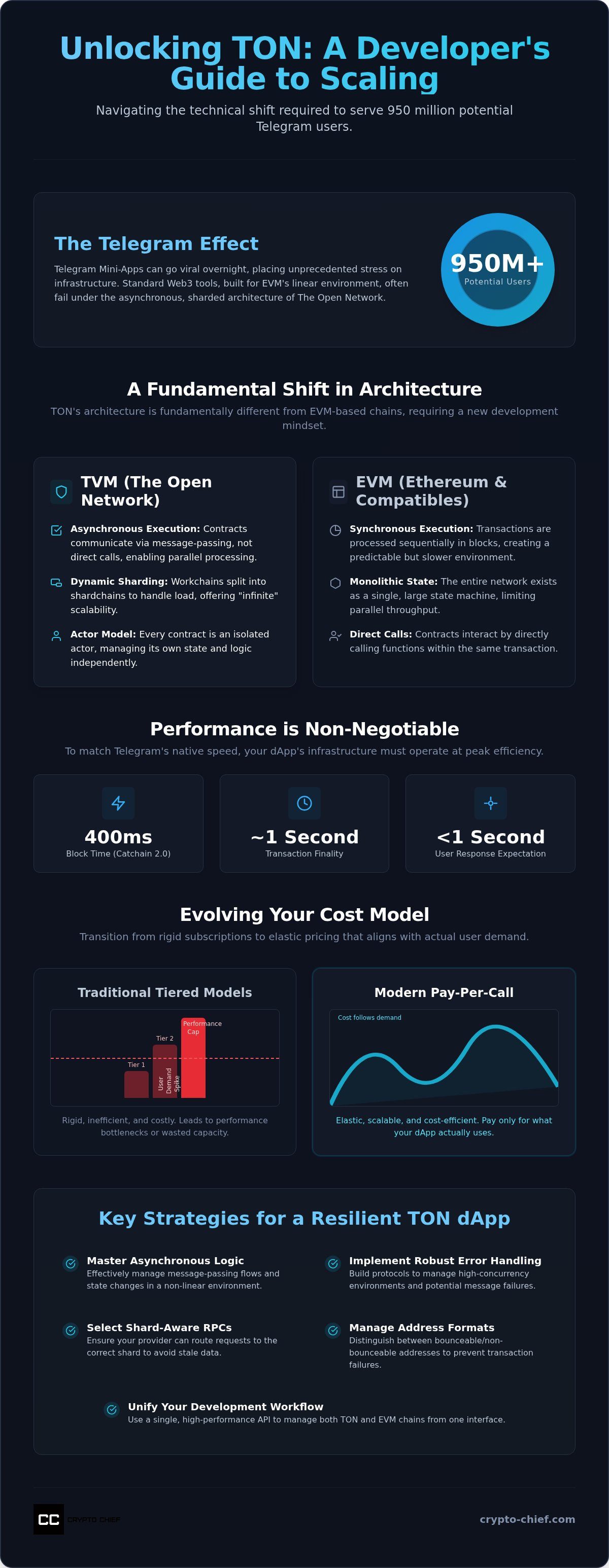
Scaling a dApp to 950 million potential users is no longer a theoretical stress test. It is the baseline requirement for anyone building on The Open Network today. With the 2026 implementation of Catchain 2.0 reducing block times to a staggering 400 milliseconds, the technical pressure on your rpc ton network infrastructure has never been higher. You likely recognize that the asynchronous, sharded nature of TON demands a complete departure from the EVM-centric playbooks you have used in the past. It is frustrating to watch a Telegram Mini-App go viral only to see your margins evaporate under the weight of rigid, high-tier subscription costs or lag-heavy responses.
We understand that modern architects need more than just a connection; they require an elastic foundation that mirrors Telegram's own global speed. This guide will help you master the complexities of TON's unique workchain architecture while revealing how to select a high-performance RPC provider that offers predictable, pay-per-call pricing. We will explore the shift toward unified multichain management and the specific strategies required to ensure your integration remains both low-latency and cost-efficient as your project reaches mass adoption. By the end of this article, you will have a clear roadmap for deploying scalable, enterprise-ready applications within the TON ecosystem.
Key Takeaways
- Master the unique technical requirements of the rpc ton network to handle the viral traffic spikes typical of Telegram Mini-Apps without performance degradation.
- Understand the impact of TON's Actor Model and dynamic sharding on your integration strategy to maintain consistent state management across workchains.
- Transition from rigid, tier-based subscription models to elastic pay-per-call pricing that aligns your infrastructure costs with actual user demand.
- Implement robust error-handling protocols and select the optimal developer libraries to manage asynchronous message flows effectively in high-concurrency environments.
- Streamline your development workflow by using a unified API to manage TON alongside EVM-compatible chains from a single, high-performance interface.
Understanding the TON RPC Landscape: Why Standard Web3 Infrastructure Isn't Enough
A TON RPC (Remote Procedure Call) serves as the essential gateway for decentralized applications to communicate with the blockchain. It's the bridge that translates your code into executable actions on-chain. As we move through 2026, the rpc ton network has evolved far beyond the simple node setups of the early crypto era. This change is largely fueled by the "Telegram Effect," a phenomenon where the viral nature of Telegram Mini-Apps places unprecedented stress on infrastructure. When an app scales to millions of users overnight, standard Web3 tools often fail to provide the necessary throughput. The TON (blockchain) requires a specialized approach because its architecture is fundamentally different from the Ethereum-based systems most developers know.
Your existing Ethereum tools won't work with the TON Virtual Machine (TVM). Standard EVM-compatible RPCs expect a linear, synchronous environment that simply doesn't exist here. This reality has forced a shift from centralized, fixed-capacity node providers toward elastic gateways. These modern solutions are designed to scale alongside your user base, ensuring that a sudden influx of traffic doesn't lead to dropped requests or skyrocketing costs. Understanding this landscape is the first step toward building a resilient integration.
The Core Differences: EVM vs. TVM RPCs
The primary hurdle for many developers is moving from a synchronous to an asynchronous mindset. TON uses a message-passing architecture where smart contracts communicate by sending messages to one another rather than calling functions directly in a single block. This impacts how you query data via the rpc ton network. Additionally, the account structure on TON is unique; "everything is a contract," including individual user wallets. This means an RPC request often involves more complex state queries than a simple balance check. Developers must also handle address formats carefully, using RPC methods to distinguish between bounceable and non-bounceable addresses to prevent transaction failures.
Why Latency is the Silent Killer for Telegram Mini-Apps
User experience is the currency of the Telegram ecosystem. If your Mini-App takes more than a second to load or respond, users will simply close it. Matching Telegram's native speed requires an RPC provider with global node distribution to minimize "Time to First Byte" (TTFB). High-performance infrastructure ensures that your app remains responsive regardless of where the user is located. TON achieves transaction finality in approximately one second, a feat that requires a high-performance RPC to relay state changes without introducing technical bottlenecks.
The Technical Architecture of TON RPC: Actor Models, Sharding, and State Queries
TON isn't just another blockchain; it's a massive distributed system of independent actors. Every smart contract on the network operates as an isolated entity, following the "Actor Model." This architecture dictates that contracts communicate exclusively through asynchronous messages rather than direct function calls. When you integrate an rpc ton network, you're interacting with a living system where state changes ripple through the network. This isolated nature means your dApp must handle message-passing logic that is fundamentally different from the synchronous environment of the Ethereum Virtual Machine.
Dynamic sharding adds another layer of complexity to the infrastructure. As transaction volume increases, workchains split into multiple shardchains to maintain throughput. The TON Whitepaper describes this "infinite sharding" capability as a core feature for global scalability. An effective RPC must seamlessly navigate these boundaries. It has to identify which shard holds the specific contract state you're requesting at any given millisecond. Without this shard-aware routing, your application risks receiving stale data or encountering failed queries during periods of high network volatility.
Querying the blockchain state requires specialized methods that go beyond simple balance checks. The `getExtendedAddressInformation` method is a technical workhorse in this ecosystem. It allows you to retrieve a contract's status, balance, and code hash in a single request. Most developers begin their journey using Lite Servers because they're lightweight and fast for basic interactions. However, enterprise-grade applications often require the depth of a Full Node to access archive data or perform complex indexing. Balancing these access methods is critical for maintaining performance without bloating your infrastructure costs.
Navigating Shardchains and Masterchains
Routing is the primary challenge in a sharded environment. If your RPC queries the wrong shard, the response will be incomplete. The Masterchain acts as the ultimate source of truth, synchronizing the states of all individual shardchains. Crypto Chief's RPC Gateway abstracts this entire routing layer. You don't have to build shard-aware logic into your backend; our infrastructure handles the heavy lifting of finding and delivering the correct state data. This allows your team to focus on building features while we manage the underlying structural integrity.
Asynchronous Message Passing via RPC
Transactions on TON follow a "fire and forget" pattern. When you send a message, it doesn't immediately result in a final state change. It might traverse several shards before completion. You can't simply wait for a transaction receipt like you would on a synchronous chain. Instead, you must track inbound and outbound messages to confirm success. Using our EventStream service provides real-time visibility into these message statuses. It ensures your Telegram Mini-App's interface reflects the actual state of the chain, providing the sub-second responsiveness users expect. If you're ready to test this performance, you can register for an account and begin exploring our high-performance endpoints today.
Evaluating TON RPC Providers: Performance, Reliability, and Cost-Per-Request
Selecting an rpc ton network provider is a strategic decision that dictates your long-term operational overhead. Many developers default to monthly subscription tiers, assuming these offer predictable costs. However, Telegram Mini-Apps often experience "bursty" traffic patterns where a viral social post can trigger millions of requests in minutes. Fixed plans either throttle your connection during these critical peaks or force you into expensive enterprise tiers that remain underutilized for the majority of the month. This "Infura bottleneck" is a common pitfall that can stall a project's growth. Reliability in this environment requires a minimum 99.9% uptime SLA to ensure your dApp remains functional during high-concurrency events.
Beyond raw connectivity, you must evaluate a provider's data indexing capabilities. Simple RPC access is often insufficient for complex NFT or DeFi queries, which require indexed data to avoid timeouts or incomplete state returns. An elastic scaling model ensures that your infrastructure expands and contracts based on real-time demand, preventing the technical debt associated with manual node management. This structural integrity is what separates hobbyist tools from enterprise-grade gateways.
Pay-Per-Call vs. Subscription Models
Calculating the ROI for inconsistent traffic reveals that pay-per-call models offer significant capital efficiency compared to fixed monthly overhead. Instead of paying for capacity you rarely use, you only settle for the requests your application actually executes. Pre-paid token balances provide a transparent way to manage budgets, allowing architects to allocate resources without the fear of hidden overage fees. The pay-per-call model provided by Crypto Chief has become a preferred standard for 2026, offering the precise elasticity required for the Telegram ecosystem.
Performance Benchmarking: Latency and Throughput
Latency is the primary differentiator between a seamless integration and a frustrating user experience. Global node distribution is non-negotiable for reducing round-trip times for an international Telegram user base. High throughput ensures that your backend can process thousands of concurrent messages without degradation. RPC request batching drastically lowers overhead for TON developers by consolidating multiple state queries into a single network transmission. This technique reduces the "Time to First Byte" and optimizes your cost-per-request, ensuring your architecture remains lean as your user base scales toward the millions.
Optimizing Your TON Integration: Best Practices for Developers
Choosing the right library is your first architectural hurdle. While TonWeb is the go-to for JavaScript developers and TonLib offers deep protocol access, these libraries often require significant boilerplate for multichain projects. Integrating an rpc ton network gateway efficiently means choosing a tool that balances power with simplicity. You should prioritize libraries that offer native support for TON's unique cell-based data structures while allowing for clean, readable code. If you're building a complex Telegram Mini-App, the right library choice can be the difference between a launch that scales and one that breaks under load.
Robust error handling is non-negotiable. Because TON transactions are asynchronous, a message can fail long after your initial request is sent. Don't assume success based on a valid response from the rpc ton network. You must implement logic to track message hashes and handle "bounced" messages effectively. Optimizing state queries is equally vital; batching requests and caching static contract data can reduce your total call volume significantly in high-traffic scenarios. Secure your infrastructure by using restricted API keys and ensuring all wallet interactions remain strictly non-custodial to maintain the highest security standards.
Integrating TON into a Multichain Stack
Managing different data formats across Ethereum, Solana, and TON is a common pain point for modern developers. Normalizing this data allows your backend to treat a TON transaction with the same logic used for an EVM chain, which streamlines your internal processes. Using a Unified API simplifies this integration immensely. It removes the need to maintain separate, bulky codebases for each individual chain, drastically reducing your team's maintenance overhead. Why build three different systems when one resilient interface can manage your entire cross-chain portfolio?
Security and AML Compliance on TON
The inherent anonymity of the TON ecosystem presents unique regulatory challenges that you cannot ignore. Proactive risk detection is essential for any dApp handling significant volume or fiat on-ramps. Integrating AML Intelligence allows you to scan TON addresses for high-risk flags before processing payments or allowing withdrawals. This ensures your project remains compliant with global standards while protecting your platform from illicit activity. To start building with these enterprise-grade security tools, contact our support team to discuss your specific integration needs and scaling goals.
Why Crypto Chief is the Premier Choice for TON RPC Infrastructure
High-performance development in 2026 requires more than just a raw connection to the blockchain. It demands a unified ecosystem where infrastructure, security, and payment logic coexist seamlessly. Crypto Chief provides this exact foundation, offering a high-performance rpc ton network gateway alongside integrated AML Intelligence and crypto processing. By placing these critical tools under one roof, we eliminate the friction of managing multiple third-party vendors. This approach doesn't just save time; it ensures that your security protocols and transaction monitoring are as fast as the network itself.
Cost efficiency remains a cornerstone of our service model. While other providers lock you into rigid monthly tiers that punish growth, our pay-per-call pricing ensures you only pay for the resources you consume. This is the most competitive model in the Web3 space, designed specifically to support the volatile traffic patterns of the Telegram ecosystem. Our team provides comprehensive documentation and dedicated technical support to ensure your integration remains future-proof. As TON continues to evolve with Catchain 2.0 and new TVM upgrades, our infrastructure updates automatically to keep your dApp at the forefront of the industry.
Elastic Scaling for the Telegram Ecosystem
The viral nature of Telegram means your user base can explode in an instant. Our infrastructure is built to handle these surges, scaling from zero to one million requests in seconds without latency spikes. Whether you're launching the next generation of TON "Clicker" games or a sophisticated DeFi protocol, our global node network provides a reliable backbone with no single points of failure. This global reach ensures that a user in Dubai experiences the same sub-second responsiveness as a developer in Singapore, maintaining the high standards your audience expects.
Getting Started with TON RPC on Crypto Chief
Deploying your first request is a straightforward process designed for speed. After a quick registration, you can generate your API keys and begin querying the TON mainnet immediately. The Crypto Chief dashboard provides real-time visibility into your usage and balance, allowing you to monitor your project's health with granular precision. You'll have access to the same high-performance endpoints used by enterprise-grade applications, backed by our commitment to uptime and structural integrity. Start building on the TON network today with Crypto Chief's high-performance RPC and experience the difference of a truly elastic, developer-centric gateway.
Scaling Your Vision on The Open Network
The transition toward a Telegram-centric Web3 economy requires a fundamental shift in how we approach blockchain infrastructure. You've seen that the asynchronous nature of the rpc ton network demands a departure from standard EVM workflows; it rewards architects who prioritize latency and elastic scalability. By moving away from rigid subscription tiers and embracing a pay-per-call model, you ensure that your dApp remains cost-efficient even during viral traffic spikes. This structural agility is the key to surviving and thriving in the 2026 landscape.
Crypto Chief stands ready as your silent, powerful partner in this journey. We provide a 99.9% global uptime guarantee and integrated AML intelligence to ensure your project remains both resilient and compliant. With our Unified Multichain API, you can manage your TON integration alongside your existing assets without doubling your development overhead. The tools for mass adoption are already in your hands; it's time to deploy them.
Build Faster on TON - Get Your RPC Endpoint Now
The future of the TON ecosystem is yours to build. We are here to ensure your foundation never falters.
Frequently Asked Questions
What is an RPC on the TON network and why do I need one?
An RPC (Remote Procedure Call) on the TON network is the primary communication layer that allows your application to interact with the blockchain. You need one to query account balances, fetch smart contract data, and broadcast transactions to the network ledger. Without a reliable rpc ton network gateway, your dApp cannot read or write to the blockchain, making it the most critical piece of your technical infrastructure.
How does TON's actor model affect RPC performance?
TON's actor model means every smart contract processes messages independently and asynchronously. This architecture requires an RPC to manage complex message-passing sequences rather than simple synchronous calls. High-performance gateways must handle this concurrency without bottlenecks, ensuring that your requests don't stall while waiting for cross-shard communications to finalize. It shifts the burden of complex state management from the developer to the infrastructure provider.
Is TON compatible with MetaMask or other EVM tools?
TON is not compatible with MetaMask or standard EVM tools because it uses the TON Virtual Machine (TVM) instead of the Ethereum Virtual Machine. The network's sharded architecture and non-linear logic require specialized wallets and developer tools that understand its unique cell-based data structures. Attempting to use Ethereum-based libraries or RPC methods will result in incompatible requests and failed transactions.
How much does a TON RPC provider cost in 2026?
Pricing for TON RPC access in 2026 typically follows three distinct models: free tiers for early-stage developers, fixed monthly subscriptions for growth projects, and custom enterprise plans for high-volume dApps. While some providers charge flat monthly fees regardless of actual usage, others utilize request-based models that charge per million calls. You should compare these options based on your expected traffic to avoid overpaying for unused capacity.
What is the difference between a TON Lite Server and a Full Node RPC?
A Lite Server is a lightweight node that provides fast access to current blockchain state without storing the entire transaction history. It's ideal for basic wallet operations and simple balance queries. In contrast, a Full Node RPC maintains the complete state and often includes archive data, which is necessary for complex indexing, historical analysis, and DeFi protocols that require deep data visibility across the network's history.
Can I use the same RPC for TON and Ethereum?
You cannot use the exact same endpoint URL for both networks, but you can use a single provider that offers a Unified API for both. This approach allows you to manage multiple chains through a centralized dashboard while keeping your backend code normalized. It simplifies the development process for multichain projects by providing a consistent interface and billing system for both TON and EVM-compatible networks.
How do I handle asynchronous transaction confirmation on TON via RPC?
Handling transaction confirmation on TON requires tracking the status of outbound messages as they move through the network's shards. Since the Catchain 2.0 upgrade in early 2026 reduced finalization to nearly one second, you must query the rpc ton network to confirm that a message was accepted and executed by the target contract. Relying on a real-time event stream is often more efficient than manual polling for high-frequency applications.
Why is pay-per-call pricing better for Telegram Mini-Apps?
Pay-per-call pricing is superior for Telegram Mini-Apps because it aligns infrastructure costs with the network's inherent virality. Telegram apps often experience sudden, massive traffic spikes that can exhaust fixed monthly tiers instantly. An elastic model ensures you only pay for the requests you actually use, providing a cost-efficient foundation that scales automatically as your user base grows from hundreds to millions without manual intervention.
Tags: rpc ton network