
Maintaining a separate infrastructure for every L1 and L2 is no longer a sign of technical depth; it's a structural liability that drains your engineering resources. You've likely felt the friction of managing disparate RPC nodes and attempting to normalize inconsistent data schemas across Ethereum, Solana, and Polygon. Integrating a robust multichain payment gateway api is the only logical path forward for architects who value performance over complexity. By unifying these connections, you can eliminate the security risks inherent in custodial solutions while maintaining direct control over your digital assets.
In this guide, you'll learn how to deploy a single, non-custodial endpoint that handles cross-chain transactions with predictable, pay-per-call pricing. We will examine the technical requirements for navigating the July 2026 MiCA compliance deadline and the US GENIUS Act mandates; ensuring your stack includes integrated AML intelligence and risk scoring is now a functional necessity. From migrating to Circle’s CCTP V2 to abstracting away gas management, this is your blueprint for a high-performance, chain-agnostic payment architecture that scales as fast as the $8 trillion global crypto market.
Key Takeaways
- Discover how a unified interface abstracts blockchain complexity by translating diverse protocols into a standardized JSON-RPC or REST schema.
- Learn to eliminate "node fatigue" by leveraging a single multichain payment gateway api to replace the overhead of managing multiple full nodes across Ethereum, BNB Chain, and Solana.
- Master the workflow of non-custodial processing to ensure your application remains secure while providing a seamless, automated checkout experience.
- Compare the efficiency of pay-per-call pricing against traditional tiers to optimize your infrastructure costs and improve operational predictability.
- Identify the essential features of a high-performance stack, including integrated EventStream and AML intelligence, for building scalable Web3 payment systems.
What is a Multichain Payment Gateway API?
A traditional payment gateway facilitates the transfer of information between a payment portal and a front-end processor. In the decentralized world, a multichain payment gateway api performs an even more complex task by abstracting the architectural differences between various ledgers. It functions as a unified interface that allows your application to interact with multiple blockchains through a single set of standardized endpoints. Rather than writing unique logic for every new chain you support, you use a single gateway to communicate with Ethereum, Solana, Bitcoin, and emerging networks simultaneously.
The core function of this technology is data normalization. It translates diverse blockchain protocols, each with its own transaction lifecycle and data format, into a predictable JSON-RPC or REST schema. This abstraction layer is vital for developers who need to scale quickly without drowning in technical debt. It's about structural integrity. By standardizing these inputs, you reduce the surface area for logic errors in your codebase, ensuring that a transaction on Solana is handled with the same programmatic ease as one on Ethereum. Modern solutions focus on non-custodial processing, allowing you to leverage a third-party Crypto Processing API while maintaining absolute control of your private keys. You get the utility of a managed service without the counterparty risk of a custodial silo.
The Evolution of Web3 Payment Infrastructure
The industry has moved beyond the era of fragile, single-chain bridges. Early adopters often struggled with manual transaction monitoring, frequently relying on custom scripts to poll individual nodes for status updates. By 2026, the standard has shifted toward automated event streaming. This transition ensures that your system receives real-time pushes for every relevant on-chain event, significantly reducing the latency between a user clicking "pay" and your backend confirming the receipt. Modern gateways prioritize this speed and security, providing a reliable foundation that handles the heavy lifting of chain-specific nuances so you don't have to.
Key Components of a Modern Gateway API
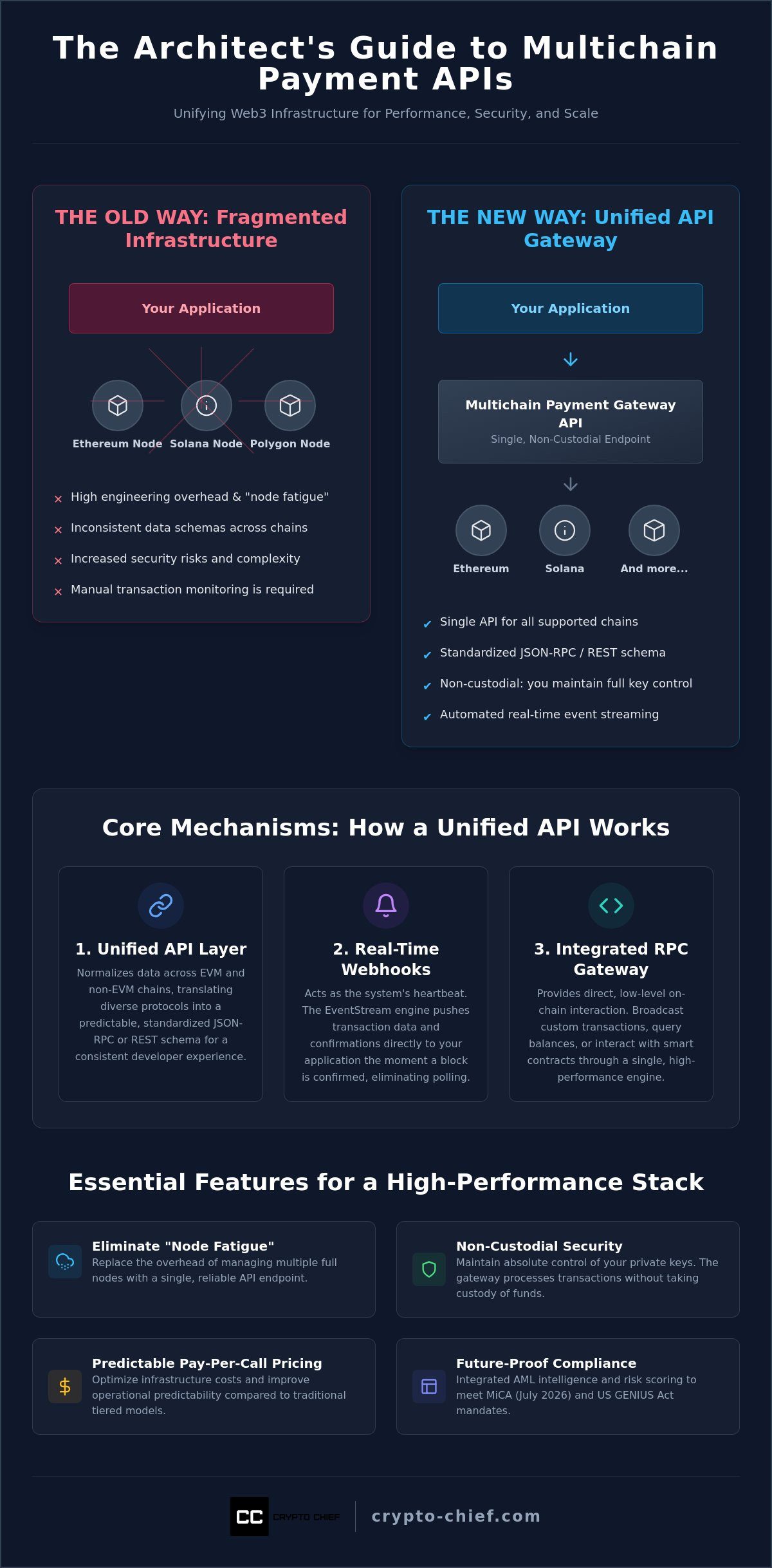
A robust multichain payment gateway api is built on three critical pillars. First, a unified API layer handles the normalization of data across both EVM and non-EVM chains, providing a consistent developer experience regardless of the underlying network. Second, real-time webhook engines act as the heartbeat of the system, delivering instant confirmation of incoming funds to your application. Finally, an integrated RPC Gateway provides direct on-chain interaction. This combination allows you to query balances, broadcast transactions, and monitor events through a single, high-performance engine that values uptime and logic above all else.
Core Mechanisms: How Unified APIs Bridge Fragmented Blockchains
The operational power of a multichain payment gateway api lies in its ability to mask the inherent fragmentation of the Web3 ecosystem. Each blockchain operates as an isolated silo with unique transaction models, address formats, and consensus speeds. A unified API acts as a sophisticated translation layer, converting these disparate data points into a single, predictable schema. Whether you're querying a UTXO-based transaction on Bitcoin or an account-based state change on Ethereum, the response arrives in a standardized format that your backend can process without custom chain logic.
Beyond data normalization, high-performance applications rely on real-time event streaming to maintain state. Rather than wasting resources polling individual nodes for status updates, architects utilize EventStream webhooks. This mechanism pushes transaction data directly to your application logic the moment a block is confirmed. For those requiring deeper control, a built-in Web3 RPC gateway provides the necessary low-level access to broadcast custom transactions or interact with smart contracts directly. This integration ensures that your payment stack isn't just a passive observer but a functional extension of the underlying networks.
The Architecture of a Unified API
Building a scalable payment system requires mapping transaction hashes and block data across wildly different network protocols. A robust multichain payment gateway api handles chain-specific nuances, such as fluctuating gas fees and varying finality times, automatically. This abstraction is critical for maintaining a consistent user experience. By leveraging a documented paradigm for near-instant cross-chain transfers, modern gateways can synchronize state across L1s and L2s with minimal latency. This approach drastically reduces the developer learning curve, allowing teams to deploy on new chains in days rather than months.
Non-Custodial vs. Custodial API Models
Security-conscious developers have shifted toward non-custodial models to eliminate counterparty risk. Non-custodial processing is a mechanism where the gateway facilitates the transaction without ever holding the underlying assets. By integrating non-custodial crypto processing, you ensure that funds move directly from the payer to a wallet you control. This architecture avoids the vulnerabilities associated with custodial silos, where a single breach can compromise the entire treasury. You don't need to manage private keys on your server; instead, the API provides the infrastructure to monitor and validate payments while you retain absolute ownership of the keys. If you're ready to secure your infrastructure, you can register for a unified API key to begin testing in a sandbox environment.
Overcoming the Complexity of Multichain Infrastructure
Managing a single blockchain node is a full-time operational commitment; scaling that to ten or twenty networks is a recipe for catastrophic overhead. This "node fatigue" is a silent killer for startups and enterprise teams alike. It involves more than just disk space and high-speed internet. You have to account for constant security patches, state pruning, and the unpredictable resource spikes that occur during periods of high network congestion. By shifting these responsibilities to a multichain payment gateway api, you replace a massive DevOps burden with a single, predictable point of integration. The gateway acts as an intelligent buffer, absorbing the shock of network upgrades and hard forks so your application logic remains untouched.
A common objection among architects is whether the latency of a gateway API is acceptable for real-time payments. It's a valid concern. However, modern infrastructure utilizes optimized RPC routing and edge computing to minimize the "extra hop" delay. In many cases, a professionally managed gateway is actually faster and more reliable than a self-hosted node that hasn't been fine-tuned for high-concurrency requests. When you use an API layer, you aren't just buying access; you're buying the stability of a geo-distributed engine designed specifically for transaction performance.
Scalability and Global Uptime
For global decentralized applications, downtime is not an option. Ensuring 99.9% uptime requires more than just one server; it requires sophisticated load balancing across multiple RPC providers and geographic regions. A high-performance multichain payment gateway api achieves this by routing requests to the healthiest available node in real-time. This redundancy ensures that even if a specific provider or data center fails, your payment processing continues without interruption. By leveraging edge-computing, the gateway reduces the physical distance between your server and the blockchain data, resulting in the low-latency response times necessary for a seamless user experience.
The Security Trade-off: Gateway vs. Direct Node
While some purists argue for direct node access, the security benefits of a unified platform are often superior. Managing fragmented integrations across multiple chains increases your attack surface, as every new library or custom script introduces potential vulnerabilities. A unified gateway centralizes your security posture, allowing you to implement robust AML Intelligence at the entry point. This integration helps you identify and block illicit funds before they ever touch your system, fulfilling regulatory requirements without adding complexity to your codebase. Ultimately, a well-architected gateway provides the structural integrity needed to scale safely in an increasingly regulated environment.
Selecting the Right API: Performance, Security, and AML Intelligence
Selecting a multichain payment gateway api is a strategic decision that impacts your platform's long-term scalability and security posture. It requires a rigorous evaluation of chain coverage, latency benchmarks, and the maturity of the provider's developer resources. Does the API offer native support for high-liquidity networks like Ethereum and BNB Smart Chain? Does it provide early access to emerging environments like TON? High-performance architects look for a partner that balances broad reach with deep technical stability. Beyond the ledger, the quality of SDKs and the clarity of technical documentation determine how quickly your team can move from sandbox to production. Integrating a reliable multichain payment gateway api ensures that your infrastructure remains agile as the Web3 landscape evolves.
Institutional-grade applications can't ignore the regulatory landscape. Implementing crypto AML risk detection is no longer optional for businesses operating at scale. A modern gateway must provide real-time intelligence to flag suspicious activity before it enters your treasury. This proactive approach protects your platform's integrity and ensures you remain compliant with global mandates. It's about building a foundation of trust that satisfies both users and regulators without sacrificing technical performance.
The Pay-Per-Call Advantage
Traditional monthly tiers often force startups into a "pay-for-what-you-might-use" trap. In contrast, a pay-per-call model utilizes pre-paid API token balances to align costs directly with actual consumption. This granular approach allows you to predict infrastructure spend with surgical precision, scaling your budget in lockstep with transaction volume. Pay-per-call models allow developers to start for free and scale infinitely without renegotiating contracts. It's a pragmatic solution that eliminates wasted capital and rewards efficient code. You don't have to worry about overages or underutilization; you simply pay for the requests your application actually makes.
Risk Detection and Funds Tracing
Maintaining a clean ecosystem requires more than just processing payments; it requires knowing where those funds originated. Automating compliance through real-time risk scoring for every incoming payment is the most effective way to mitigate regulatory risk. AML intelligence identifies high-risk addresses associated with mixers, hacks, or sanctioned entities before they contaminate your internal wallets. This process happens in the background, ensuring that risk detection doesn't add friction to the user experience. By integrating these checks at the gateway level, you create a secure, automated perimeter that defends your business 24/7. Ready to implement a compliant stack? You can review our technical documentation to see how our unified endpoints handle risk scoring natively.
Crypto Chief: A Unified Infrastructure for Scalable Web3 Payments
Crypto Chief represents the culmination of years spent solving the most persistent bottlenecks in decentralized finance. We don't just offer a basic processing tool; we provide a high-performance engine that consolidates an RPC Gateway, a Unified API, and EventStream into one cohesive service. This "Chieftoad Crypto" philosophy prioritizes structural stability and raw performance, ensuring that enterprise builders have the foundation they need to scale without compromise. By integrating these three pillars, we've created a multichain payment gateway api that acts as a silent, powerful partner for your development team. It's about moving from fragmented tools to a unified intelligence layer.
Getting started is designed for speed. You can purchase prepaid tokens and begin making authenticated requests in minutes, avoiding the bureaucratic hurdles of traditional enterprise contracts. This pay-per-call model ensures your costs are always aligned with your actual usage. Whether you're testing on a sandbox environment or moving to global production, the transition is seamless. You can deploy with confidence, knowing the underlying infrastructure has already solved the complexities of data normalization and network upgrades for you.
Why Developers Choose Crypto Chief
The primary advantage of our ecosystem is simplicity without sacrifice. You manage all your multichain needs through a single API key, eliminating the security risks and administrative burden of handling multiple provider credentials. For teams building specialized platforms, we offer white-label solutions that allow you to deploy custom payment infrastructure under your own brand. This flexibility is paired with a global network designed for 99.9% uptime, providing the reliability required for institutional-grade decentralized applications. We've built the engine so you can focus on the user experience.
Quick Start Integration
Your journey begins with our developer-first resources. We recommend reviewing the official documentation to explore our multichain endpoints and understand the payload structures for various networks. Setting up your first webhook is the next logical step; this allows your application to receive real-time payment notifications through our EventStream service. Once your logic is validated in a test environment, switching to live production requires only a simple configuration change. You don't have to rebuild your stack to scale it. If you're ready to modernize your payment architecture, register your account and get your API key today to experience the power of a truly unified multichain payment gateway api.
Future-Proofing Your Web3 Payment Stack
The transition from fragmented blockchain integrations to a unified architecture is a necessity for any architect building for the 2026 market. By centralizing your infrastructure through a robust multichain payment gateway api, you eliminate the operational drain of managing individual nodes while maintaining the security of non-custodial control. You've seen how data normalization and automated event streaming can transform a complex backend into a streamlined, high-performance engine. Success in this landscape requires more than just connectivity; it demands a foundation that integrates compliance and cost-efficiency at every level.
Crypto Chief provides this foundation through a global network of geo-distributed RPC nodes and integrated, real-time AML risk scoring. Our pay-per-call pricing model ensures that your overhead scales only when your business does, removing the friction of traditional enterprise tiers. It's time to stop fighting infrastructure and start building value. Build your multichain payment solution with Crypto Chief today and deploy a stack that is ready for the future of global commerce. Your next integration should be your last.
Frequently Asked Questions
What is the difference between an RPC gateway and a payment gateway API?
An RPC gateway provides low-level access to a blockchain node's raw functions, while a payment gateway API is a higher-level abstraction designed specifically for transaction lifecycles. Think of the RPC gateway as the underlying plumbing that allows you to talk to the ledger. The payment API is the intelligent dashboard that manages data normalization, status tracking, and business logic. Using the API layer allows you to focus on the user experience rather than the granular details of node maintenance.
Is a multichain payment gateway API non-custodial?
Yes, modern enterprise-grade solutions are typically non-custodial. The multichain payment gateway api acts as a secure relay that monitors the blockchain and notifies your application, but it never holds your private keys. You maintain absolute control over the destination wallets, ensuring that funds move directly from the payer to your controlled environment. This architecture significantly reduces counterparty risk and aligns with the decentralized ethos of Web3 infrastructure.
How much does it cost to use a multichain payment API in 2026?
Pricing has shifted toward a high-efficiency pay-per-call model using pre-paid token balances. This approach replaces the rigid, tiered monthly plans of the past, allowing you to scale costs precisely with your actual request volume. You only pay for the infrastructure you consume, which eliminates wasted spend on unused capacity. This model provides the predictability needed for long-term budgeting while remaining accessible for startups that are just beginning to scale.
Does a multichain API support stablecoins like USDT and USDC on all chains?
Yes, comprehensive gateways provide native support for major stablecoins across both EVM and non-EVM networks. This includes handling the specific contract addresses and decimal configurations for USDT and USDC on Ethereum, Polygon, BNB Chain, and Solana. The API normalizes these assets into a standardized interface. You can process stablecoin payments across multiple chains without writing unique logic for every new token contract or network protocol.
How do I handle AML compliance when using a multichain payment API?
Compliance is managed through integrated AML intelligence layers that provide real-time risk scoring for every incoming transaction. The system automatically screens sender addresses against global sanction lists and known high-risk clusters. This automated perimeter allows you to identify and flag illicit funds at the moment of entry. It ensures your platform meets evolving regulatory standards, such as MiCA or the GENIUS Act, without requiring manual intervention for every payment.
Can I use a single API key for Ethereum, Polygon, and BNB Smart Chain?
Yes, the primary benefit of a unified multichain payment gateway api is the use of a single authentication key for all supported networks. This centralized access simplifies your credential management and reduces the potential attack surface. You can query balances, monitor events, or broadcast transactions across various chains using the same authentication header. This drastically reduces development complexity and streamlines the integration process for your engineering team.
What happens if a blockchain network goes down?
The gateway utilizes geo-distributed RPC nodes and automatic failover mechanisms to maintain high availability. If a specific node or regional provider experiences downtime, the API intelligently reroutes your request to the healthiest available peer in real-time. This redundancy ensures your application remains functional even during periods of network congestion or provider outages. It provides the structural integrity necessary for maintaining a reliable, global payment service 24/7.
How do webhooks work for payment notifications?
Webhooks function as the real-time heartbeat of your infrastructure by pushing data directly to your server when a transaction is confirmed. Instead of your backend constantly polling the blockchain for updates, the EventStream service sends an HTTP POST request with a standardized JSON payload. This allows your application to trigger immediate logic, such as order fulfillment or account credits, the moment funds are verified on-chain. It is the most efficient way to maintain state synchronization.