
Scaling a Web3 application shouldn't feel like solving a complex calculus problem every time you review your monthly infrastructure bill. The traditional "Compute Unit" model often masks the true cost of operations, leaving developers to face unexpected overages and performance throttles during peak network congestion. If you're tired of navigating tiered subscriptions that don't align with your actual usage, it's time to consider a more transparent moralis api alternative.
We understand the frustration of managing fragmented providers for RPC access, AML intelligence, and data streaming. It's a technical balancing act that frequently leads to latency issues and the suffocating weight of enterprise contract lock-in. In this article, you'll discover how to transition to a unified, pay-per-call Web3 stack that prioritizes architectural logic and absolute cost control. We'll examine the top alternatives for 2026, highlighting platforms that offer non-custodial processing and real-time EventStream capabilities to keep your overhead low and your global performance high.
Key Takeaways
- Learn why the industry is moving away from opaque "Compute Units" toward transparent, pay-per-call billing models that offer predictable infrastructure overhead.
- Understand how a unified API simplifies multichain development by providing normalized data across various networks through a single, consistent schema.
- Discover how to integrate real-time AML intelligence and EventStream webhooks to meet 2026 regulatory standards without sacrificing transaction speed.
- Identify the ideal moralis api alternative by comparing infrastructure performance, data depth, and the flexibility of prepaid token-based scaling.
- Explore the advantages of utilizing a non-custodial processing API to ensure secure, high-performance crypto payments while maintaining full control over your assets.
Why Developers Seek a Moralis API Alternative in 2026
The architecture of Web3 has evolved past the era of monolithic SDKs that bloat your application code. Today, developers prioritize stability and modularity over all-in-one promises. The shift from heavy frameworks to specialized, high-performance API providers reflects a growing need for technical agility. When you rely on a single, massive provider, you inherit their technical debt and their latency. This reality is pushing many architects to seek a moralis api alternative that offers better performance without the unnecessary overhead of unused features.
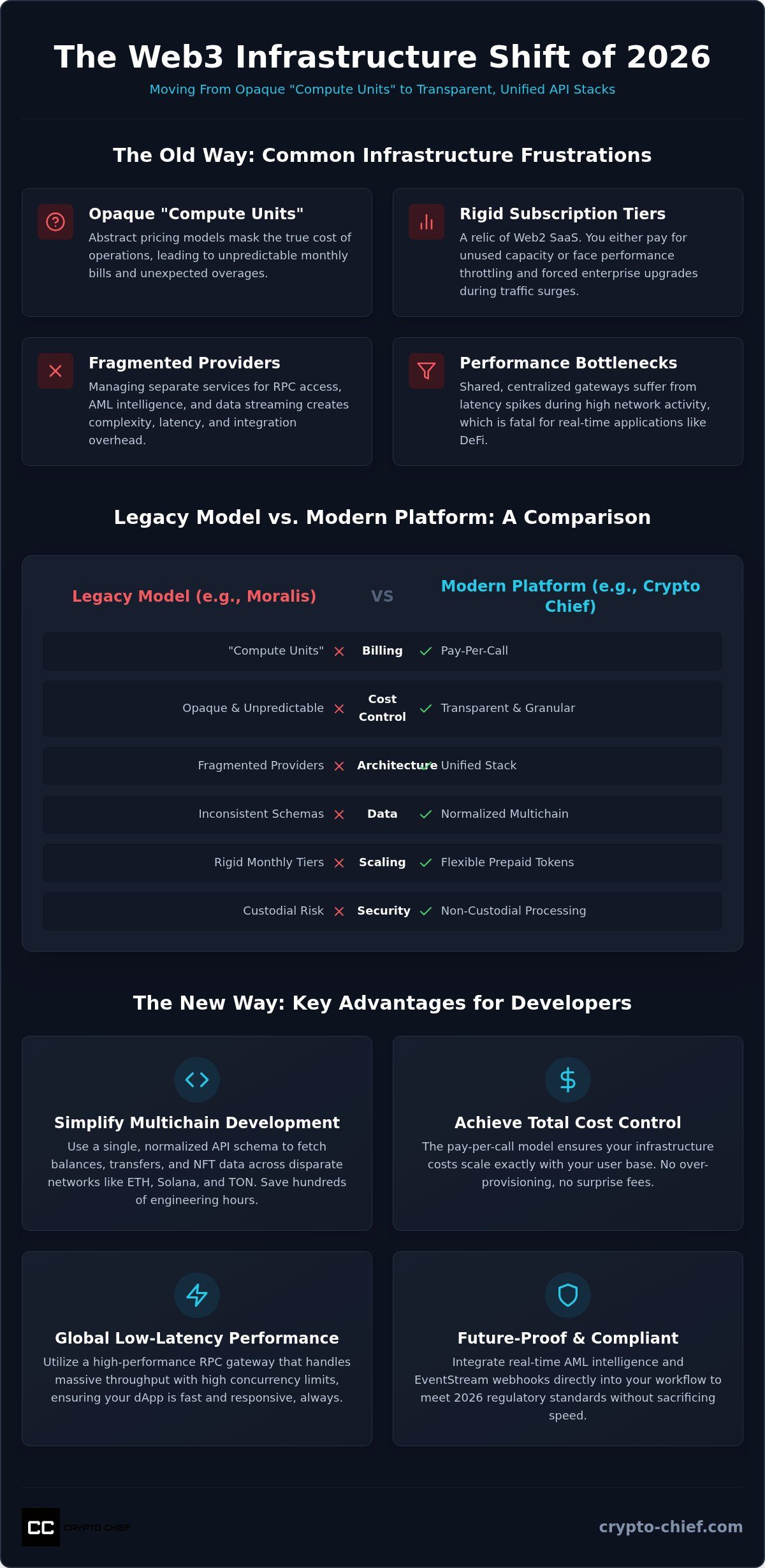
Abstract pricing models like "Compute Units" (CU) have become a significant source of friction for scaling projects. These units create a layer of obfuscation between the developer's code and their monthly bill. If you can't predict exactly what a specific call will cost in real-world currency, you can't build a sustainable business model. This lack of transparency, combined with the recent sunsetting of support for several chains like Fantom and Zeta Chain, has left many teams looking for more reliable, long-term partners. In 2026, the demand is for multichain normalization where data from Ethereum, Polygon, or Bitcoin follows a single, consistent schema.
The Hidden Complexity of Tiered Subscription Models
Monthly tiers are a relic of Web2 SaaS that don't translate well to the volatile nature of blockchain traffic. If your project experiences a sudden surge in users, you risk being cut off or forced into a massive enterprise upgrade with little notice. Conversely, during quiet periods, you're paying for capacity you aren't using. This "over-provisioning" trap is why the industry is shifting toward prepaid token balances. You top up your balance and pay only for the calls you actually execute. This provides granular financial control and ensures your infrastructure costs scale exactly with your user base.
Performance Bottlenecks in Centralized Web3 Gateways
Shared node infrastructure often suffers from latency spikes during high network activity. These delays are fatal for real-time DeFi applications where every millisecond counts toward transaction success. In 2026, global uptime and low-latency endpoints are non-negotiable requirements for any production-grade application. Developers now require a single, high-performance RPC Gateway that can handle massive throughput without throttling. A high-performance RPC gateway serves as a resilient, low-latency bridge that translates complex blockchain data into actionable application logic with near-zero delay. By integrating AML Intelligence directly into this gateway, you can ensure compliance without adding extra hops to your request flow.
Evaluating Alternatives: RPC Performance and Data Depth
Selecting a moralis api alternative requires a rigorous assessment of technical depth. It's not just about the number of chains supported; it's about how that data is served and indexed. As the market matures in 2026, the ability to query across disparate networks like TON, Solana, and traditional EVM chains using a single, consistent interface has become the baseline for professional development. Architects now demand infrastructure that provides high-concurrency limits and deep data indexing without the bloat of legacy SDKs.
Multichain RPC Gateway: The Backbone of Your dApp
Managing separate endpoints for Ethereum and BNB Smart Chain is an operational burden that increases the risk of downtime. A centralized multichain RPC gateway eliminates this friction by providing a single, resilient point of entry for all your requests. High-concurrency limits are vital here. When network traffic spikes during a market event, you need an infrastructure that doesn't throttle your requests or force an immediate enterprise upgrade. This stability is what separates a truly scalable stack from a hobbyist tool.
Unified APIs and Data Normalization
Raw blockchain data is notoriously messy and inconsistent across different protocols. A unified Web3 developer platform abstracts this complexity by normalizing the output. By utilizing a Unified Blockchain API, you can fetch balances, transfers, and NFT metadata across multiple chains using one standardized schema. You don't need to build and maintain custom indexers for every new network you support. This efficiency saves hundreds of engineering hours and significantly reduces your time-to-market.
Real-time event streaming represents a fundamental shift in how modern dApps interact with the blockchain. Polling for updates is an inefficient practice that wastes resources and increases server load. Instead, using webhooks to stream events directly to your backend allows your application to react instantly to on-chain activity. This reduction in unnecessary API calls directly lowers your operational costs, especially when operating under a transparent pay-per-call model. Establishing a robust Unified Web3 Infrastructure is also a prerequisite for meeting global compliance standards as the regulatory environment tightens.
Evaluating developer tools is equally critical. Comprehensive documentation and reliable faucets reduce the friction between ideation and deployment. When an API provider offers a seamless experience, it allows your team to focus on the frontend user experience rather than the underlying backend plumbing. If you're ready to test these capabilities in a live environment, you can start your first project with a complimentary credit balance to explore the performance of our global gateway.
The Pay-Per-Call Revolution: Moralis vs. Crypto Chief
Financial predictability is often the deciding factor when choosing a moralis api alternative for a scaling project. While established players rely on "Compute Units" (CUs), this abstraction often obscures the true cost of individual requests. These units vary in weight depending on the complexity of the call, making it nearly impossible to budget with precision. A transparent pay-per-call model removes this layer of uncertainty. You pay exactly for the technical operations you trigger, ensuring your infrastructure costs align perfectly with your application's actual demand.
This shift in billing logic is powered by prepaid token balances. This system functions like a "Web3 gas tank" for your infrastructure. You deposit a balance, and as your dApp executes requests, that balance is drawn down in real-time. There are no monthly subscriptions to manage and no recurring invoices that charge you for idle capacity during low-traffic periods. Startups and enterprises alike are moving toward this model to avoid the rigid constraints of traditional tiered SaaS pricing.
Cost Optimization Strategies for Web3 Developers
Technical efficiency directly translates to financial savings in a usage-based environment. Batching requests is one of the most effective methods for reducing Web3 API expenses. Instead of sending multiple individual queries, you group them into a single call to optimize your token burn. Many developers find that switching from a $500 monthly tier to a pay-per-call model significantly lowers their overhead because they stop paying for "provisioned" limits they never reached. Prepaid tokens prevent unexpected billing overages by ensuring you never spend more than the balance you've explicitly allocated to your project.
Scalability Without the Enterprise Price Tag
Standard infrastructure providers often lock high rate limits or specialized chains behind an "Enterprise" wall. This typically requires a lengthy negotiation phase with sales teams and a commitment to a custom contract. A pay-per-call architecture democratizes access to high-tier features. A small project can utilize the same global RPC Gateway as a major protocol because the system scales automatically with request volume. There is no artificial ceiling based on your subscription level. You get the performance of an elite engine with the service-oriented delivery that respects your project's current stage of growth.
This flexibility is essential in the fast-moving 2026 market. Whether you are handling a sudden viral surge or maintaining a steady flow of transactions, your infrastructure should act as a silent partner that solves problems rather than creating billing hurdles. By moving away from tiered lock-in, you gain the freedom to pivot and scale without the weight of legacy contracts.
Beyond Data: Integrating AML and Event Streams
In 2026, the regulatory landscape has shifted compliance from an optional safety net to a core requirement for every dApp architect. High-performance infrastructure must now provide more than just raw data; it must offer protection. While many seek a moralis api alternative to escape tiered pricing, the real value lies in integrating risk management directly into the development workflow. Managing separate providers for node access and compliance intelligence creates unnecessary latency and technical debt. A unified approach allows you to secure your platform using a single API key for data, global nodes, and immediate risk detection.
The implementation of the GENIUS Act in the United States and the full authorization of MiCA in Europe have made robust compliance non-negotiable. With regulators issuing 139 fines totaling $1.23 billion for AML and sanctions violations in the first half of 2025 alone, the cost of negligence is staggering. Modern developers require a silent partner that handles these complexities in the background. This allows you to focus on the creative aspects of your project while the infrastructure maintains structural integrity and regulatory alignment.
Automated Compliance with AML Risk Detection
Protecting your smart contracts from tainted funds is vital for long-term viability. By utilizing a crypto AML risk detection API, you can automate the screening process before transactions ever reach your contract. This proactive tracing of funds helps identify illicit activity in real-time, significantly reducing legal friction for DeFi protocols. Integrating AML intelligence directly into your transaction flow ensures that your platform remains compliant with global standards without slowing down the user experience. It's a logic-driven solution for a complex legal environment.
Real-Time Monitoring with EventStream Webhooks
Efficiency in 2026 is defined by push-based architectures. Polling nodes for updates is an expensive, resource-heavy practice that lacks the precision required for modern finance. Setting up real-time blockchain webhooks through an EventStream allows your backend to react the moment a block is confirmed. Whether you're monitoring for liquidations, tracking DAO voting updates, or sending large transfer alerts, event streaming provides the low-latency response your users expect. It's a fundamental upgrade over legacy polling systems that often miss critical state changes during peak traffic.
You can integrate AML Intelligence today to secure your dApp's transaction flow against high-risk activity and ensure total compliance.
Choosing Crypto Chief as Your Unified Web3 Infrastructure
Crypto Chief stands as the logical evolution for developers seeking a moralis api alternative that prioritizes structural integrity over marketing hype. While other platforms focus on proprietary node architectures that create vendor lock-in, we provide a silent, powerful partner that allows you to maintain full control over your stack. The inclusion of non-custodial crypto processing distinguishes our platform from traditional data providers. It enables you to handle secure, high-performance payments without ever relinquishing control of your private keys. This builder-centric ethos ensures that your application remains resilient, secure, and financially efficient as you scale.
Choosing a unified infrastructure means you no longer have to juggle multiple API keys for different functional requirements. Whether you're querying historical data or managing real-time transaction flows, our platform acts as a steady, knowledgeable guide. It's a global engine designed for those who value uptime and logical scaling. By consolidating your RPC access, AML intelligence, and event streaming into one gateway, you remove the friction that typically slows down enterprise-grade deployments.
Seamless Migration from Legacy Platforms
Transitioning your project shouldn't be a friction-heavy ordeal. You can easily map your existing Moralis endpoints to our Unified API using our technically precise documentation. We provide a Web3 Faucet and initial trial credits to let you test performance in a live environment before committing production traffic. If your project has specific enterprise requirements, our support team is available to help architect a solution that meets your exact concurrency and data depth needs. This ensures a seamless migration that respects your development timeline.
Building for the Future of Web3
The twin pillars of non-custodial architecture and pay-per-call billing are the foundation of 2026 development. This combination ensures your platform remains both secure and cost-effective as you scale across 20+ blockchains. By choosing a moralis api alternative that respects your project's autonomy, you're investing in a long-term partnership that grows with your user base. Our roadmap continues to expand support for emerging networks, ensuring you always have a unified developer experience regardless of where the market shifts. You can register your account today and start building with a high-performance RPC gateway that puts the architect back in control.
Architecting a Sustainable Web3 Future
The transition toward modular, usage-based infrastructure marks a significant shift in how we build for the decentralized web. By moving away from abstract compute units and rigid subscription tiers, you reclaim control over your project's financial and technical trajectory. A robust moralis api alternative serves as a high-performance engine that integrates security and scalability into a single, unified workflow. It doesn't have to be complicated.
Your choice of infrastructure dictates your ability to adapt to a tightening regulatory environment while maintaining the low-latency performance your users demand. Utilizing a High-performance RPC Gateway alongside Integrated AML Intelligence and 100% Non-Custodial Processing ensures your platform remains resilient. This builder-centric approach removes the friction of legacy contracts. It allows you to focus on creative innovation while we maintain the background infrastructure.
Scale your dApp today with our Pay-Per-Call Web3 API and experience the stability of an architect-centric platform. The future of Web3 belongs to those who build on logic, transparency, and structural integrity.
Frequently Asked Questions
What is the best Moralis API alternative for high-volume dApps?
Crypto Chief is a premier moralis api alternative for high-volume applications because it offers a high-performance RPC gateway with a transparent pay-per-call model. Unlike tiered systems, it provides the concurrency limits needed for massive traffic spikes without requiring enterprise contract negotiations. This ensures your infrastructure remains stable and predictable regardless of network congestion or user growth.
How does pay-per-call pricing compare to Moralis's monthly tiers?
Pay-per-call pricing replaces rigid monthly subscriptions with a flexible, usage-based model where you only pay for the specific requests you make. Moralis uses "Compute Units" that can vary in weight, making costs difficult to forecast. With our prepaid token system, you top up your balance like a gas tank, eliminating the risk of over-provisioning or sudden service cut-offs when you exceed a tier.
Can I use Crypto Chief for real-time smart contract event monitoring?
Yes, you can utilize our EventStream webhooks to monitor smart contract events in real-time without the overhead of polling. This push-based architecture delivers instant notifications for on-chain activities like liquidations, DAO votes, or large transfers. By using EventStream, you reduce server load and ensure your application reacts immediately to state changes across multiple blockchains.
Does Crypto Chief support multichain data for NFTs and DeFi?
Our Unified API provides normalized data for NFTs and DeFi across all supported networks through a single, consistent schema. You can fetch token balances, transfer histories, and metadata without building custom indexers for each chain. This architectural logic simplifies development and allows you to scale your multichain application with significantly less engineering effort.
Is there an AML compliance API integrated with the RPC gateway?
We offer integrated AML Intelligence directly alongside our RPC gateway to streamline your compliance workflow. This allows you to screen transactions and detect high-risk activity before it reaches your smart contracts, which is essential for meeting 2026 regulatory standards. Consolidating risk detection and node access into one provider reduces latency and technical complexity for your team.
How do I migrate my dApp from Moralis to Crypto Chief?
Migration is a straightforward process that involves mapping your existing Moralis endpoints to our Unified API documentation. We provide a Web3 Faucet and initial trial credits to help you verify performance before shifting production traffic. Our technical documentation is designed for professional architects, ensuring a seamless transition that respects your existing application logic and deployment schedule.
What chains are supported by the Crypto Chief RPC Gateway?
Our global RPC network supports a wide range of blockchains, including Bitcoin, Ethereum, BNB Smart Chain, Polygon, Tron, and TON. We also provide dedicated endpoints for Bitcoin Cash, Litecoin, Dogecoin, and various other networks. This extensive support ensures you have a reliable foundation for building cross-chain applications using a single, high-performance infrastructure provider.
Is the Crypto Chief processing API non-custodial?
Yes, our Crypto Processing API is 100% non-custodial, ensuring you maintain full control over your private keys at all times. This architecture removes the risks associated with third-party asset management while providing a high-performance engine for handling payments. It's a secure, builder-centric solution for developers who prioritize technical sovereignty and structural integrity in their financial stack.
Tags: moralis api alternative