
In 2026, the ability to build a truly chain-agnostic application is no longer an optional luxury; it's the baseline for survival in a fragmented Web3 ecosystem. You've likely spent countless hours managing disparate node providers and wrestling with non-standardized data formats while searching for a unified blockchain api for dapps that actually delivers on its promises. It's frustrating to watch your development velocity slow down because the background infrastructure isn't as agile as your vision. We understand that your focus should remain on creating unique user experiences, not on the repetitive plumbing of multichain integration.
This guide demonstrates how to eliminate these technical hurdles and scale your decentralized application using high-performance, normalized data streams. You'll learn how a single point of integration provides access to 19 mainnets while delivering clean JSON responses and built-in AML security. We'll examine the transition from rigid monthly fees to a predictable, pay-per-call model that ensures your costs align perfectly with your growth. By the end of this article, you'll have a clear roadmap for deploying a secure, high-uptime architecture that turns multichain complexity into a distinct competitive advantage.
Key Takeaways
- Understand how a unified interface abstracts multiple protocols into a standardized set of endpoints, allowing you to support dozens of chains through a single integration workflow.
- Discover how the normalization layer converts raw hex data into clean, structured JSON to ensure consistent address formats and transaction statuses across all networks.
- Learn to automate security by integrating real-time AML intelligence directly into your transaction broadcast process to mitigate risk without adding latency.
- Optimize your infrastructure budget by switching to a pay-per-call model that eliminates the high costs of idle tiered subscriptions and avoids paying for unused capacity.
- Scale your application using a unified blockchain api for dapps that provides high-performance RPC access, real-time EventStream webhooks, and secure payment processing.
What is a Unified Blockchain API for dApps?
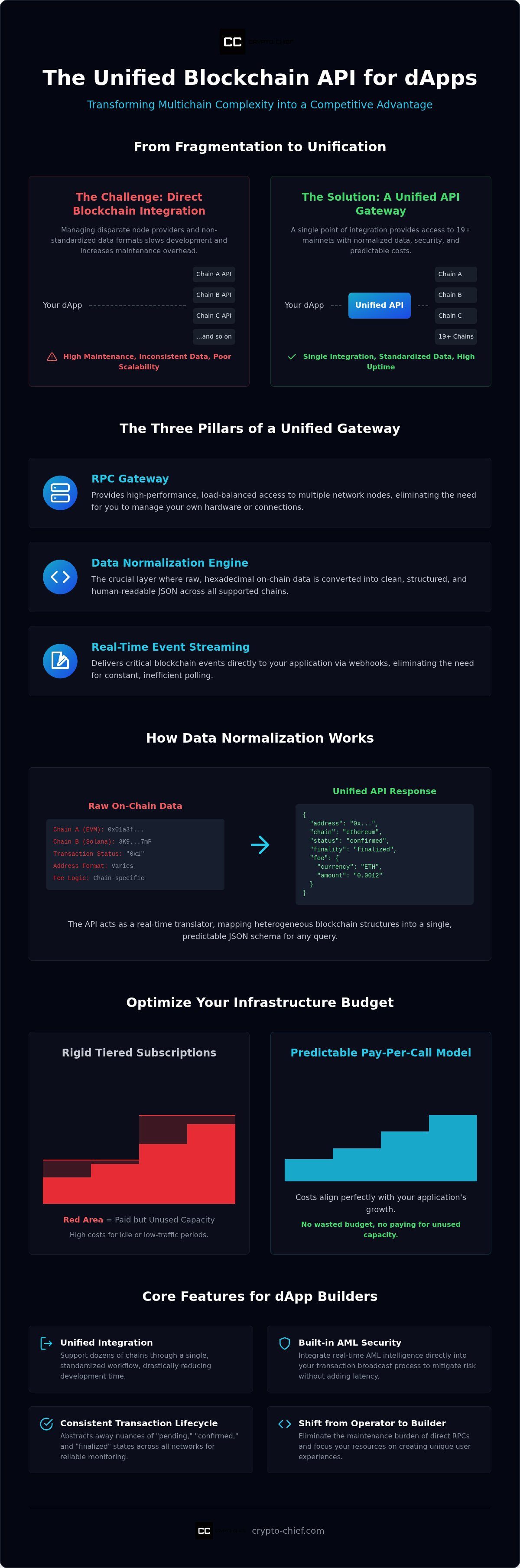
A unified blockchain api for dapps is a sophisticated abstraction layer that translates the unique protocols of disparate blockchains into a single, standardized set of endpoints. In the past, supporting ten different chains required ten distinct integration workflows, each with its own data structures and maintenance cycles. By 2026, the industry has moved beyond the labor-intensive era of node management toward a model of pure API consumption. This transition allows developers to focus on the frontend experience while the infrastructure layer handles the complexities of multichain communication.
The architecture of a unified gateway typically rests on three technical pillars:
- RPC Gateway: It provides high-performance, load-balanced access to multiple network nodes.
- Data Normalization: This is the crucial layer where raw, hexadecimal on-chain data is converted into clean, structured JSON.
- Event Streaming: These are real-time webhooks that deliver blockchain events directly to your application without the need for constant polling.
The Evolution of Web3 Infrastructure
The infrastructure landscape has matured through several distinct phases. It began with developers self-hosting nodes, which required significant hardware investment and constant manual updates. Managed RPC providers eventually solved the hardware problem, yet they still left teams to manage the logic for every individual chain. We then saw the rise of specialized APIs for NFT and DeFi data, providing better granularity but often lacking a cohesive structure. The unified blockchain api for dapps represents the final stage of maturity; it provides a single, high-performance engine that abstracts the entire multichain environment into a predictable developer experience.
Why dApp Architects are Ditching Direct RPCs
Direct RPC connections present a massive maintenance burden that scales poorly. Every network upgrade or hard fork requires manual intervention to ensure integrations don't break. Additionally, response formats are wildly inconsistent between clients like Geth, Erigon, and Solana. This lack of standardization forces developers to write extensive "glue code" just to handle basic data retrieval. Architects now prefer unified solutions to eliminate these inconsistencies and remove the risk of a single-point-of-failure, ensuring that their applications remain stable and scalable regardless of underlying network volatility. It's a shift from being a "node operator" to being a "product builder."
Multichain Data Normalization: How It Works
Data normalization is the process of mapping heterogeneous blockchain structures into a single, predictable schema. At its core, this layer acts as a real-time translator that intercepts raw, hexadecimal data from various nodes and converts it into a clean, human-readable JSON format. Without this abstraction, developers are forced to build custom parsers for every chain they support, which is a significant drain on engineering resources. A robust unified blockchain api for dapps ensures that whether you're querying a block header on Ethereum or a transaction status on Solana, the response structure remains consistent and reliable.
This standardization extends to address formats and metadata. Fetching token balances or NFT ownership across EVM and non-EVM chains typically requires managing multiple library dependencies and disparate data models. By using a unified gateway, your backend receives a single, normalized response for asset holdings regardless of the underlying network's architecture. This level of structural integrity is what allows teams to scale their products globally without getting bogged down in the technical minutiae of individual protocols. It's the difference between managing a chaotic data lake and utilizing a high-performance engine.
Standardizing the Transaction Lifecycle
One of the most complex challenges in multichain development is managing transaction states. Different consensus mechanisms result in varying definitions of "pending," "confirmed," and "finalized." A unified API abstracts these nuances, providing a consistent lifecycle monitor that alerts your application only when specific finality thresholds are met. It also handles chain-specific fee logic, such as the distinction between legacy gas fees and EIP-1559 priority fees, ensuring that your transaction broadcasts are both efficient and successful. Unified error handling further simplifies the process by translating cryptic on-chain revert messages into actionable error codes.
The Power of a Single Backend Integration
Integrating a single gateway can reduce your backend code complexity by 70% or more. Instead of maintaining a sprawling codebase filled with conditional logic for every new chain, your team works with a stable set of endpoints. This consistency makes testing and debugging significantly faster, as a single test suite can often cover multiple networks. For developers looking to implement these features, the Crypto Chief Documentation provides comprehensive endpoint examples and schema definitions. By adopting this streamlined approach, you can simplify your payment architecture and redirect your focus toward building features that truly resonate with your users.
Integrating AML and Risk Intelligence into the Unified Layer
In the current regulatory climate, simple data access is no longer sufficient for institutional-grade applications. A unified blockchain api for dapps must do more than just read and write to the chain; it must act as a sophisticated filter that protects your platform from illicit activity. By integrating real-time risk assessment directly into the infrastructure layer, you can automate AML checks during the transaction broadcast process. This proactive approach allows you to detect high-risk addresses and tainted funds before they ever interact with your smart contracts, effectively bridging the gap between raw data access and comprehensive compliance-as-a-service.
The challenge has always been the trade-off between security and user experience. Traditionally, compliance checks were batch-processed or handled by third-party services that added significant latency. Modern unified architectures solve this by running parallel risk evaluations. This ensures that every transaction is screened against global watchlists and historical behavior patterns without compromising the responsiveness of your application. It transforms compliance from a bottleneck into a silent, powerful partner that operates in the background of your multichain operations.
Real-Time Risk Scoring for dApps
Speed is the most critical metric when protecting a decentralized ecosystem. Our infrastructure is designed to flag suspicious activity in under 100 milliseconds, providing an immediate risk score that your backend can use to accept or reject a request. For a deeper dive into these technical implementations, consult our guide on the Crypto AML Risk Detection API. Integrating these risk scores into user-facing dashboards allows you to provide transparency to your community while maintaining a robust security posture against sophisticated on-chain threats.
Compliance Without the Friction
Utilizing the AML Intelligence tool allows you to satisfy global regulatory requirements without sacrificing the decentralized ethos of your project. This system employs non-custodial tracing, which means you can ensure platform safety while respecting user privacy. By leveraging a unified blockchain api for dapps that includes built-in compliance, you avoid the friction of managing multiple third-party vendors. Safe operations don't have to be slow. With a unified infrastructure, you gain the stability of an enterprise-ready environment and the agility of a startup, ensuring your dApp remains both compliant and competitive in a rapidly evolving market.
Optimizing Web3 API Costs: Pay-Per-Call vs. Tiered Plans
Many developers are lured by the promise of "unlimited" plans, only to discover restrictive rate limits hidden in the fine print. These ceilings often trigger throttled responses at the exact moment your application needs throughput the most. By contrast, a unified blockchain api for dapps utilizing a pay-per-call model removes these arbitrary barriers. You aren't paying for "shelfware" or idle capacity that never gets used. Instead, you pay only for the requests your users actually generate. Pay-per-call ensures that infrastructure costs scale linearly with actual user activity.
Budgeting for viral growth becomes significantly more manageable when you eliminate the threat of sudden service interruptions. If your dApp experiences a massive spike in traffic, your infrastructure should expand to meet that demand without requiring a manual plan upgrade. This utility-based approach allows you to focus on scaling your user base while the background engine handles the increased load. It's a shift from rigid, wasteful subscriptions toward a model that respects your capital and your growth trajectory.
Analyzing the Pay-Per-Call Advantage
"Tier Jump" anxiety is a common burden for growing startups. Traditional SaaS models often force a massive price increase when you move from a mid-tier plan to an enterprise level, often for features you don't yet need. Modern utility pricing mirrors cloud computing models where your prepaid balance acts as a flexible fuel tank for your infrastructure. This allows for precise financial forecasting without the risk of overpaying during quiet development periods. Every project starts with a foundation of stability, and our $10 initial credit allows you to test this efficiency without upfront commitment.
Reducing Waste in Multichain Data Fetching
Batching requests is a powerful strategy for maintaining efficiency and reducing overall overhead. A unified gateway simplifies this by allowing you to bundle multiple queries into a single call across different networks. For a technical breakdown of this method, see our guide on RPC Request Batching for Cost Reduction. Optimizing your dApp's data hunger ensures that every call adds value to the user experience while keeping your operational expenses lean. You can start optimizing your infrastructure costs today with a transparent model that scales alongside your success.
Building with Crypto Chief: The Ultimate Unified Gateway
Consolidating your infrastructure into a single, high-performance engine is the most decisive move a developer can make in 2026. Crypto Chief provides this consolidation by offering a singular gateway for multichain RPC nodes, a unified blockchain api for dapps, and real-time EventStream webhooks. This integrated approach ensures that your application remains responsive and synchronized with on-chain events without the overhead of managing multiple service providers. By utilizing our global, enterprise-grade architecture, you gain a foundation that values uptime and structural integrity above all else.
Security remains at the forefront of our delivery. Our non-custodial Crypto Processing API allows you to facilitate secure, direct payments while maintaining full control over your private keys. This means your users benefit from the speed of modern fintech without the centralized risks typically associated with custodial solutions. When you combine this with our real-time event notifications, your dApp becomes a living, breathing ecosystem that reacts to the blockchain with millisecond precision.
The Crypto Chief Integration Workflow
The path from development to production is designed to be seamless and methodical. We understand the practical challenges of the field; therefore, we've stripped away the friction. Follow these three stages to deploy:
- Step 1: Secure your unified API key to gain instant access to over 19 mainnets and 6 testnets.
- Step 2: Configure your multichain event streams to receive automated, filtered notifications for specific smart contract interactions.
- Step 3: Integrate Crypto Processing to enable non-custodial payouts and automated transaction routing.
Future-Proofing Your dApp Infrastructure
Relying on a single, robust platform significantly reduces technical debt and prevents the vendor lock-in that often plagues fragmented setups. As your project evolves from a prototype to a global enterprise, our unified blockchain api for dapps scales alongside you, providing the same high-performance endpoints at every stage. This consistency allows your team to maintain a clean codebase and focus on innovation rather than infrastructure maintenance. To explore the strategic advantages of this model further, read The Architect’s Guide to a Unified Web3 Developer Platform in 2026. By choosing a partner that understands the logic of the builder, you ensure that your application is ready for whatever the next block brings.
Accelerate Your dApp's Global Reach
The era of managing siloed node connections and complex data parsers is behind us. By adopting a unified blockchain api for dapps, you empower your team to build on a foundation of structural integrity and real-time precision. We've explored how data normalization removes the friction of multichain integration and how built-in AML intelligence secures your platform against evolving risks. This transition isn't just about technical ease; it's about shifting your focus back to the creative innovation that defines your project.
Efficiency is the engine of sustainability. You don't have to overpay for idle capacity when you utilize a pay-per-call model that aligns costs with actual user activity. Our non-custodial security architecture and real-time multichain event streaming provide the stability you need to scale from a prototype to an enterprise leader. The tools for a faster, safer, and more cost-effective Web3 experience are already within your reach. We're ready to act as your silent, powerful partner in this journey.
Start Building with Crypto Chief’s Unified API Today
Frequently Asked Questions
What is the difference between a standard RPC and a Unified Blockchain API?
A standard RPC provides direct, raw access to a specific node's full method set, returning data in formats that vary between clients like Geth or Solana. In contrast, a unified API abstracts multiple chains into a single, standardized schema. It normalizes raw hexadecimal data into structured JSON responses. This allows developers to use one set of endpoints for multiple networks, which significantly reduces the custom code required for multichain support.
Does using a unified API increase transaction latency for my dApp?
Using a unified API does not significantly increase latency when it is built on high-performance infrastructure. On-chain data is typically available within 100 to 400 milliseconds after block finalization. While a minimal abstraction layer exists for data normalization, this is offset by optimized routing and global load balancing. For most dApps, the benefits of standardized data and reduced backend processing far outweigh any negligible difference in raw retrieval speed.
How many blockchains does Crypto Chief's Unified API support?
Crypto Chief's Unified API currently supports 19 mainnets and 6 testnets, offering comprehensive coverage for the industry's most prominent protocols. The broader platform infrastructure extends even further, providing direct RPC access for over 70 blockchains. This extensive reach ensures that your unified blockchain api for dapps remains capable of scaling as you expand into new ecosystems. We continuously integrate additional networks to the normalization layer based on developer requirements.
Can I use the Unified API for non-custodial crypto payments?
Yes, you can facilitate secure, direct transactions through our non-custodial Crypto Processing API. Unlike custodial services that require you to relinquish control of your assets, this solution ensures you maintain full ownership of your private keys at all times. It is specifically engineered for developers who prioritize security and decentralization. This API works in tandem with our data services to provide a cohesive environment for managing both on-chain information and financial value.
How does pay-per-call pricing save money compared to monthly subscriptions?
Pay-per-call pricing eliminates the common problem of "shelfware," where businesses pay for unused capacity in a rigid monthly subscription. With a prepaid token balance, you are only charged for the exact number of requests your application executes. This model is ideal for scaling startups because it ensures infrastructure costs grow linearly with actual user activity. You won't face steep price jumps between tiers or pay for idle resources during development phases.
What kind of data can I fetch through a Unified API?
You can fetch a wide array of on-chain information, including transaction histories, block headers, and real-time token balances. The API also provides structured access to NFT metadata and smart contract events across various protocols. Because the data is normalized, the responses follow a consistent format regardless of whether the source is an EVM or non-EVM chain. This consistency makes it easier to build cross-chain dashboards or portfolio trackers with minimal backend complexity.
Is AML intelligence included in the unified API service?
AML Intelligence is a core component of our integrated service suite and is accessible alongside our data APIs. It allows you to perform real-time risk assessment and funds tracing directly within your existing workflow. By checking addresses against global watchlists and identifying high-risk assets, you can automate compliance and protect your platform from illicit activity. This intelligence layer provides a holistic solution for building secure, institutional-grade applications without needing multiple third-party vendors.
How do real-time webhooks work with a unified blockchain API?
Real-time webhooks, delivered through our EventStream service, push blockchain events directly to your server the moment they occur. Instead of constantly polling the unified blockchain api for dapps for updates, your application receives an automated notification whenever a specific on-chain condition is met. This significantly reduces server overhead and ensures your frontend reflects the latest blockchain state with minimal delay. It is an essential tool for creating responsive, event-driven decentralized applications at scale.