
Why are you paying for a 500 million credit tier when your application only consumes 60 million? Understanding the web3 infrastructure cost breakdown is no longer just a task for the finance department; it's a critical architectural requirement for 2026. Many developers feel the sting of unpredictable monthly bills and the opaque complexity of Compute Unit (CU) pricing models that often feel more like a gamble than a professional service. You've likely experienced the frustration of paying for unused capacity in high-tier subscriptions while still battling latency and cost overhead from multichain fragmentation.
It's a common struggle, but it doesn't have to be your reality. We'll show you how to master the technical and financial variables of blockchain infrastructure to slash your operational overhead by up to 70%. This guide details the shift from inefficient polling to high-performance streaming and identifies the specific "tier traps" that drain your budget. We'll explore how to align your RPC and data strategy with actual usage to ensure your foundation is as lean as it is powerful. By the end, you'll have a clear roadmap to scale without the burden of exponential cost increases.
Key Takeaways
- Identify the "Multichain Tax" and hidden fees within your web3 infrastructure cost breakdown to stop overpaying for redundant API keys and fragmented subscriptions.
- Reduce your total network request volume by up to 90% by implementing technical optimizations like JSON-RPC batching and migrating from polling to real-time event streaming.
- Evaluate the financial drain of tiered subscription models versus pay-per-call structures to eliminate the waste of unused credits and high-cost overage fees.
- Learn a structured audit process to map your most expensive RPC methods directly to user actions, ensuring you only pay for the data your users actually see.
- Streamline your operations using a unified API to normalize data across multiple chains, removing the need for costly and complex custom indexing solutions.
The Hidden Costs of Web3 Infrastructure in 2026
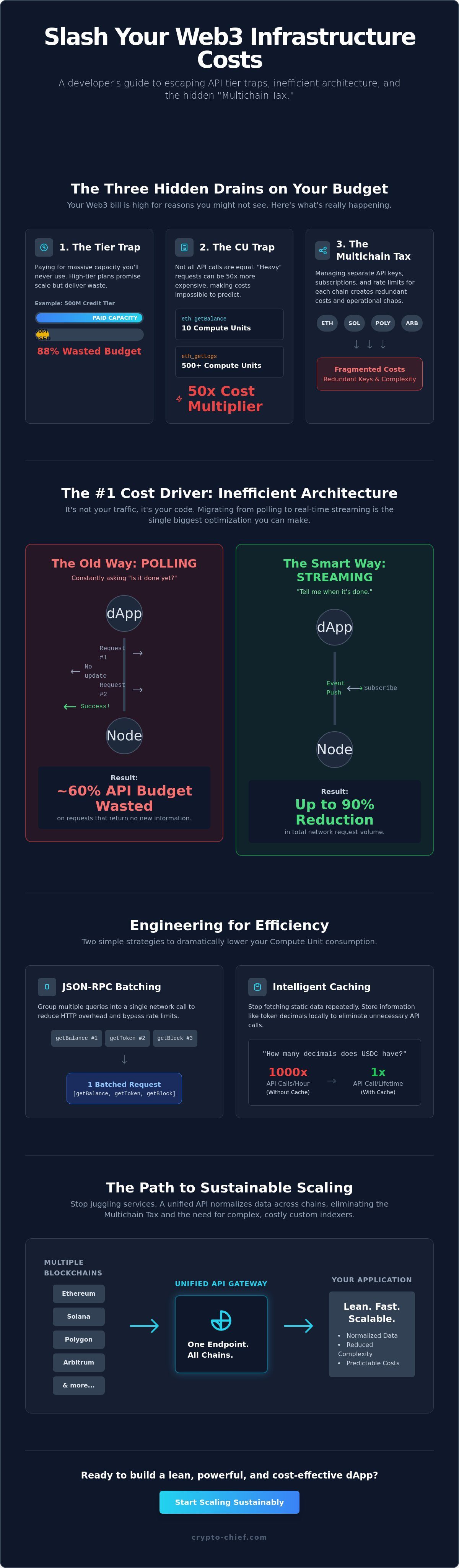
Building a decentralized application requires a complex stack that extends far beyond a simple server. In 2026, a comprehensive web3 infrastructure cost breakdown includes RPC nodes for network communication, data indexers for queryable history, AML compliance for regulatory safety, and processing gateways for transaction management. While many teams start by mastering Web3 fundamentals, they quickly hit the "Multichain Tax." This is the hidden financial and operational burden of managing separate API keys, tiered subscriptions, and disparate rate limits for five or more different blockchains simultaneously.
Free tiers often act as loss-leaders. They lure developers in with generous initial limits but lead to non-linear scaling costs that spike the moment a project gains traction. Unlike legacy cloud hosting where costs scale predictably with bandwidth or storage, blockchain API expenses are tied to the technical complexity of the data requested. It's common to see a monthly bill jump from zero to thousands of dollars without a corresponding increase in user revenue or server load.
The Compute Unit (CU) Trap Explained
Providers have largely moved away from simple request counting in favor of Compute Units (CUs). This shift creates a significant pricing trap. A simple balance check might cost 10 CUs, while a "heavy" call like eth_getLogs can consume 500 CUs or more. This 50x price difference makes it nearly impossible for CFOs to predict monthly infrastructure burn. For high-volume DeFi protocols or gaming dApps that require constant state updates, these hidden multipliers turn a seemingly affordable plan into a massive overhead that eats into margins.
Polling vs. Real-Time Data Overheads
Inefficiency is often baked into the code rather than the traffic volume. Consider a polling loop that checks transaction status every five seconds; this pattern can waste 60% of a typical Web3 API budget on redundant requests that return no new information. This constant chatter creates artificial congestion and drives up costs without improving the user experience. In contrast, using real-time data streams ensures you only pay for actual state changes. Architectural inefficiency, not traffic, is the primary driver of high Web3 bills.
Technical Strategies to Minimize Web3 API Request Volume
Engineering for efficiency is the most effective way to manage your web3 infrastructure cost breakdown. While providers profit from your high call volume, a builder-centric approach focuses on reducing unnecessary chatter between your application and the blockchain. You don't need to fetch the same static metadata thousands of times; you need a strategy that prioritizes data persistence and intelligent request grouping.
Implementing JSON-RPC request batching allows you to group multiple queries into a single network request. This doesn't just reduce the HTTP overhead; it often allows you to bypass per-request rate limits that can throttle your dApp during peak usage. By grouping calls like eth_getBalance for multiple addresses into one array, you minimize the round-trip time and lower the total Compute Unit consumption per user session.
Mastering RPC Batching and Caching
To optimize your ethers.js implementation, distinguish between static and dynamic data. Information like token decimals should never be fetched from the node more than once. Storing this in a local Redis cache drastically reduces API dependencies. For block-sensitive data, set a strict Time-to-Live (TTL) that matches the network's average block time to ensure accuracy without over-calling the gateway.
Switching to an Event-Driven Architecture
Polling is an architectural relic that drains your budget. Migrating from a pull-based model to Real-Time Blockchain Webhooks can reduce your total call volume by 90%. Instead of asking the node every few seconds if a transaction has confirmed, an event-driven system pushes a notification to your server the moment the event hits the chain.
Using a service like EventStream allows you to set up specific filters for wallet addresses or contract topics. By optimizing these filters, you prevent the node from fetching unnecessary block data, which keeps your infrastructure lean. You can find detailed guides on how to configure these triggers in the Crypto Chief documentation. By shifting the responsibility of monitoring to a dedicated stream, you free up resources to focus on building features. This structural change is an essential component of a sustainable web3 infrastructure cost breakdown for any scaling project. If you're looking for a more efficient way to handle these requests, consider switching to a unified RPC Gateway designed for high-performance scaling.
Tiered Subscriptions vs. Pay-Per-Call: A Cost Comparison
Traditional SaaS billing models often fail when applied to the volatile nature of blockchain data. When analyzing your web3 infrastructure cost breakdown, the choice between tiered subscriptions and pay-per-call models is often the difference between a sustainable business and a drained budget. Most legacy providers rely on the "Shelf-Life" problem; they sell you a plan with 10 million requests for a fixed monthly fee, but if your application only consumes 2 million, the remaining 8 million simply vanish at the end of the month. You're essentially paying for idle capacity that offers no return on investment.
The financial risk intensifies when you cross the threshold of your plan. Overage fees in tiered models are notoriously aggressive, frequently costing 300% more than the base rate of your subscription. This creates a perverse incentive where success, meaning more users and higher traffic, is punished with exponential costs. Pay-per-call models eliminate this friction by ensuring total alignment between your dApp’s revenue and your infrastructure expenses. You only pay for the data you actually use.
Analyzing the "Tier Trap" for Scaling dApps
The "Tier Trap" is a common hurdle for growing projects. Consider a dApp that currently utilizes 90% of its Tier 1 allocation. As soon as it grows by a small margin, it's forced into Tier 2, which might offer significantly more capacity but at a 4x price hike. This jump is rarely linear. Because the next tier is so expensive, developers often feel discouraged from adding new features that might increase call volume, such as more detailed transaction histories or real-time price feeds. Metered models remove this psychological barrier, allowing for infinite scaling without the fear of a sudden, massive bill.
Prepaid Token Balances for Web3 Teams
Efficiency is also found in how you manage cross-chain operations. Instead of maintaining separate subscriptions for Ethereum, Polygon, and Solana, sophisticated teams use a single prepaid balance that works across all networks. Prepaid tokens eliminate bill shock while providing the flexibility of pay-as-you-go pricing. This approach allows for granular usage tracking and provides a hard cap on spending, ensuring your burn rate remains within the limits set by your business architects. To see how this model supports long-term growth, you can explore the Web3 RPC Gateway pricing flexibility, which is designed to adapt to your specific traffic patterns. This system ensures your web3 infrastructure cost breakdown remains predictable as you expand into new ecosystems.
Step-by-Step: Implementing a Web3 Infrastructure Cost Audit
Audit your stack before you scale. A professional web3 infrastructure cost breakdown isn't a static document; it's a living audit that identifies where your code is leaking capital. Many teams wait for a massive bill to investigate their usage, but proactive auditing can prevent overages before they occur. Follow these five steps to regain control over your operational budget.
Step 1: Export your usage logs from your current RPC provider. Identify the top five most expensive methods by volume and Compute Unit consumption. Step 2: Map these calls to specific user actions. If your application is fetching data that the user never sees, such as background balance updates for hidden wallet tabs, you're paying for "ghost traffic." Step 3: Consolidate your multichain logic into a Unified API. This reduces the parsing overhead and custom indexing code your team has to maintain. Step 4: Implement a "Stale-While-Revalidate" caching strategy. For non-critical data like historical transaction counts, serve the cached version first while updating the background. Step 5: Move high-frequency monitoring, such as tracking whale movements or contract state changes, to a dedicated EventStream service to stop the polling drain.
Profiling Your RPC Call Profile
Use middleware to track which frontend components trigger the most API calls. You'll often find redundant balance checks that occur on every page refresh or component re-render. Visualizing these trends over time helps you spot anomalies, such as a bot attack or a recursive loop in your code, that could spike your costs overnight. Eliminating these redundancies is the fastest way to trim your monthly infrastructure burn.
Consolidating Multichain Infrastructure
Managing separate RPC nodes for Ethereum and BNB Smart Chain introduces a significant "Hidden Labor Cost." Your dev-ops team spends hundreds of hours on API key rotation, endpoint maintenance, and troubleshooting fragmented uptime issues. A single gateway reduces this burden, allowing your engineers to focus on product features instead of background plumbing. When you calculate the total cost of ownership, the time saved on maintenance often outweighs the direct API fees. Ready to stop the fragmentation? Register your account to access a unified RPC Gateway and start optimizing your infrastructure today.
Scaling Sustainably with Crypto Chief Infrastructure
Building a sustainable web3 infrastructure cost breakdown requires moving away from fragmented service providers and adopting a unified foundation. While previous sections detailed how to audit and optimize your existing calls, the most significant long-term savings come from structural consolidation. Crypto Chief provides a high-performance, pay-per-call platform that replaces the need for multiple expensive subscriptions with a single, streamlined gateway. This builder-centric approach ensures that your infrastructure costs remain a predictable reflection of your actual usage rather than a collection of "just in case" monthly fees.
A primary driver of operational overhead is the need for custom data indexing across different chains. Traditional indexing requires building proprietary subgraphs or maintaining complex databases for every network you support. Our Unified API normalizes data across multiple blockchains, delivering a consistent response format regardless of the source. This normalization saves thousands in custom development and indexing costs, allowing your team to query cross-chain data through a single endpoint without the burden of maintaining your own data lake.
Security and compliance shouldn't exist as separate, costly silos. By integrating AML Intelligence and Crypto Processing through the same high-performance gateway, you eliminate the need for third-party risk tools that charge high premiums for simple API access. Our non-custodial architecture further reduces your transaction-related infrastructure overhead. Because you maintain control over your keys, you bypass the massive security and insurance costs associated with custodial hosting while still enjoying enterprise-grade processing capabilities.
A Single High-Performance Foundation
Stability is the prerequisite for growth. Our platform provides access to global RPC nodes with a 99.9% uptime guarantee and low-latency routing, ensuring your users experience seamless performance regardless of their location. Integrated AML risk detection identifies suspicious addresses before they interact with your contracts, reducing your reliance on expensive external compliance suites. You can scale from 1,000 to 1,000,000 calls without ever worrying about changing your pricing tier or hitting a sudden "success tax."
Getting Started with Optimized Infrastructure
Transitioning to a more efficient stack is straightforward. First, you register and fund your first prepaid token balance to gain immediate access to our full suite of tools. For a quick start, replace your existing chain-specific endpoints with our unified RPC URL and update your request headers. Most developers find they can move their first endpoint in under ten minutes. By shifting to a metered, unified model, you ensure your infrastructure remains an asset rather than a liability. Optimize your Web3 infrastructure costs with Crypto Chief today and build for the future of decentralized finance with total financial clarity.
Master Your Infrastructure Economics
Efficiency in the decentralized space is an architectural decision rather than a byproduct of growth. By identifying the specific "tier traps" within your current stack and migrating toward event-driven architectures, you shift the focus from managing overhead to delivering genuine user value. A comprehensive web3 infrastructure cost breakdown proves that sustainable scaling is possible when you align your expenses with actual network demand. You've seen how auditing your RPC calls and consolidating multichain logic can transform your burn rate into a strategic advantage.
Crypto Chief provides the high-performance foundation required for this transition. Our platform offers transparent pay-per-call pricing with no hidden Compute Units, a Unified API supporting over 10 major blockchains, and enterprise-grade uptime across a global node network. You don't have to choose between elite performance and financial predictability. Start optimizing your Web3 infrastructure with Crypto Chief today to secure a stable, cost-efficient path for your project. The tools for smarter scaling are ready; it's time to build without the burden of unpredictable bills. Your project deserves a foundation that is as ambitious as your vision.
Frequently Asked Questions
What is the most expensive Web3 RPC call?
Data-intensive methods like eth_getLogs and debug_traceTransaction are typically the most expensive calls in any web3 infrastructure cost breakdown. These requests require the node to scan multiple blocks or re-execute transactions in a virtual environment, consuming significantly more resources than a simple balance check. Developers often see these "heavy" calls billed at 10x to 50x the rate of standard queries when using Compute Unit models.
How does pay-per-call pricing differ from Compute Units (CUs)?
Pay-per-call pricing provides a flat, predictable fee for every request regardless of its technical complexity. In contrast, Compute Units (CUs) assign different "weights" to calls based on the server resources they consume. This means a single trace could cost as much as fifty simple balance checks, making it difficult for teams to predict their monthly burn without deep technical analysis.
Is it cheaper to run my own node or use a cloud RPC provider?
Self-hosting is rarely cheaper for scaling projects due to the high fixed costs of specialized hardware and 24/7 dev-ops labor. Managing your own infrastructure also introduces a "Multichain Tax" because you must maintain separate nodes for every network you support. Cloud providers offer a shared infrastructure model that converts these massive capital expenditures into manageable operational expenses with guaranteed uptime.
How much can I save by batching JSON-RPC requests?
Batching can significantly reduce your total network overhead by grouping multiple queries into a single HTTP request. While it doesn't always reduce the total credit count on metered plans, it helps you stay within rate limits and reduces the latency of multiple round-trips. This optimization is essential for frontends that need to load various data points simultaneously without triggering redundant per-request overhead.
Do Unified APIs increase latency for multichain dApps?
Unified APIs utilize high-performance routing that minimizes latency while providing the massive benefit of normalized data. The micro-difference in raw network speed is usually offset by the efficiency gained in your application logic. Because you don't have to parse different response formats for every chain, your overall processing time and development complexity often decrease.
What are the hidden costs of using a "free" Web3 API tier?
The hidden costs of "free" tiers lie in their aggressive, non-linear scaling paths and lack of enterprise-grade support. Once you exceed the initial limits, you're often forced into expensive subscriptions that charge for capacity you don't use. This creates a "shelf-life" problem where you pay for a large block of requests even if your actual traffic is only slightly above the free threshold.
How do Webhooks reduce API expenses compared to WebSockets?
Webhooks reduce expenses by operating on a push-based model that only consumes resources when a specific event occurs on-chain. In contrast, WebSockets require a persistent, stateful connection that can be more resource-intensive to maintain at scale. By using an EventStream service, you eliminate the need for constant polling, which directly lowers your web3 infrastructure cost breakdown.
Can I track my Web3 API spend in real-time with Crypto Chief?
Yes, you can track your infrastructure spend in real-time through the Crypto Chief dashboard. Our system utilizes a prepaid token balance that provides immediate visibility into your remaining credits across all supported chains. This transparency prevents "bill shock" and allows your architects to adjust their data fetching strategies before costs exceed the project budget.