
In 2026, the most expensive mistake a ZKsync developer can make isn't a code bug; it's paying for idle infrastructure capacity that sits dormant while your budget drains. You've likely felt the frustration of rigid monthly subscriptions that fail to scale with your traffic, or perhaps you've watched your application stall due to aggressive rate-limiting during critical network spikes. Managing a high-performance zksync rpc node alongside separate providers for AML intelligence and event streaming adds unnecessary layers of complexity that slow down your deployment cycle.
This guide will empower you to master ZKsync Era infrastructure by transitioning to a sophisticated, request-based model that prioritizes sub-millisecond latency and predictable, usage-based billing. We'll explore technical optimization strategies for the v31 protocol upgrade, including native interoperability and the shift toward institutional-grade privacy with Prividium. You will learn how to build a unified multichain stack that removes the friction of infrastructure management, allowing you to focus entirely on your core logic while maintaining total structural integrity. By the end of this deep dive, you'll have a clear roadmap for scaling your ZKsync operations with precision and efficiency.
Key Takeaways
- Understand the specialized JSON-RPC handling requirements of ZKsync Era to maintain seamless synchronization between sequencers and provers.
- Reduce latency and improve throughput by deploying a zksync rpc node with geo-balanced endpoints and advanced request batching.
- Transition from rigid monthly tiers to a transparent pay-per-call model to ensure you only pay for the infrastructure your application actually uses.
- Enhance your security posture by combining RPC infrastructure with real-time AML risk detection and transaction monitoring.
- Simplify your multichain stack with a unified API that integrates RPC, EventStream, and processing through a single, high-performance gateway.
Understanding ZKsync Era RPC Nodes in the 2026 L2 Landscape
By mid-2026, the ZKsync Layer 2 protocol has transitioned from a single scaling solution into a complex, elastic network of Hyperchains. At the heart of this evolution lies the zksync rpc node, which acts as the essential bridge between decentralized applications and the zero-knowledge proof machinery. Unlike standard full nodes, these specialized endpoints must manage the intricate flow of data between sequencers, which order transactions, and provers, which generate the cryptographic evidence for L1 finality. In this high-stakes environment, the RPC layer is no longer just a data relay; it is a performance bottleneck or a catalyst for growth.
Efficiency in 2026 is measured by time-to-finality and the implementation of data availability sampling. Developers no longer just look for basic uptime. They require nodes that can handle the v31 protocol upgrade's native interoperability features. This upgrade allows for seamless asset transfers across the ZK Stack, but it places a higher computational load on the RPC layer to track state across multiple chains simultaneously. Achieving sub-millisecond response times requires an architecture that understands the nuances of ZK-proof verification and batch commitment cycles.
ZKsync Era vs. Standard EVM RPCs
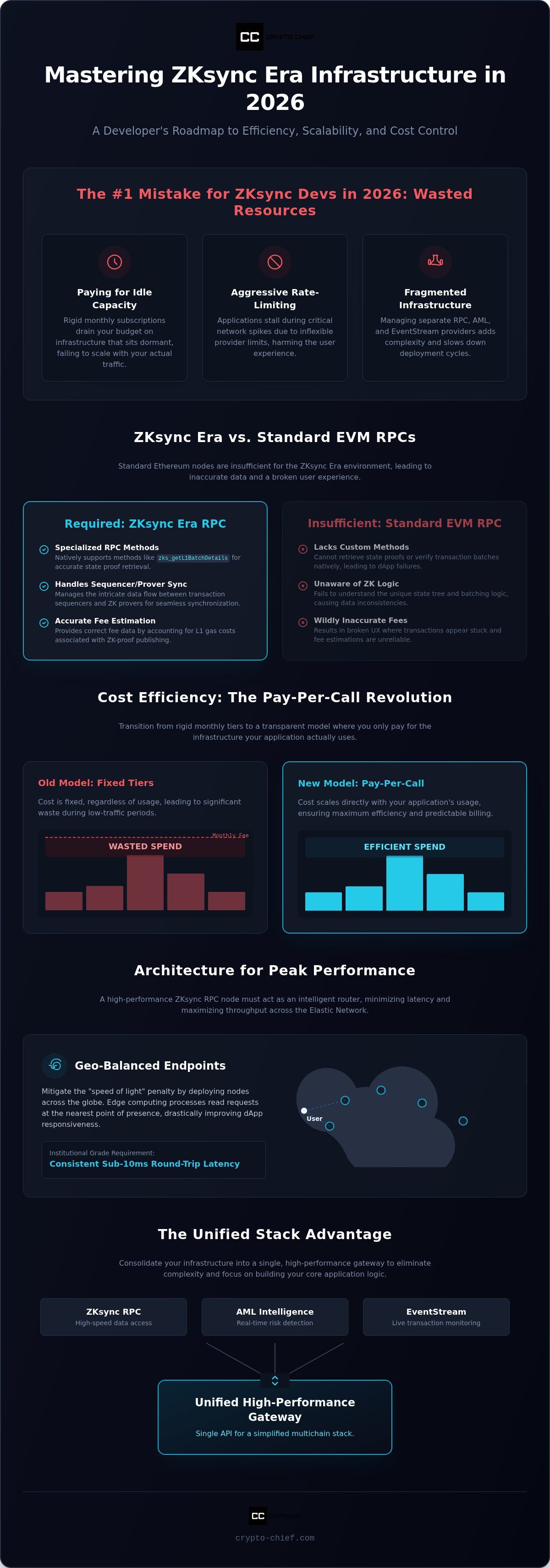
Standard Ethereum nodes are insufficient for the Era environment. While ZKsync maintains high EVM compatibility, it utilizes a fundamentally different state tree and batching logic. Your zksync rpc node must support custom methods such as zks_getL1BatchDetails and zks_estimateFee to provide accurate, real-time data to your users. Without a specialized RPC Gateway, dApps cannot retrieve state proofs or verify transaction batches natively. This often leads to broken user experiences where transactions appear stuck or fee estimations are wildly inaccurate because the node fails to account for the specific L1 gas costs associated with ZK-proof publishing.
The Rise of Hyperchains and Elastic Throughput
The ZK Stack has enabled a landscape where the ZKsync Elastic Network grew to over 19 ZK Chains by early 2025, and that number has expanded into a diverse ecosystem of L3s and specialized Hyperchains in 2026. These chains require dedicated infrastructure that can scale elastically during traffic spikes. Managing this complexity demands a unified approach to node architecture. As the "Internet of ZK" matures, the ability to query across different Hyperchains through a single, high-performance interface becomes a competitive necessity. Builders who rely on fragmented infrastructure struggle with latency; those who utilize a unified gateway maintain the speed required for institutional-grade applications.
Technical Architecture: Optimizing for Low Latency and High Throughput
Building a resilient application on the ZK Stack requires more than just a functional connection; it demands an architecture that anticipates the massive throughput of the Elastic Network. In 2026, a high-performance zksync rpc node must do more than relay messages. It acts as an intelligent router that manages state across various Hyperchains and L3s. As transaction volumes on ZKsync Era continue to climb, the infrastructure layer must evolve to prevent congestion and minimize the physical distance between the user and the data.
Geo-Balanced Endpoints and Edge Computing
Global distribution is no longer a luxury for enterprise dApps. By deploying geo-balanced endpoints, developers can effectively mitigate the "speed of light" penalty that plagues centralized infrastructure. Edge computing allows for the processing of read requests at the nearest possible point of presence, which drastically improves the responsiveness of frontend interfaces. Institutional-grade high-frequency trading on ZKsync in 2026 demands consistent sub-10ms round-trip latency to maintain competitive execution in the Elastic Network. This level of performance is only achievable when your gateway intelligently routes traffic to the most available and geographically proximate node in the cluster. Utilizing an optimized RPC Gateway can resolve these routing challenges automatically without manual configuration.
Advanced Request Management
Choosing between WebSocket (WSS) and HTTP protocols depends entirely on your specific use case. While HTTP is sufficient for standard, stateless queries, real-time applications like decentralized exchanges or automated liquidators require WSS for persistent, low-latency data streams. To ensure 99.99% uptime, even during major protocol upgrades like v24 or the anticipated v31, high-availability clusters utilize automated failover mechanisms. These systems monitor node health in real time; they shift traffic away from underperforming nodes before the user even notices a delay.
Optimization also extends to how you structure your calls. Each JSON-RPC request consumes compute units (CU), and inefficient querying can lead to unexpected costs. Implementing RPC Request Batching for Cost Reduction allows you to consolidate multiple queries into a single network round-trip. This reduces the overhead on the node and speeds up the data retrieval process for complex dApp states. By minimizing the number of individual connections, you maintain higher throughput and keep your infrastructure expenses aligned with actual application performance.
Cost Efficiency: Why Pay-Per-Call Beats Fixed Tier RPC Pricing
Traditional Web3 infrastructure often imposes a "Subscription Tax" on growing projects. This occurs when developers are forced into rigid monthly tiers that rarely align with actual usage patterns. If you pay for a high-capacity tier to handle potential spikes but your application only utilizes a fraction of that limit during development, you're effectively subsidizing the provider's idle hardware. A high-performance zksync rpc node should be a tool for scaling, not a fixed overhead that drains your capital during quiet periods.
The pay-per-call model shifts the paradigm by aligning infrastructure costs directly with user growth. It removes the friction of manual tier upgrades, ensuring your dApp remains responsive during unexpected traffic surges without requiring a midnight configuration change. By treating RPC access as a granular resource, you gain the flexibility to scale up for a major launch and scale down immediately afterward, maintaining a lean operation that prioritizes efficiency over arbitrary limits. This model transforms infrastructure from a rigid cost center into a dynamic asset that responds to your project's real-time needs.
The Economics of Prepaid API Tokens
Prepaid balances offer a level of financial predictability that recurring billing simply can't match. By using tokens that don't expire, you eliminate the risk of surprise overage charges that often accompany "unlimited" plans with hidden fair-use clauses. This transparency allows business architects to calculate the exact cost of every user interaction. For a detailed breakdown of how to forecast these expenses, consult our Web3 API Pay Per Call Pricing guide. This approach ensures that your budget remains focused on product innovation rather than background maintenance.
Case Study: Spiky Traffic on ZKsync
Consider the infrastructure demands of a high-profile NFT mint or a protocol launch on ZKsync Era. In a tiered model, you must over-provision weeks in advance, paying for capacity you aren't yet using. Conversely, request-based billing handles the surge automatically. Some industry professionals report that developers save up to 40% using this model during development cycles, as they aren't penalized for low-traffic testing phases. This structural integrity allows your zksync rpc node connection to remain a silent, powerful partner that supports your project through every stage of its lifecycle, from the first testnet deployment to global production.
Security and Compliance: Integrating AML with ZKsync RPC
In the 2026 regulatory environment, a zksync rpc node serves as more than just a data conduit; it's the primary defensive layer for your application. As institutional adoption of ZKsync grows, evidenced by over 35 financial institutions validating the Prividium architecture, the need for integrated compliance becomes undeniable. Developers can no longer afford to treat security as a separate, isolated module. By embedding risk detection directly into the RPC flow, you can intercept malicious activity before it ever touches your smart contracts or affects your users' funds. This proactive stance is essential for maintaining the structural integrity of your dApp.
Real-time transaction monitoring on ZKsync Era requires a sophisticated approach to funds tracing and risk scoring. L2 bridges are often targeted by bad actors, making it essential to identify the source of funds as they move between layers. Maintaining a non-custodial processing model allows you to meet these stringent regulatory standards without sacrificing the core tenets of decentralization. You retain control while the infrastructure handles the heavy lifting of identifying high-risk interactions. This balance ensures your project remains both compliant and trustless.
Real-Time AML Intelligence
Automating compliance at the entry point is the most efficient way to protect your ecosystem. By filtering malicious addresses at the RPC level, you prevent illegal actors from interacting with your frontend or backend services. Every interaction is assigned a risk score that ranges from 'Safe' to 'High Risk', allowing for automated decision-making based on your specific risk tolerance. Integrating AML Intelligence directly into your stack ensures that compliance is a silent, background process that doesn't disrupt the user journey. It's a professional necessity for any enterprise-grade deployment.
Secure Data Streaming
Real-time awareness is critical when managing assets across the ZK Stack. Using webhooks allows you to receive instant security alerts the moment a suspicious transaction is detected on ZKsync Era. For a deeper understanding of how to implement these systems, explore our guide to Real-Time Blockchain Webhooks. In 2026, the 'Zero-Trust' infrastructure model for dApps assumes that every incoming request is potentially compromised until verified by multiple layers of cryptographic and behavioral analysis. This rigorous approach minimizes friction while maximizing security. To start building on a secure foundation, register for a unified developer account today.
Scaling with Crypto Chief: Unified ZKsync Infrastructure
Complexity is the primary enemy of scalability. When developers are forced to juggle disparate providers for their zksync rpc node, risk scoring, and event streaming, they introduce fragile points of failure into their architecture. Crypto Chief eliminates this friction by providing a singular, high-performance gateway that consolidates these essential services under one API key. This approach doesn't just save time; it ensures that every component of your stack communicates with the same level of structural integrity and speed. It's the silent, powerful partner your application needs to handle the demands of the 2026 L2 landscape.
Efficiency is found in consolidation. By centralizing your infrastructure, you reduce the surface area for errors and simplify your billing into a single, predictable stream. Our platform is built by builders who understand that your focus should remain on product innovation, not on managing the background noise of infrastructure maintenance. Whether you're deploying a custom Hyperchain or a general-purpose dApp, having a unified foundation allows you to move from concept to production with total confidence. This is where high-level professional stability meets technical accessibility.
The Power of a Unified Web3 Platform
Consolidating your infrastructure providers is a strategic move that pays dividends in both performance and cost. By using our Web3 RPC Gateway, you gain access to global ZKsync Era endpoints that are optimized for the v31 protocol upgrade and native interoperability. This setup allows you to integrate non-custodial payments via our Crypto Processing API without adding unnecessary latency to your stack. For a comprehensive look at how this model transforms development, see The Architect’s Guide to a Unified Web3 Developer Platform. It's about building a cohesive narrative for your application's growth.
Getting Started with Crypto Chief on ZKsync
Transitioning to our infrastructure is a methodical process designed to respect your deployment schedule. You can start by utilizing the ZKsync Faucet to secure testnet assets for initial stress testing and environment configuration. Once your local setup is validated, moving to a production-grade zksync rpc node is as simple as updating your endpoint URL. Our developer-first documentation provides granular support for the ZK Stack, ensuring you have the technical precision required for enterprise-grade deployments. Start building on ZKsync with Crypto Chief today and secure the high-performance engine your project deserves.
Building for the ZKsync Elastic Network Era
The transition from experimental Layer 2 solutions to institutional-grade Hyperchains requires a fundamental shift in how developers approach infrastructure. You've seen how the traditional subscription model creates unnecessary overhead, whereas a request-based approach aligns your expenses with actual network demand. By consolidating your zksync rpc node with real-time AML intelligence and event streaming, you eliminate the architectural fragmentation that often leads to latency and security gaps. This unified foundation allows you to maintain total focus on your core logic while the background engine handles the complexity of the ZK Stack.
As the ZKsync ecosystem continues its expansion into a global network of interoperable chains, having a silent, powerful partner becomes your greatest competitive advantage. You can now deploy with sub-millisecond precision and predictable billing that scales alongside your user base. The future of Web3 development is defined by structural integrity and resource efficiency. It's time to remove the friction from your deployment cycle and build for the long term.
Scale your ZKsync dApp with Crypto Chief's Pay-Per-Call RPC and experience the stability of professional-grade infrastructure. Your next breakthrough is ready for production.
Frequently Asked Questions
What is a ZKsync RPC node and why do I need one?
A zksync rpc node is the essential gateway that allows your application to communicate with the ZKsync Era network. You need one to query blockchain state, broadcast signed transactions, and retrieve historical data without the immense resource burden of maintaining a private full node. It translates your application's JSON-RPC requests into a format the network understands, facilitating seamless interaction with the sequencer and provers that power the Layer 2 ecosystem.
How does pay-per-call pricing compare to monthly RPC subscriptions?
Pay-per-call pricing eliminates the "subscription tax" by charging you only for the specific requests your application executes. Unlike monthly subscriptions that force you into rigid tiers with fixed limits, this request-based model ensures your costs scale precisely with your user growth. It's particularly efficient for developers during testing phases or for projects with spiky traffic patterns, as you never pay for idle capacity or unused monthly quotas.
Does Crypto Chief support the ZKsync Era Sepolia testnet?
Yes, we provide full support for the ZKsync Era Sepolia testnet to facilitate rigorous pre-production testing. Developers can utilize our dedicated testnet endpoints to validate smart contract logic and frontend integrations before moving to mainnet. To simplify the development lifecycle, you can also access our faucet to secure the necessary testnet assets, ensuring your team can iterate quickly without infrastructure bottlenecks and unnecessary delays.
Can I use ZKsync RPC endpoints for high-frequency trading?
You can absolutely use our high-performance endpoints for high-frequency trading applications that require minimal round-trip times. Our infrastructure utilizes geo-balanced routing to ensure your zksync rpc node requests are handled by the nearest physical cluster. This architecture is designed to maintain consistent sub-10ms round-trip latency, which is the necessary threshold for competitive execution in the fast-paced environment of the ZKsync Elastic Network in 2026.
How do I integrate AML compliance into my ZKsync dApp?
Integration is handled through our unified AML Intelligence service, which provides real-time risk scoring for every transaction. By configuring your gateway to filter malicious addresses automatically, you create a first line of defense against illicit activity without adding complexity to your smart contracts. This non-custodial approach allows you to maintain decentralization while meeting the stringent compliance standards required by the modern regulatory landscape without sacrificing user privacy.
What is the latency for ZKsync RPC requests on Crypto Chief?
Internal request processing occurs with sub-millisecond latency to ensure your data remains as close to the current state-of-the-chain as possible. Total round-trip latency depends on your geographic proximity to our global clusters, but our intelligent routing system minimizes this delay by selecting the most efficient path. This high-speed performance is critical for applications that rely on real-time state updates, such as decentralized exchanges or automated liquidators on the ZK Stack.
Do I need a separate API key for different ZKsync Hyperchains?
No, you don't need separate keys for different Hyperchains or L3s within the ecosystem. Our Unified API allows you to manage all your ZK Stack infrastructure through a single credential, significantly reducing architectural complexity. This streamlined approach makes it easier to track usage and manage security across multiple chains, allowing your team to scale the "Internet of ZK" without the friction of fragmented access management or multiple provider accounts.
How do I monitor ZKsync smart contract events in real time?
Monitoring smart contract events in real time is achieved through our EventStream service and persistent WebSocket connections. Instead of repeatedly polling the node for updates, you can configure webhooks to receive instant notifications the moment specific criteria are met on-chain. This event-driven architecture reduces the load on your infrastructure and ensures your application responds immediately to critical state changes, such as large liquidity transfers or specific contract executions.
Tags: zksync rpc node