
Why is your engineering team still burning hundreds of hours building custom data adapters for every new L2 or non-EVM chain that enters the market? You recognize that maintaining separate pipelines for every network is a relic of an inefficient past. It's frustrating to juggle high latency and fragmented schemas when all you need is a reliable single api for multiple blockchains to power your application. You've likely felt the sting of opaque credit-based pricing that turns successful scaling into a financial liability.
This guide provides a blueprint for mastering the complexities of cross-chain data with a unified strategy that slashes engineering overhead and introduces predictable pay-per-call costs. We'll explore how to implement normalized data schemas, integrate real-time event streaming, and secure your infrastructure with embedded AML intelligence to meet 2026 regulatory standards like MiCA. By the end, you'll understand how to replace your bloated backend with a streamlined, enterprise-ready engine built for the modern multichain landscape.
Key Takeaways
- Understand why the 2026 explosion of Layer 2s and modular stacks makes chain-specific engineering a primary source of technical debt.
- Learn how to leverage a single api for multiple blockchains to normalize raw RPC data into a unified, developer-friendly JSON schema.
- Identify critical performance benchmarks for sub-second propagation and cross-chain finality to ensure your data pipelines remain enterprise-ready.
- Master architectural best practices like request batching and dataset prioritization to significantly reduce operational overhead and API call volume.
- Discover how to optimize infrastructure costs by transitioning from rigid monthly subscriptions to a transparent, pay-per-call model.
The State of Multichain Interoperability in 2026
The 2026 blockchain landscape is a sprawling network of Layer 2 rollups, sovereign AppChains, and modular execution environments. This explosion of choice is a double-edged sword for architects. While scaling is finally achievable, the complexity of managing these disparate environments has reached a breaking point. Traditional "one chain, one stack" development models are failing. They create massive engineering bloat and force teams to reinvent the wheel for every integration. Maintaining a custom data pipeline for every new network is a guaranteed way to accumulate technical debt that will eventually paralyze your development cycle.
We've moved past the era where simple asset bridges were the primary focus of interoperability. Today, the industry is shifting toward data-centric dApp architectures. It's not enough to move tokens; you must be able to read and interpret the state of the world across all chains simultaneously. DeFi and NFT platforms now face a severe "Data Silo" problem where liquidity is spread thin and critical information is trapped in chain-specific formats. Solving this requires a fundamental change in how we approach multichain infrastructure.
The Fragmentation Crisis
Liquidity fragmentation is a well-known hurdle, but data fragmentation is the silent killer of user experience. Architects find themselves forced to maintain a dozen different RPC endpoints for Ethereum, Solana, and various L2s just to provide a basic portfolio view. This overhead isn't just a financial burden. It's a performance bottleneck. Developers are rapidly shifting toward a single api for multiple blockchains to consolidate these streams into a manageable flow. In the early days, we focused on atomic swaps to move assets between chains, but today's architect needs more than just movement. We need a unified view of the entire multichain state without the friction of manual integration. Consolidating your infrastructure through a high-performance RPC gateway is no longer an optional optimization; it's a foundational requirement for scalability.
The Role of Aggregation APIs
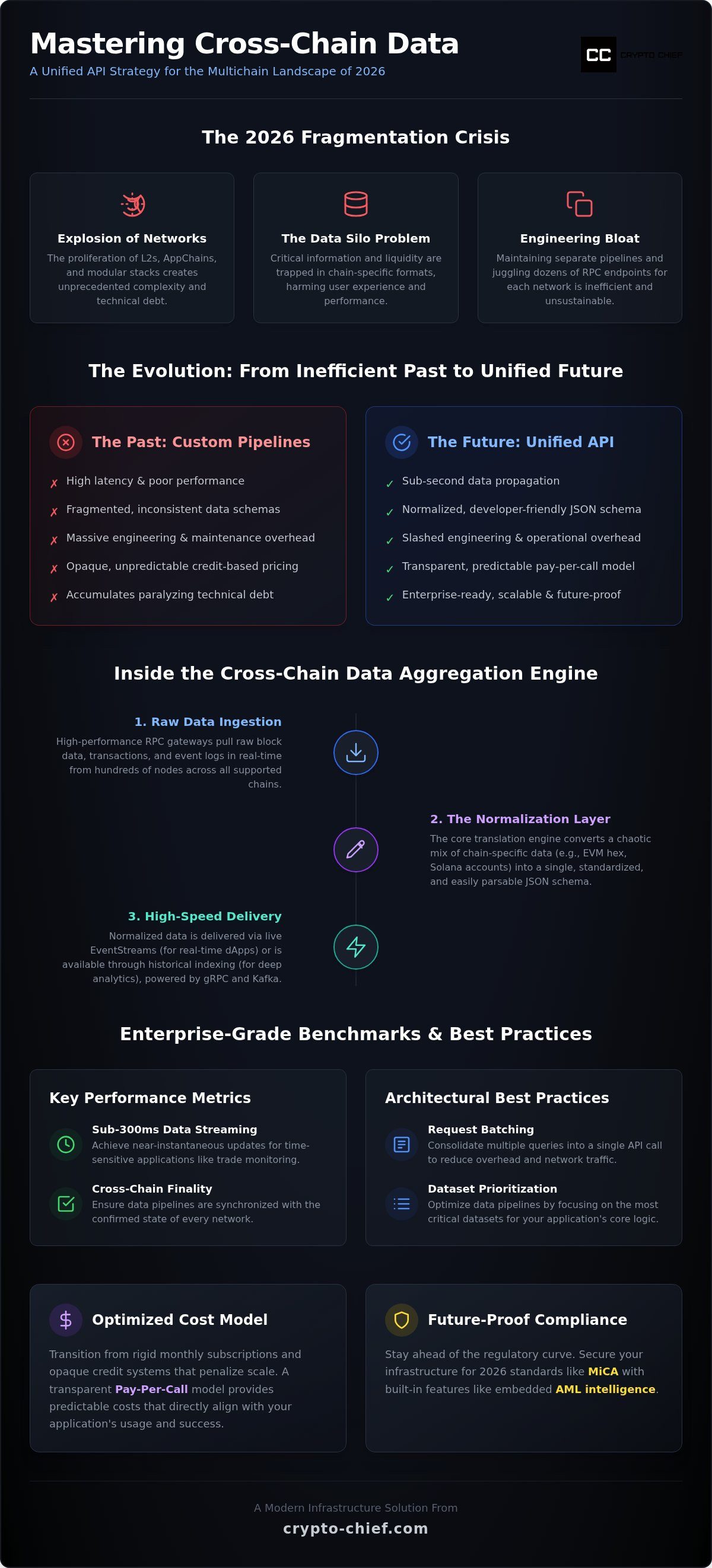
A cross-chain data aggregation API serves as the critical middleware layer for modern dApps. It doesn't just pull raw data; it normalizes it. There is a fundamental difference between simple asset bridging and the complex task of data normalization for cross-chain analytics. Raw hex values from an EVM chain look nothing like the account-based data from Solana. Aggregation layers solve this by converting disparate formats into a standard JSON schema. To meet 2026 performance requirements, enterprise-grade solutions now utilize gRPC and Kafka to achieve sub-300ms data streaming. This ensures that your application reacts to on-chain events as they happen, regardless of which network they originate from. By using a single api for multiple blockchains, you remove the need for custom parsers and allow your team to focus on building features rather than maintaining infrastructure.
Inside the Cross-Chain Data Aggregation Mechanism
Understanding the internal mechanics of a single api for multiple blockchains requires a deep dive into how disparate data streams are captured, parsed, and delivered. It starts with the raw ingestion layer. High-performance RPC gateways must maintain stable connections to hundreds of nodes across various networks, pulling raw block data and transaction logs in real time. Because every chain has its own idiosyncratic way of broadcasting state changes, this ingestion layer acts as the primary filter that prevents upstream service interruptions. This raw data is often a chaotic mix of hex values and chain-specific event logs that are virtually unusable for high-level application logic without a sophisticated middle layer.
Beyond simple ingestion, architects must choose between historical indexing and real-time streaming. Indexing is essential for deep-dive analytics and auditing, where you need to query a historical database for every transaction a wallet has ever made. However, modern trade monitoring and DeFi dashboards rely on live EventStreams. These non-custodial data streams push updates the moment they happen, ensuring your application remains synchronized with the latest block height without the latency of repeated database polling. Research on Blockchain-Enabled Payment System Using API Integration highlights that the efficiency of these systems depends heavily on the robustness of the underlying API architecture.
Normalization: The Translation Layer
Normalization is where the real value of a single api for multiple blockchains becomes apparent. It's the process of mapping EVM logs to non-EVM equivalents, such as translating Solana SPL token transfers into a format that looks identical to an Ethereum ERC-20 event. This layer standardizes transaction statuses, gas fees, and timestamps into a uniform JSON schema, allowing your frontend to treat every chain the same way. Data normalization in Web3 is the systematic process of mapping divergent on-chain data structures into a uniform, human-readable format that ensures interoperability across different virtual machines. If you're looking to simplify your stack, exploring a global RPC Gateway can provide the high-uptime foundation needed for this translation layer.
gRPC vs. REST for High-Frequency Data
For 2026 applications, the choice between gRPC and REST is a matter of survival. Trade monitoring and liquidation bots require the extreme low latency that only gRPC can provide through its binary protocol and multiplexed streams. While REST is sufficient for occasional balance checks, it often fails under the weight of high-concurrency requests and deep query depths. A robust Unified API handles these high-frequency demands by balancing response speed with the structural integrity of the data. This allows developers to maintain real-time dashboards that react to market shifts in sub-millisecond timeframes, providing a competitive edge in fast-moving multichain markets.
Evaluating API Performance: Latency, Normalization, and Cost Models
Performance in the 2026 multichain environment is measured by more than just raw speed. While sub-second block propagation has become the industry standard for high-performance applications, true reliability depends on how an infrastructure provider handles the underlying chaos of decentralized networks. A single api for multiple blockchains must do more than just deliver data; it has to manage the nuances of chain reorgs and varying finality times across different consensus mechanisms. Without these safeguards, your application risks displaying "ghost" transactions that never actually finalized on-chain, leading to critical errors in balance reporting or trade execution.
Architects often overlook the security and structural risks inherent in cross-chain data flows. During the recent NIST workshop on blockchain interoperability, experts emphasized that technical architectures must account for these security risks at the middleware layer. Using a unified endpoint helps mitigate these risks by providing a consistent security posture across all supported networks. However, performance isn't just a technical metric; it's also a financial one. Many developers fall into the "free tier" trap, only to find that scaling their dApp triggers exorbitant monthly subscription fees or confusing credit-based systems that make budgeting impossible.
The Pay-Per-Call Advantage
Rigid subscription models often force teams to pay for capacity they don't use, resulting in thousands of wasted credits at the end of every billing cycle. We've seen a massive shift toward transparent pricing where you only pay for the literal data you consume. By utilizing a single api for multiple blockchains with a pay-per-call model, you eliminate the abstraction of "points" and gain granular control over your infrastructure spend. This approach allows scaling startups to maintain a lean operation while ensuring they have the headroom to handle sudden traffic spikes. For a deeper look at how this fits into a broader multichain strategy, see our guide on the Web3 RPC Gateway.
Reliability and Uptime Metrics
True enterprise-ready infrastructure requires a 99.9% production uptime, which is difficult to achieve when relying on individual node providers. Global load balancing is essential for routing cross-chain requests to the healthiest available nodes, effectively bypassing localized network congestion or node outages. You shouldn't have to manually manage failover strategies for every chain you support. A high-performance RPC Gateway handles these failovers automatically, ensuring that your data pipeline remains uninterrupted even if a specific blockchain network experiences degraded performance. This silent, background resilience is what separates an elite service provider from a standard node reseller.
Architecture Best Practices for Cross-Chain Data Pipelines
Building a resilient data pipeline in a multichain environment requires a shift from reactive coding to proactive architectural design. It's no longer enough to simply "connect" to a network; you must orchestrate how data flows through your system to ensure scalability and cost-efficiency. By utilizing a single api for multiple blockchains, you avoid the logistical nightmare of managing separate SDKs and authentication keys for every new rollup or AppChain that hits the market. This centralized approach allows you to implement a standardized workflow that remains consistent regardless of the underlying network's consensus mechanism.
Your first step is to define your "Source of Truth" chains and required datasets. By identifying which networks and specific event types are mission-critical, such as DEX trades on Solana or simple transfers on Ethereum, you prevent your database from being flooded with irrelevant telemetry. Once your sources are defined, implement request batching. Efficiency is profit. Batching multiple queries into a single call significantly reduces your overhead and optimizes your pay-per-call costs, ensuring you only spend on the data you actually need for your application logic.
Implementing Webhooks with EventStream
Moving from inefficient polling to push-based notifications is the most impactful change you can make for real-time responsiveness. Polling an RPC endpoint every few seconds is a resource hog that creates unnecessary latency and bloat. Instead, use an EventStream to push transaction alerts directly to your backend the moment they're detected on-chain. For a detailed breakdown of this architecture, refer to our guide on Real-Time Blockchain Webhooks. To maintain data integrity, ensure your system handles webhook retries and idempotent processing, which prevents the same event from being recorded twice in the event of a network hiccup.
Security and Risk Mitigation
Security must be integrated at the data ingestion point rather than treated as an afterthought. Using non-custodial APIs ensures you maintain private key sovereignty while accessing the multichain data you need. However, data privacy is only half the battle. You must also automate risk scoring for incoming transfers to protect your platform from illicit activity. Integrating AML Intelligence directly into your pipeline allows you to flag high-risk transactions before they're processed by your application. This proactive compliance layer is essential for meeting 2026 regulatory standards without slowing down your development velocity. Start building your compliant, high-performance pipeline today by registering for a Unified API account.
Scaling with Crypto Chief’s Unified API Infrastructure
Managing infrastructure in 2026 doesn't have to be a fragmented mess of separate vendors and inconsistent billing cycles. We've built our ecosystem around a "One API" philosophy that consolidates everything you need into a single, high-performance point of entry. By utilizing a single api for multiple blockchains, you gain immediate access to high-performance RPC nodes, normalized data streams, and automated risk scoring through a unified token balance. This approach eliminates the friction of managing multiple subscriptions and allows you to scale your operations with total financial transparency. You only pay for what you use, ensuring your infrastructure costs always align with your actual traffic.
Our infrastructure is designed for the most demanding production environments. We provide high-concurrency gRPC endpoints for Ethereum, Solana, and BNB Smart Chain to ensure your application maintains sub-millisecond responsiveness. This flexibility between gRPC and REST allows you to choose the protocol that best fits your specific stack and performance requirements. Once you've aggregated the necessary data, the transition to Crypto Processing is seamless. You can move from reading on-chain state to executing secure, non-custodial payments within the same architectural framework, which significantly reduces the complexity of your backend and improves overall system reliability.
A Unified Developer Ecosystem
Modern tech stacks are often plagued by vendor sprawl that leads to unnecessary technical debt and integration headaches. Combining our Unified API with real-time AML Intelligence allows you to build a complete data and compliance pipeline in a fraction of the time. You won't need to reconcile different billing accounts or worry about inconsistent data formats between disparate providers. It's a steady, logic-driven foundation that acts as a silent partner in your growth, letting you focus on your core product while we handle the background complexity. This centralized billing model provides the elite performance you expect without the administrative overhead of traditional enterprise solutions.
Getting Started with Crypto Chief
The path to a more efficient infrastructure begins with a simple free registration. Once your account is active, you can top up your balance and start making calls immediately without being locked into a rigid, expensive tier. We also provide access to a multichain faucet for development and sandbox testing, ensuring you can refine your logic before moving to production. If you have unique requirements or need customized support for a high-volume application, contact our team to discuss your custom scaling needs and architectural goals. We're here to provide the structural integrity your project deserves.
Future-Proofing Your Multichain Architecture
The complexity of the 2026 multichain landscape requires more than raw data access; it demands a structural rethink of how we ingest and normalize cross-chain intelligence. By consolidating your infrastructure into a single api for multiple blockchains, you remove the technical debt associated with fragmented node maintenance and inconsistent data formats. You've identified the best practices for asynchronous EventStreams and request batching. Now it's time to implement a foundation that supports your long-term growth.
Our platform provides the stability you need with a global 99.9% uptime for production apps. You don't have to worry about opaque credit models because our transparent pay-per-call pricing ensures you only pay for the data you use. With integrated AML Intelligence and Risk Scoring, your compliance layer is built directly into the ingestion point. It's a professional, elite solution designed for architects who value logic and performance.
Start Building with Crypto Chief’s Unified API and transform your multichain strategy today. We're excited to see what you create on this powerful, unified foundation.
Frequently Asked Questions
What is a cross-chain data aggregation API and why is it needed?
A cross-chain data aggregation API is a unified interface that allows developers to query state and transaction data from multiple networks through a single endpoint. It is essential in 2026 because the explosion of Layer 2s and AppChains makes maintaining individual node connections for every network technically and financially unsustainable. By using a single api for multiple blockchains, teams can focus on application logic instead of the background noise of infrastructure management.
How does normalized data differ from raw RPC data in 2026?
Normalized data is raw blockchain information that has been parsed and mapped into a consistent JSON schema. Raw RPC data is often idiosyncratic; it requires specific decoders for different virtual machines like EVM or Solana. Normalization ensures that a transfer event on Solana looks identical to one on Ethereum. This allows your frontend to handle multichain data without complex, chain-specific logic, which significantly reduces your engineering overhead.
Why is pay-per-call pricing better for Web3 startups than monthly tiers?
Pay-per-call pricing is superior because it eliminates the financial waste of unused credits found in traditional monthly subscription tiers. Startups often have fluctuating traffic; a prepaid token model ensures you only pay for the literal volume of data consumed. This transparency prevents the "subscription trap" where teams pay for enterprise-level capacity during low-traffic periods, preserving vital capital for development and user acquisition.
Can I monitor smart contract events across multiple chains in real-time?
Yes, you can monitor cross-chain smart contract events in real-time using EventStream webhooks. This architecture replaces inefficient polling with push notifications that trigger the moment a transaction is detected on-chain. It is a critical tool for trade monitoring and payment confirmation, providing sub-second alerts that ensure your application reacts to global state changes as they occur across any supported network.
Does Crypto Chief support non-EVM chains like Solana, TON, or Bitcoin?
Crypto Chief provides comprehensive support for a wide range of networks, including non-EVM chains like Solana, TON, and Bitcoin. Our single api for multiple blockchains abstracts away the differences between account-based and UTXO models, providing a unified developer experience. This allows you to integrate high-performance data streams from disparate environments without needing to master the technical nuances of every individual protocol.
What are the latency expectations for cross-chain API calls in 2026?
In 2026, the industry standard for high-performance data streaming is sub-300ms for gRPC-based EventStreams. For standard RPC propagation, architects expect sub-second delivery to ensure real-time accuracy. These low-latency benchmarks are essential for competitive trade execution and interactive user interfaces where even a minor delay can lead to outdated price information or failed transaction confirmations.
How do I integrate AML compliance into my cross-chain data feed?
You can integrate AML compliance directly at the ingestion point by utilizing our built-in AML Intelligence services. This allows you to automate risk scoring for every incoming transfer, flagging illicit activity before it impacts your platform. With regulations like the EU's MiCA now fully enforceable in 2026, having automated transaction monitoring is a core requirement for staying compliant while maintaining a seamless user experience.
Is a cross-chain API more secure than using a standard bridge?
A cross-chain API is inherently more secure for data retrieval because it is read-only and non-custodial. Bridges often involve complex smart contract risks and the movement of actual assets, which can be vulnerable to exploits. An API focused on data aggregation allows you to monitor the state of the multichain world without exposing your private keys or your users' funds to the risks associated with bridge protocols.