
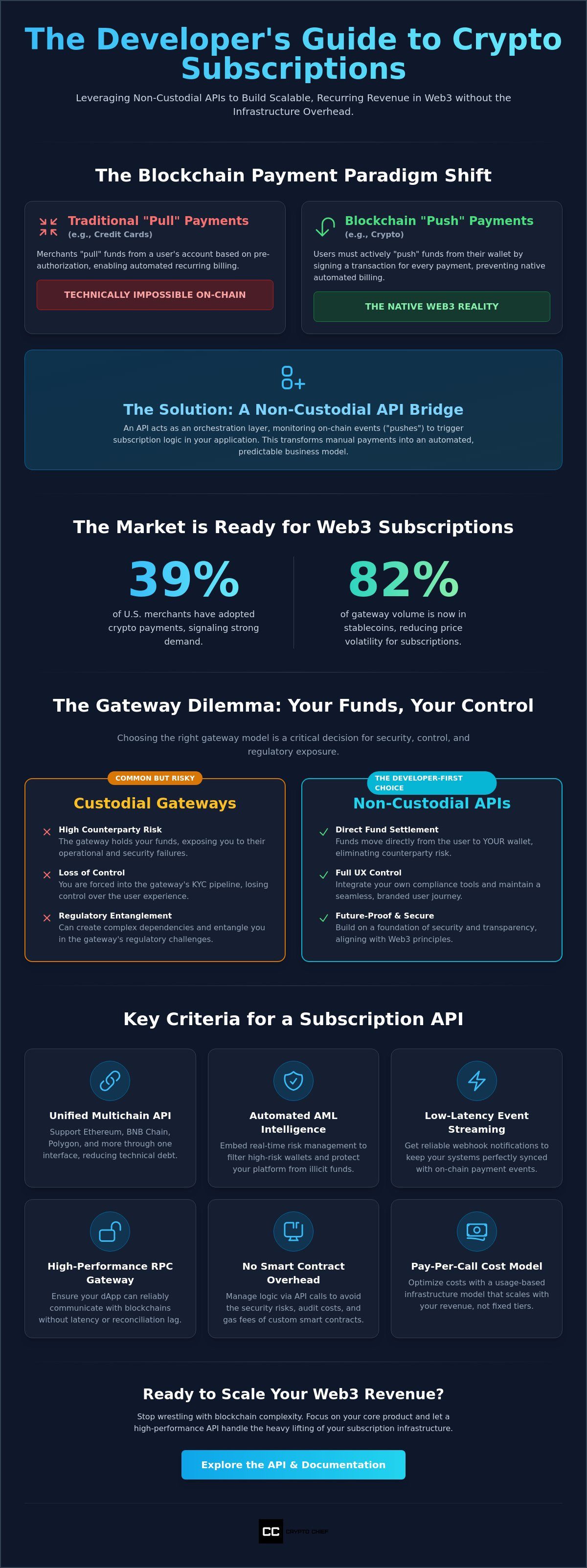
What if you could automate global recurring revenue without the overhead of managing complex smart contract permissions or the unpredictability of on-chain gas fees? With merchant adoption reaching 39% in the U.S. and stablecoins now accounting for 82% of gateway volume, the requirement for a professional crypto payments for subscription services api has moved from a luxury to a technical necessity. Most developers recognize that while on-chain payments offer unparalleled global reach, the friction of manual reconciliation and the risk of processing "dirty" funds can stall even the most robust projects. You've likely encountered the frustration of high-latency transactions or the lack of reliable webhook notifications when trying to build a seamless user experience.
This guide explores how to leverage high-performance, non-custodial APIs to achieve multichain scalability without the burden of custodial risks or complex infrastructure. We'll evaluate the essential criteria for a developer-first integration, moving from broad value propositions to the granular technical details of unified architecture. You'll discover how to implement automated AML intelligence and low-latency event streaming that keeps your internal systems perfectly synced with the blockchain. By the end, you'll have a clear roadmap for selecting a solution that handles the heavy lifting of background infrastructure so you can focus on your core product.
Key Takeaways
- Understand why native 'pull' payments are technically impossible on major blockchains and how a developer-centric bridge enables automated recurring billing.
- Evaluate the essential features of a crypto payments for subscription services api, focusing on non-custodial architecture and seamless multichain integration.
- Discover how to automate risk management by embedding real-time AML intelligence into your payment flow to filter high-risk wallet interactions.
- Analyze the cost benefits of a pay-per-call infrastructure model compared to traditional tiered pricing for scaling your dApp’s revenue operations.
- Learn to implement high-performance processing APIs and RPC gateways to manage subscription logic without the security overhead of custom smart contracts.
The Architecture of Crypto Payments for Subscription Services
Integrating a crypto payments for subscription services api requires a fundamental shift in how developers approach transaction flow. Unlike traditional credit card systems that rely on a "pull" mechanism, where a merchant can initiate a charge against a pre-authorized card, public blockchains like Bitcoin and Ethereum are strictly "push" based. Every transaction must be cryptographically signed by the user's private key. This architectural reality means that a native, automated recurring charge doesn't exist at the protocol level. To bridge this gap, a developer-centric gateway acts as an orchestration layer, monitoring the chain for specific events and triggering the necessary business logic in your application.
The role of a professional API is to transform these manual on-chain actions into a predictable subscription business model. Instead of asking users to manually send funds every month, which leads to high churn and missed payments, developers use high-performance APIs to track deposits and manage trial periods or tier upgrades. By utilizing non-custodial processing, you ensure that funds move directly to your own wallet. This eliminates the counterparty risk associated with custodial gateways that hold your revenue in their own accounts, providing a more secure and transparent foundation for your SaaS operations.
Why Traditional Subscriptions Fail in Web3
Traditional billing logic often breaks when it meets the decentralized web. The primary challenges include:
- Authorization Constraints: You can't store a user's private key to sign future transactions, making automated "pulls" technically impossible without complex, gas-intensive smart contract proxies.
- Gas Fee Volatility: On-chain congestion can make small-value recurring payments economically unviable; if a gas fee exceeds the subscription price, the transaction fails the utility test.
- Reconciliation Lag: Without real-time event monitoring, your system won't know if a payment was confirmed, dropped, or replaced, leading to service interruptions for your users.
The Role of Unified APIs in Multichain Billing
Modern developers shouldn't have to build separate integrations for every blockchain they want to support. A unified API normalizes the data coming from Ethereum, BNB Chain, and Polygon, presenting a consistent interface for your backend. This approach significantly reduces technical debt. You don't need to learn the nuances of every RPC method or handle different transaction receipt formats for each network. A unified API abstracts the underlying blockchain complexity, allowing SaaS providers to manage billing cycles across multiple networks through a single, consistent data interface. By leveraging a robust Processing API alongside a reliable RPC Gateway, you can ensure that your subscription infrastructure is both scalable and chain-agnostic. For more detailed implementation steps, you can always consult the official documentation to see how these layers interact in a production environment.
Comparing Developer Crypto Payment Gateway Models
Selecting the right crypto payments for subscription services api involves more than comparing feature lists; it requires a strategic decision on fund custody and regulatory exposure. Many developers face a fork in the road: do they prioritize the perceived simplicity of a custodial middleman, or do they build for the future with a direct, non-custodial architecture? Regulatory clarity is improving. In 2026, frameworks like MiCA and the OECD's CARF have established clearer boundaries for digital asset reporting. Your choice of gateway determines how much of this burden falls on your shoulders. A custodial model often forces you into the gateway's specific KYC pipeline, whereas a non-custodial API allows you to integrate your own AML Intelligence while maintaining full control over the user experience.
Transaction broadcasting latency is another critical metric. Custodial systems might offer low-latency internal ledger updates, but they often struggle with mainnet settlement speeds because they batch transactions to save on costs. In contrast, high-performance Web3 infrastructure broadcasts directly to the network. This ensures that your subscription logic triggers as soon as the block is confirmed. It's the difference between a system that feels like a legacy bank and one that operates at the speed of the blockchain.
Custodial Gateways: Convenience at the Cost of Control
Centralized storage creates a "honeypot" for attackers. When you rely on a third party to hold funds, you aren't just trusting their code; you're trusting their solvency and internal security protocols. Withdrawal delays and settlement friction are common in these environments, as providers often subject transactions to manual reviews that can take 24 to 48 hours. If the provider's platform goes down, your access to revenue vanishes. For a deeper technical comparison, read our architectural guide on Circle API vs Non-Custodial Processing.
Non-Custodial APIs: The Gold Standard for Developers
Direct-to-wallet settlement has become the industry benchmark for 2026. By removing the intermediary, you eliminate counterparty risk and provide immediate liquidity for your business. This transparency builds trust with your subscribers, who can verify payments on-chain without wondering if a centralized processor is holding their funds. It's a builder-centric approach that prioritizes structural integrity. If you're ready to build a more resilient stack, you can register for an account to begin testing these endpoints. For more details, explore our Non-Custodial Crypto Payment API Guide. This model ensures that your crypto payments for subscription services api remains a transparent, high-performance engine for your global growth.
Key Criteria for Evaluating a Subscription API
Building a resilient revenue engine requires more than just a basic connection to a node. It demands a sophisticated crypto payments for subscription services api that balances technical performance with proactive risk management. Developers often overlook the long-term technical debt of ecosystem locks. If your service is restricted to a single chain, you're alienating a massive segment of users who prefer the efficiency of Polygon or BNB Chain over the higher costs of Ethereum mainnet. A production-ready API provides a unified interface across these environments, documented through clear OpenAPI or Swagger specifications to ensure your team isn't guessing at endpoint structures during the integration phase.
Reliability also hinges on the quality of the developer experience. High-performance APIs don't just process transactions; they provide the structural integrity needed to scale. This includes robust error handling, predictable rate limits, and a sandbox environment that mirrors mainnet conditions. When you're evaluating a provider, look for a partner that acts as a silent innovator, solving the complex problems of chain abstraction so you can focus on building your product's core value.
AML and Risk Mitigation in Subscription Billing
Security in a decentralized environment isn't just about protecting your own private keys. It's about protecting your business from the source of the funds you receive. Many legacy providers treat compliance as an external hurdle, forcing you to bolt on third-party tools after the transaction is already complete. This approach is reactive and creates unnecessary vulnerability. By utilizing integrated AML Intelligence, you can automate risk scoring for every incoming subscription transaction in real-time. This proactive filter identifies high-risk wallets before you accept a payment, effectively shielding your platform from sanctioned addresses or "dirty" crypto assets. It's a critical layer that prevents regulatory friction and ensures your revenue remains clean and reportable from day one.
EventStream and Webhooks for Seamless UX
User experience in a subscription model depends entirely on the speed of service delivery. If a user pays for a premium tier, they shouldn't have to wait for a manual backend refresh to see their status update. Relying on real-time blockchain webhooks allows your dApp to react instantly to on-chain confirmations. These event streams can trigger immediate access, send automated notifications, or handle "insufficient balance" events without manual intervention. EventStream minimizes the need for constant RPC polling by pushing transaction updates directly to your listener the moment they're confirmed on-chain. This architecture reduces server overhead and ensures that your internal database stays perfectly synchronized with the global ledger, providing the seamless experience that modern subscribers expect.
API Cost Optimization: Pay-Per-Call vs. Tiered Pricing
Financial efficiency in Web3 infrastructure requires a departure from the legacy SaaS subscription model. Monthly tiers, while familiar, often introduce hidden costs that penalize growth or reward inactivity. A crypto payments for subscription services api should align its cost structure with the actual utility it provides. By shifting to a pay-per-call model, you eliminate the risk of paying for idle capacity during quiet months or facing exorbitant overage penalties during peak growth periods. It's about logic. This structure ensures that your overhead remains perfectly proportional to your revenue, providing a stable foundation for long-term scalability.
Prepaid token balances offer a level of transparency that monthly invoices can't match. You maintain a single balance that decrements only when an actual request is processed. This approach empowers early-stage startups by lowering the initial barrier to entry; meanwhile, high-volume enterprises benefit from a predictable cost-to-revenue ratio that scales linearly with their user base. It's a builder-centric approach that values uptime and performance over marketing-driven pricing tiers.
Eliminating Overages and Idle Costs
Tiered pricing often forces developers into a "buffer" mentality, where they pay for the next tier up just to avoid service interruptions. Industry data suggests this leads to roughly 30-40% of budgets being wasted on unused API credits. With a pay-per-call architecture, you scale instantly. There are no plans to change and no manual upgrades required. This flexibility is essential when managing high-volume periods, such as when your own subscription renewal dates trigger a surge in transaction monitoring and webhook activity. You don't have to worry about hitting a ceiling; the engine simply continues to run.
Unified Token Balances Across Services
Managing fragmented billing for different infrastructure components is a significant administrative drain. A more efficient approach uses a single balance for your RPC Gateway, Processing API, and AML Intelligence calls. This unified system simplifies accounting and reconciliation for crypto payments, providing a consolidated view of your infrastructure spend. You can manage API keys and set granular usage limits to prevent runaway costs, ensuring your crypto payments for subscription services api remains a sustainable part of your tech stack. If you're ready to optimize your infrastructure costs, register for an account to start using a unified, pay-per-call balance today.
Implementing Crypto Chief for Subscription Scalability
Transitioning from architectural evaluation to production deployment requires a platform that mirrors your own technical standards. Integrating a robust crypto payments for subscription services api involves more than just a simple endpoint connection; it requires a systematic approach to infrastructure as a service. By registering for a non-custodial Processing API account, you establish a direct pipeline for revenue that bypasses third-party hold periods. This builder-centric model ensures that your funds settle directly into your designated wallet, maintaining the structural integrity of your financial operations from the very first transaction.
Configuration begins with the RPC Gateway, where you can define multichain endpoints tailored to your user base's preferences. Whether your subscribers utilize Ethereum, Polygon, or BNB Chain, the unified interface normalizes the data flow to your backend. Once the connection is established, setting up EventStream webhooks becomes the core of your subscription lifecycle management. These webhooks eliminate the need for manual polling, pushing real-time updates for successful renewals, failed attempts, or trial expirations. Testing the entire flow, from the initial wallet connection to the automated AML check and final settlement, ensures that your users experience a seamless, low-latency checkout that rivals traditional fiat systems.
Developer-First Integration Workflow
Rapid deployment is facilitated through comprehensive documentation that provides clear OpenAPI specifications and integration examples. To ensure your production environment remains stable, utilize the Crypto Faucet to obtain testnet assets for rigorous environment staging. This allows you to simulate high-volume renewal periods and edge-case transaction failures without risking real capital. If your brand requires a consistent visual identity, Whitelabel solutions allow you to customize the checkout experience, ensuring that the crypto payments for subscription services api remains a silent, powerful partner behind your own interface.
Securing Your Subscription Infrastructure
Operational security is a continuous responsibility that demands best practices in API key rotation and granular permission management. By utilizing a high-performance, multichain gateway, you ensure global uptime and resilience against regional network congestion. This infrastructure acts as a steady guide, handling the complexities of blockchain synchronization while you focus on refining your product's value proposition. A secure, scalable revenue engine is the foundation of any successful SaaS venture in the Web3 space. Don't let technical debt or custodial risks stall your growth. Start building your subscription service today and leverage an elite engine designed for the future of global commerce.
Building the Future of Automated Web3 Revenue
Scaling a global subscription model requires more than just a gateway; it demands a high-performance engine that removes the friction of manual reconciliation and custodial risk. By prioritizing non-custodial settlement and direct-to-wallet liquidity, you ensure that your business remains resilient against the vulnerabilities of centralized middlemen. Integrating a professional crypto payments for subscription services api allows you to automate complex billing cycles while maintaining the structural integrity of your dApp. You've seen how pay-per-call pricing eliminates the waste of idle tiers, and how integrated AML intelligence shields your platform from high-risk interactions across 10+ supported networks.
The transition to a frictionless, multichain revenue stream is now a technical reality. You have the tools to build a system that is both elite in its capabilities and humble in its service to your users. It's time to focus on your core product while the background infrastructure handles the heavy lifting of blockchain synchronization and security. Register for Crypto Chief and start processing non-custodial payments to leverage a developer-first platform built for long-term scalability. Your journey toward a more efficient, transparent, and global subscription engine begins with a single integration.
Frequently Asked Questions
How do I handle recurring payments if the user's wallet is offline?
Blockchain transactions require the user's active cryptographic signature, so you can't "pull" funds if a wallet is offline or disconnected. Instead, your system uses the API to monitor for incoming transfers and triggers automated reminders or grace periods when a payment is due. This workflow ensures that your business logic remains in sync with the user's on-chain activity without requiring them to be constantly connected to your dApp.
Which blockchains are best for low-cost subscription payments in 2026?
Polygon, BNB Chain, and Solana are the most efficient options for recurring billing due to their minimal gas fees and high transaction throughput. In 2026, stablecoins like USDC and USDT on these networks have become the industry standard for subscriptions. They provide the price stability of fiat currency while leveraging the global reach and speed of decentralized infrastructure.
Can I use a single API for both Bitcoin and Ethereum subscriptions?
Yes, a unified crypto payments for subscription services api abstracts the underlying differences between UTXO-based chains like Bitcoin and account-based chains like Ethereum. You can manage multiple assets through a single, consistent interface. This approach significantly reduces technical debt by allowing your backend to process diverse payment types without building unique integrations for every individual protocol.
Is a non-custodial gateway more difficult to integrate than a custodial one?
Modern non-custodial solutions are just as accessible as custodial ones, offering comprehensive documentation and standardized endpoints. While you're responsible for managing your own destination wallet, the API handles the complex task of monitoring the blockchain and delivering real-time event notifications. It's a builder-centric approach that prioritizes security and fund ownership without adding significant development overhead.
How does the pay-per-call model compare to Infura or Alchemy pricing?
The pay-per-call model offers superior cost efficiency by ensuring you only pay for the specific processing and RPC requests you consume. Traditional providers often utilize tiered plans that lead to wasted budget on unused capacity or steep overage penalties. By utilizing a unified balance for processing and node access, you align your infrastructure costs directly with your dApp's actual usage and revenue.
What happens if a subscription payment fails an AML check?
Integrated risk scoring identifies high-risk funds before they enter your ecosystem, allowing your system to automatically reject transactions from sanctioned or flagged addresses. If a payment fails an AML check, the API provides an immediate status update that you can use to block service access or trigger a compliance review. This proactive filter protects your business from regulatory friction and ensures your revenue remains clean.
Do I need to deploy my own smart contracts to accept crypto subscriptions?
Deployment of custom smart contracts is not required to manage recurring billing. The API layer provides all the necessary infrastructure to track deposits, verify confirmations, and manage subscription states. This allows you to focus on your core application logic rather than the security risks and gas costs associated with developing and maintaining your own on-chain payment contracts.
How can I automate reconciliation for thousands of monthly crypto subscribers?
Automation is achieved through high-performance event streaming and webhooks that link on-chain transaction hashes with your internal user IDs. As soon as a payment is confirmed, the crypto payments for subscription services api pushes a notification to your server, which then updates your database instantly. This creates a seamless reconciliation loop that removes the need for manual spreadsheet tracking and ensures your users never lose access to their services.