
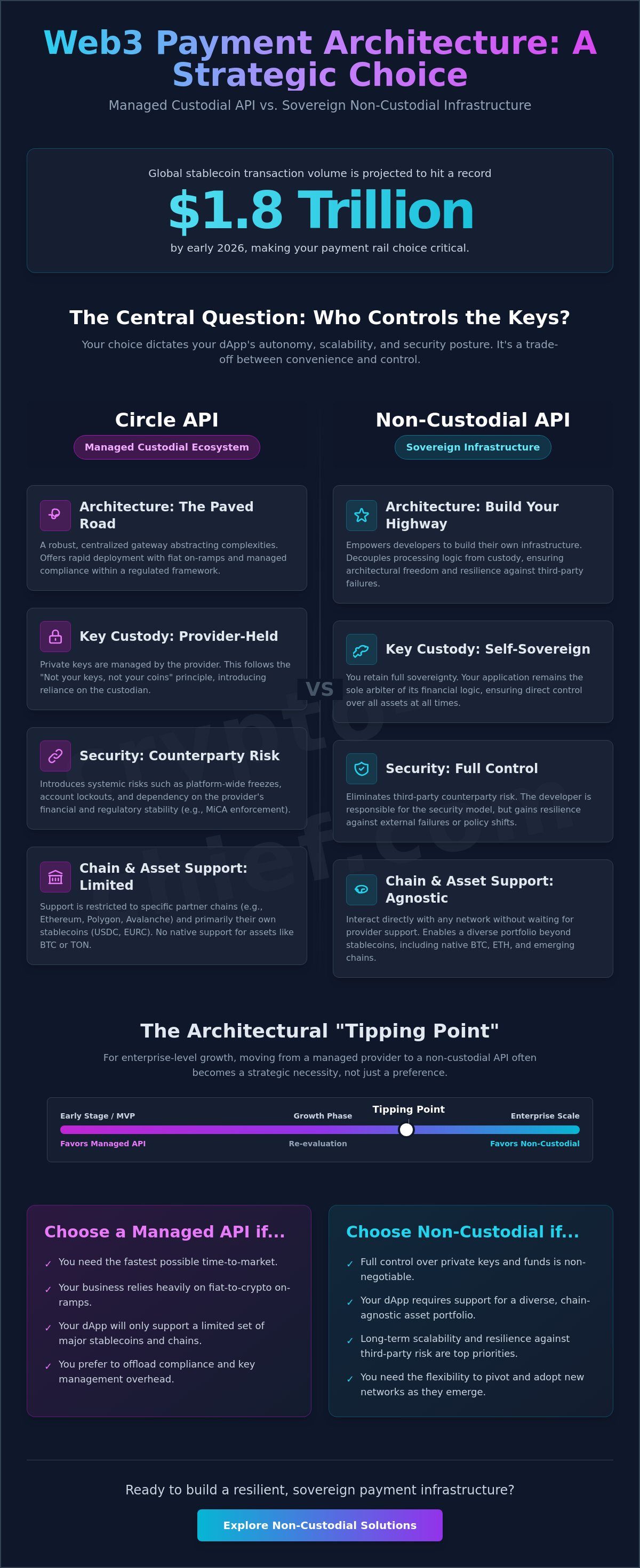
What if the "plug-and-play" convenience of a managed custodial API is actually the architectural bottleneck preventing your dApp from reaching its full potential? For many developers, the choice between the circle api vs non-custodial processing isn't just a technical preference; it's a strategic decision that dictates how much control you truly have over your user's assets and your platform's long-term scalability. With global stablecoin transaction volume hitting a record $1.8 trillion in early 2026, the stakes for getting your payment rail right have never been higher.
You likely recognize the frustration of balancing high network fees against the need for a seamless user experience, especially when managed ecosystems limit your chain support or demand custody of private keys. This guide provides a technical deep dive into the trade-offs between managed custodial ecosystems and sovereign non-custodial infrastructure. You'll discover how to navigate the complexities of multichain architecture while preparing for the 2026 regulatory shifts like MiCA and the GENIUS Act. We'll explore transaction efficiency, security models, and the operational reality of maintaining your own payment gateway versus leveraging a third-party service.
Key Takeaways
- Determine whether a managed custodial rail or a sovereign infrastructure better serves your dApp's need for private key control and operational autonomy.
- Analyze the critical differences between circle api vs non-custodial processing to ensure your payment infrastructure scales alongside evolving regulatory landscapes.
- Look past surface-level transaction fees to calculate the true total cost of ownership, accounting for gas sponsoring and internal DevOps overhead.
- Discover why chain-agnostic processing is vital for supporting a diverse asset portfolio that extends beyond stablecoins to include native BTC, ETH, or emerging networks.
- Identify the architectural "tipping point" where moving from a managed provider to a non-custodial API becomes a requirement for enterprise-level growth.
Defining the Architecture: Circle API vs Non-Custodial Processing
Building a Web3 application requires a fundamental decision regarding how value moves through your stack. This choice dictates your development velocity, your compliance burden, and your ultimate control over user funds. When evaluating the circle api vs non-custodial processing, you're essentially choosing between a managed ecosystem and a sovereign infrastructure. One offers a paved road; the other provides the tools to build your own highway.
The core of this architectural debate lies in the definition of a Cryptocurrency wallet and who holds the underlying keys. Managed APIs act as a custodial layer where the provider handles the heavy lifting of private key management and regulatory compliance. Non-custodial processing, however, empowers the developer to retain full sovereignty over the keys, ensuring that the application remains the sole arbiter of its financial logic.
Choosing between these paths defines your dApp’s future scalability. A managed approach might accelerate your initial launch, but it often tethers your project to the provider's roadmap and asset support. Conversely, a sovereign approach ensures that your infrastructure remains resilient against third-party failures or sudden policy shifts in a rapidly changing regulatory environment.
The Managed Ecosystem Approach (Circle)
Circle operates as a robust, centralized gateway primarily focused on its own stablecoins, USDC and EURC. It integrates deeply with Circle Mint and established compliance rails, making it a powerful tool for projects that require immediate fiat-to-crypto on-ramps within a regulated framework. Their Programmable Wallets allow for rapid deployment by abstracting away the complexities of gas management and transaction signing.
This convenience comes with trade-offs. You're limited to specific partner chains like Ethereum, Polygon, or Avalanche, and your users must operate within Circle's centralized compliance gates. While this simplifies the developer experience, it introduces counterparty risk and limits your ability to support native assets like BTC or TON that fall outside the Circle ecosystem.
The Sovereign Infrastructure Approach (Non-Custodial)
Non-custodial processing serves as the bridge between raw blockchain data and application logic without asset custody. By leveraging a Crypto Processing API, developers can interact directly with multichain RPC nodes to broadcast transactions without ever surrendering control of their private keys. This decoupling of processing logic from custody is the hallmark of true architectural freedom.
This approach allows for a chain-agnostic strategy. You can broadcast transactions across any network, from Ethereum to Bitcoin, without waiting for a third-party provider to add support. Utilizing non-custodial crypto payment APIs provides the flexibility to optimize for speed and cost while maintaining the security of a self-custodied environment. It's the preferred route for architects who value uptime, scalability, and the ability to pivot as new blockchain networks emerge.
Security, Custody, and Counterparty Risk
Security is often the primary battleground when debating circle api vs non-custodial processing. At the heart of this discussion is a single, critical question: who holds the "Master Key" to your business funds? While custodial providers offer a polished interface, they also introduce a layer of counterparty risk that can impact your dApp’s long-term stability and user trust.
The Custodial Trade-off
Custodial systems provide a streamlined developer experience by abstracting away the complexities of key management. However, this convenience comes with the "Not your keys, not your coins" reality. If your provider faces regulatory hurdles, such as the upcoming MiCA enforcement in July 2026, or experiences a financial crisis, your access to funds could be restricted. Platform-wide freezes are a systemic risk in managed ecosystems; an issue affecting one segment of the provider's infrastructure can lead to account lockouts for your specific application. Additionally, custodial minting flows often rely on Authorized Participants, adding another layer of dependency between your project and the underlying liquidity.
Non-Custodial Security Models
Relying on a third party for security creates a single point of failure that many enterprise architects prefer to avoid. By utilizing Web3 RPC gateways, developers can maintain direct, unfiltered access to blockchain networks. This model allows for client-side key management where the application or the end-user retains sovereignty over the private keys. It eliminates the risk of centralized freezes and ensures that your processing logic remains functional as long as the blockchain itself is active. For teams prioritizing uptime and resilience, integrating a direct RPC connection ensures that your dApp retains a direct line to the blockchain, even if a primary API provider experiences downtime.
Compliance doesn't have to be tied to custody. While managed APIs often bundle KYC and AML into their service, a non-custodial approach allows for a modular security stack. You can integrate specialized AML Intelligence tools to screen transactions without surrendering control of the assets. This decoupled architecture provides the same level of regulatory rigor while maintaining the structural integrity of a sovereign system.
Custodial providers like Circle manage asset recovery through a centralized help desk charging a 10% fee or $500 minimum, while non-custodial systems place the burden of recovery entirely on the developer’s key management strategy and the user’s possession of their private keys. Choosing the right path requires weighing this immediate ease of recovery against the long-term security of true asset ownership.
Cost Efficiency: Managed Fees vs Pay-Per-Call Models
Cost isn't just a line item in a budget; it's an architectural constraint that determines how your dApp survives high-traffic events. When you weigh the circle api vs non-custodial processing, you're choosing between a subscription-heavy ecosystem and a utility-focused infrastructure. While managed systems offer predictable monthly billing, they often introduce hidden overhead that can erode margins as your transaction volume grows.
Circle’s Fee Structure
Circle’s managed services operate on a tiered subscription model that requires upfront commitment. For instance, the Professional plan starts at $89 per month with a 2% transaction fee, while the Business tier jumps to $199 per month. These costs are only the baseline. Developers must also account for the "Gas-Free" illusion. While Circle’s Gas Station abstracts network fees for the end-user, the platform typically adds a 5% platform fee on top of the actual on-chain network costs. For a high-frequency application, these markups represent a significant departure from the raw cost of the blockchain, effectively taxing your growth for the sake of abstraction.
Beyond the monthly tiers, custodial systems often apply fees for moving assets out of their managed environment. Recovery fees for misdirected assets can be particularly steep, often reaching 10% of the total value or a $500 minimum. These financial friction points create an ecosystem lock-in where the cost of migration or interoperability becomes a deterrent to architectural evolution.
The Pay-Per-Call Advantage
Sovereign infrastructure shifts the economic model toward technical utility. By utilizing a Crypto Processing API, you move away from revenue-sharing and high-entry subscription tiers. Instead, you pay for the specific resources your application consumes, such as API requests or blockchain broadcasts. Pay-per-call models prevent overpaying for unused capacity by ensuring that your infrastructure costs align perfectly with your real-time user activity. This granularity is essential for early-stage projects that need to keep burn rates low while maintaining the ability to scale instantly during a surge.
Eliminating monthly "dead weight" costs allows developers to allocate resources toward core application logic rather than infrastructure maintenance. Using a RPC Gateway with a token-based model provides a transparent path to global multichain processing. You pay for the data you fetch and the transactions you broadcast, without the 1-2% transaction tax common in custodial platforms. This approach ensures that as your volume increases, your cost per transaction remains tied to the network's actual performance, providing a more sustainable foundation for long-term profitability.
Multichain Reach and Asset Flexibility
Stablecoins like USDC and EURC are undeniably the bedrock of modern crypto payments, yet a dApp's longevity often depends on its ability to support a broader spectrum of assets. When evaluating the circle api vs non-custodial processing, the primary technical constraint is often the scope of the underlying network support. While a managed ecosystem provides a streamlined path for specific stablecoins, it can inadvertently create an architectural silo that limits your project's global reach.
Ecosystem Silos vs. Open Access
Circle’s infrastructure is optimized for its own partner networks, focusing heavily on Ethereum, Solana, and their specialized Arc chain. This focus is excellent for USDC centric applications, but it leaves a massive gap for developers who need to support native BTC, ETH, or emerging ecosystems. If your user base is active on TON or requires the low-fee environment of Polygon, a custodial API may not provide the necessary hooks for native asset integration.
Moving toward a sovereign approach allows you to leverage a RPC Gateway for direct chain access. This model ensures your processing logic is chain-agnostic, allowing you to broadcast transactions across a Multichain RPC infrastructure that includes everything from Bitcoin Cash to the latest Layer 2 solutions. By using Unified APIs, you can normalize disparate data formats from different blockchains into a single, clean application logic, ensuring that adding a new network doesn't require a complete rewrite of your payment flow.
Real-Time Event Monitoring
Confirming a payment is only the first step; building a truly reactive dApp requires deep visibility into on-chain state changes. Circle provides event notifications for transactions within its managed wallets, but these are often limited to high-level status updates. In contrast, non-custodial systems allow you to stream raw Smart Contract Events directly from the source. This granular data is vital for complex applications that trigger internal logic based on specific contract interactions rather than just simple balance transfers.
Implementing real-time blockchain webhooks ensures that your application stays in sync with the network without constant polling. This reactive model is essential for maintaining a high-performance user experience where payment confirmations happen in milliseconds. If your project requires broader network support and deep event visibility, explore how our Crypto Processing API can normalize your multichain operations without sacrificing architectural freedom.
The Verdict: When to Choose Circle vs Non-Custodial
Deciding between the circle api vs non-custodial processing isn't about identifying a single "superior" tool; it's about selecting the architectural foundation that aligns with your project's technical requirements and business goals. If your roadmap is exclusively centered on a USDC-centric application and your team has limited DevOps resources, Circle’s managed environment offers a rapid, paved path to market. However, for architects building for the "Agentic Economy" of 2026, where autonomous agents require sovereign control over assets, non-custodial infrastructure becomes a strategic necessity.
Choose non-custodial processing if your dApp requires multichain support beyond the stablecoin silos. This path is essential for developers who prioritize key sovereignty, desire to eliminate transaction-based revenue sharing, and need the flexibility to support native assets like BTC, ETH, or TON. As your volume scales, the shift from a custodial to a sovereign model often pays for itself by removing the 1-2% transaction tax common in managed ecosystems and replacing it with a lean, pay-per-call utility model.
Strategic Implementation Steps
Moving from a managed provider to a sovereign stack requires a methodical approach. Start by auditing your current custody requirements and identifying which regulatory constraints, such as the July 2026 MiCA deadline, apply to your specific jurisdiction. Transitioning doesn't have to happen overnight. You can begin by testing your integration using multichain RPC endpoints to ensure your application logic remains responsive across different networks. For detailed implementation guides and technical specifications, consult the Crypto Chief documentation to understand how to decouple your processing logic from third-party custody.
Future-Proofing Your Web3 Stack
In the evolving landscape of 2026, modularity is your most important feature. A rigid, single-issuer platform may struggle to adapt to new blockchain protocols or shifting compliance standards. By combining non-custodial processing with modular AML Intelligence, you create a compliant, sovereign stack that protects your users without surrendering control of the underlying private keys. This hybrid approach ensures you meet the 100% reserve backing requirements of the GENIUS Act while maintaining the architectural freedom that defines the Web3 ethos.
The infrastructure you choose today dictates your ability to innovate tomorrow. If you're ready to move beyond the limitations of managed ecosystems and build a truly resilient, multichain payment rail, the next step is implementation. Register for a Crypto Chief account today to start building your sovereign payment infrastructure.
Building for Sovereignty in a Multichain Future
Selecting your payment rail is a defining moment for your dApp's technical roadmap. While managed ecosystems offer a quick start for stablecoin-only projects, true architectural resilience requires the decoupling of processing logic from third-party custody. By prioritizing sovereign infrastructure, you eliminate the risk of centralized freezes and avoid the transaction-based taxes that often hinder long-term profitability.
The trade-offs identified in the circle api vs non-custodial processing debate highlight a clear shift toward developer sovereignty. Transitioning to a non-custodial model ensures you can support any asset on any chain while maintaining a lean, utility-focused budget. With global multichain RPC coverage and enterprise-grade AML risk detection, you can build a compliant foundation that scales without friction.
Our predictable pay-per-call pricing model allows you to optimize costs as you expand into new markets. It's time to take full control of your application's financial logic and future-proof your stack against the shifting regulatory landscape. Build your sovereign payment infrastructure with Crypto Chief today and start creating the next generation of decentralized commerce with confidence.
Frequently Asked Questions
Is non-custodial processing more difficult to secure than Circle's API?
Non-custodial security shifts the responsibility of private key management to the developer, whereas custodial systems like Circle manage the keys on your behalf. While this requires a robust internal key management strategy, it eliminates the counterparty risk inherent in managed ecosystems. You trade the convenience of a third-party "master key" for the structural integrity of a system where you are the sole arbiter of your funds.
Can I accept USDC using a non-custodial processing API?
You can absolutely accept USDC and other stablecoins using a non-custodial architecture. Since USDC is a standard token on networks like Ethereum, Polygon, and Solana, any non-custodial processing API can detect and broadcast these transactions. This allows you to leverage the liquidity of the USDC ecosystem while maintaining sovereign control over your application's wallet infrastructure without being tied to a single issuer's platform.
How does pay-per-call pricing compare to Circle's transaction fees?
Pay-per-call pricing models focus on technical resource consumption, whereas Circle typically charges monthly subscription fees plus a percentage of each transaction. For high-volume applications, a percentage-based tax can become significantly more expensive than paying for the actual API requests. Choosing the right model in the circle api vs non-custodial processing debate depends on whether you prefer predictable utility costs or revenue-sharing structures.
Do I need to run my own nodes to use non-custodial processing?
You don't need to maintain your own blockchain nodes to utilize non-custodial infrastructure. A professional RPC Gateway provides the necessary connection to various blockchain networks, abstracting the hardware maintenance while still giving you direct control over transaction signing. This allows your team to focus on application logic rather than the DevOps overhead of running global node clusters or managing complex server environments.
Which blockchains are supported by non-custodial processing APIs?
Non-custodial APIs typically offer broader network support than custodial providers, including native Bitcoin, Ethereum, TON, and various Layer 2 solutions. While custodial services often limit support to their specific partner chains, a sovereign approach allows you to broadcast transactions across a wider array of networks. This flexibility is vital for dApps targeting global users who may prefer native assets or emerging blockchains that fall outside of managed ecosystems.
What happens to my payments if the API provider goes offline in a non-custodial model?
Your funds remain secure and accessible even if your API provider experiences downtime because you retain possession of your private keys. In a non-custodial model, the provider only acts as a messenger for your signed transactions. If one gateway goes offline, you can simply point your application to a different RPC provider to resume processing without waiting for a centralized service to recover your account access.
Is non-custodial processing compliant with global AML regulations?
Non-custodial processing is fully compatible with global regulations like MiCA when integrated with modular compliance tools. You can use AML Intelligence to screen wallets and transactions for risk without surrendering custody of the assets. This decoupled approach allows you to build a regulated, enterprise-ready application that meets the July 2026 MiCA standards while maintaining the security benefits of a non-custodial architecture.
Can I use non-custodial APIs for automated payouts and payroll?
Automated payouts and payroll are highly efficient when using non-custodial APIs due to their programmable nature and low friction. By leveraging a Unified API, you can automate bulk distributions across multiple blockchains simultaneously without manual intervention. This is particularly useful for global teams or "agentic" applications that require real-time, automated value transfers without the manual approval steps often found in custodial dashboards.