
Why are you still sacrificing significant margins to legacy middlemen when the infrastructure to bypass them is already at your fingertips? As stablecoin transaction volume surpasses $28 trillion in early 2026, the decision to integrate crypto payments api into your stack is no longer an experiment; it's a core requirement for global scalability. You likely understand that the real friction isn't just displaying a wallet address, but rather the complexity of managing multichain RPC nodes and the inherent security risks of custodial gateways that hold your funds hostage. It's a frustrating bottleneck that eats into your development time and your bottom line.
This guide provides the technical blueprint to master the architecture, cost models, and security protocols necessary for a high-performance integration. You will learn how to deploy a secure, non-custodial workflow that ensures you maintain full control over every asset. We'll also examine how to achieve unified access to BTC, ETH, and SOL through a single interface, allowing you to bypass fragmented data and move toward a predictable, scalable infrastructure that works for your specific business logic.
Key Takeaways
- Differentiate between custodial and non-custodial architectures to eliminate counterparty risk and maintain total control over your digital assets.
- Analyze how pay-per-call pricing models offer a predictable cost structure that scales more efficiently than traditional percentage-based commission fees.
- Follow a precise technical roadmap to integrate crypto payments api with secure multichain address generation for BTC, ETH, and emerging Layer 2 solutions.
- Leverage a unified infrastructure to abstract the complexity of RPC node management, allowing your team to prioritize product development over background maintenance.
- Implement high-level security protocols for API authentication to ensure the structural integrity of your financial stack and protect sensitive transactional data.
What is a Crypto Payments API and Why Does Your Stack Need One?
A crypto payments API acts as the programmatic bridge between your application's logic and the immutable ledgers of decentralized networks. By 2026, the industry has moved past the era of static payment buttons that simply display a static wallet address. Modern developers now require a sophisticated layer of integrated financial infrastructure that handles high-concurrency requests and provides real-time visibility into the state of various blockchains. When you choose to integrate crypto payments api, you are essentially plugging your stack into a global, 24/7 liquidity engine that operates independently of traditional banking hours or regional intermediaries. This infrastructure ensures that your platform remains operational even when traditional markets are closed, providing a seamless experience for a global user base that expects instant results regardless of their time zone.
The Core Functionality of Modern Crypto APIs
Modern APIs provide three critical functions that transform a simple application into a global financial tool. First, they automate address generation and monitoring; they watch for incoming transactions across multiple chains simultaneously to ensure no payment goes unnoticed. Second, they handle real-time exchange rate conversions. This is vital given that stablecoins now account for 75% of crypto trading volume and have reached a market cap of approximately $320 billion as of June 2026. Finally, they facilitate automated payout logic. This is particularly relevant for marketplaces that need to distribute funds to vendors or users without manual intervention. Unlike a standard cryptocurrency exchange that focuses on retail trading, a dedicated API focuses on backend stability and programmatic execution for enterprise-grade applications.
Why Developers are Moving Away from TradFi Gateways
Settlement speed is a primary driver for this shift in development priorities. Blockchain finality is nearly instant, whereas traditional bank transfers can take days to clear, especially across borders. There is also the matter of chargebacks. In the traditional credit card world, a merchant can lose funds months after a sale due to a dispute. Crypto transactions are push-based and final; this eliminates the risk of fraudulent reversals and protects your margins. By utilizing a Crypto Processing API, you remove the barriers to entry for a global customer base that may not have access to Western banking systems. This is a decisive move for any platform aiming for global reach without the friction of local bank entities or high cross-border commissions that typically eat into thin margins.
Custodial vs. Non-Custodial Architecture: Choosing the Right Path
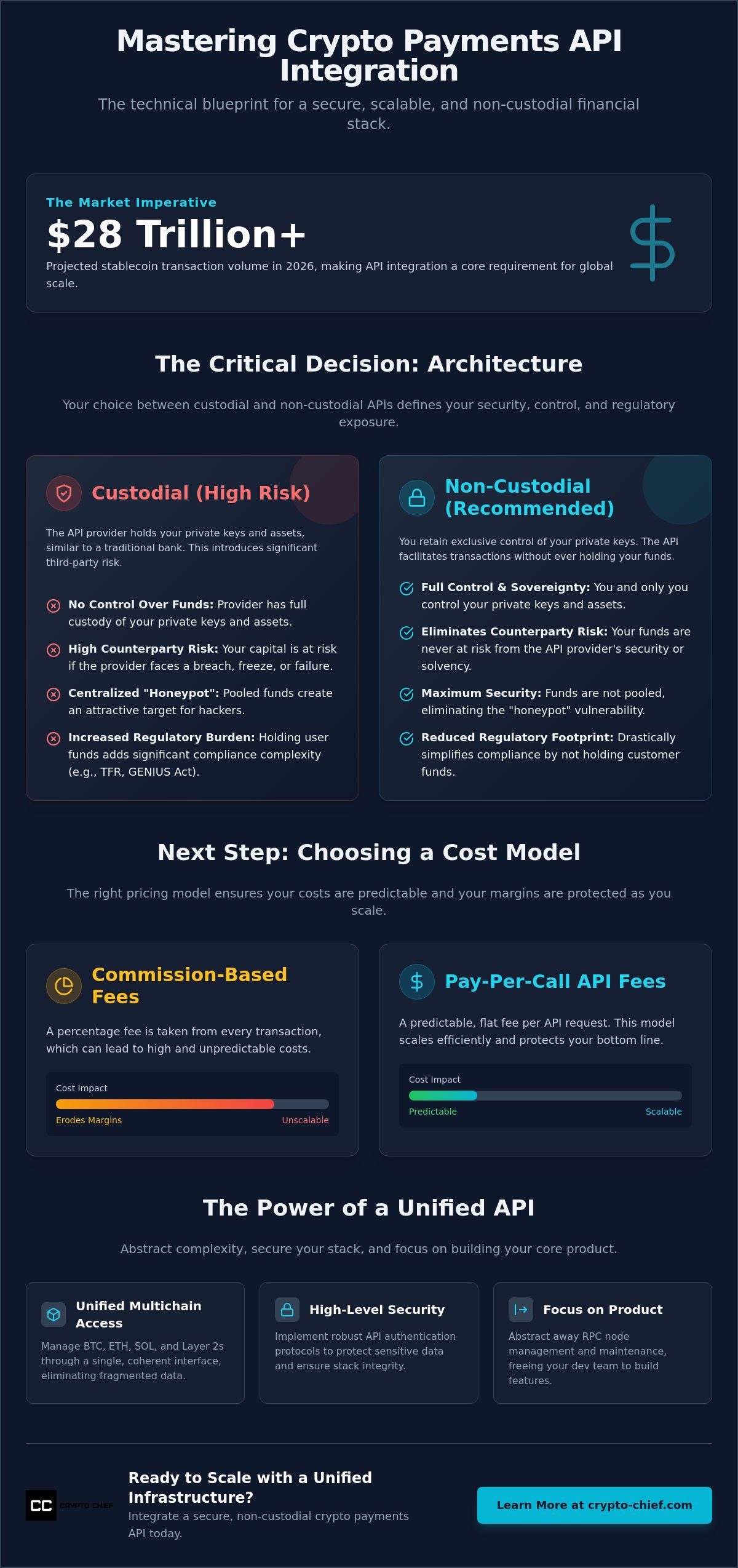
Choosing between custodial and non-custodial architecture is the most significant decision you'll make when you plan to integrate crypto payments api. A custodial API operates much like a traditional bank; the provider holds the private keys and manages the funds on your behalf. While this offers a degree of convenience for teams that don't want to manage their own infrastructure, it introduces substantial counterparty risk. If the provider suffers a security breach or a regulatory freeze, your business capital is effectively locked. In contrast, non-custodial APIs allow the merchant or the end user to retain exclusive control of their private keys. This ensures maximum security and adheres to the core principle of trustlessness that defines the blockchain space.
Non-Custodial Processing is a method where the API facilitates transaction detection without ever touching the user's private keys. In the regulatory environment of 2026, enterprise developers increasingly prioritize this path. With the GENIUS Act mandating strict reserve disclosures for stablecoins and the EU's Transfer of Funds Regulation (TFR) in full effect, holding user funds creates a massive compliance burden. By choosing a non-custodial route, you drastically reduce your regulatory footprint while maintaining the highest possible security standards for your treasury.
The Security Benefits of Non-Custodial Integration
Centralized gateways are attractive targets for hackers because they act as "honeypots" for massive amounts of pooled capital. By moving to a non-custodial model, you eliminate this centralized risk entirely; your funds are never mixed with those of other merchants. This architecture also provides a distinct compliance advantage. Since you aren't technically "holding" the assets in a custodial sense, you may bypass certain licensing requirements in various jurisdictions. Most importantly, it enables direct-to-wallet settlement. This means your business enjoys immediate liquidity, as funds move straight from the customer to your controlled environment without an intermediary's holding period.
Architectural Complexity vs. User Control
Some developers fear that avoiding custody means managing thousands of individual wallets manually, but this is a common misconception. Modern non-custodial APIs utilize Hierarchical Deterministic (HD) wallet structures to simplify key management. By using a single extended public key (xPub), your system can generate and monitor an infinite number of unique deposit addresses while the private keys remain safely offline. This application of public key cryptography allows for seamless scaling without compromising the structural integrity of your financial stack. For a deeper dive into the technical implementation, you can explore our Non-Custodial Crypto Payment API Pillar. If you're ready to build on a foundation that values your autonomy, consider exploring how a Crypto Processing API can secure your next deployment.
Pricing Models: Commission-Based vs. Pay-Per-Call API Fees
Infrastructure costs often dictate the long-term viability of your financial stack. When you decide to integrate crypto payments api, the pricing model you select will directly impact your profit margins as your transaction volume scales. Most traditional gateways rely on a commission-based model, typically charging between 0.5% and 2% per transaction. While this may seem accessible for small-scale testing, it quickly becomes a "success tax" that penalizes your growth. As your platform processes larger tickets or higher frequencies, these percentage-based fees drain capital that should be reinvested into your core product development.
The alternative is a pay-per-call (pay-per-request) model, which treats blockchain interaction as a utility rather than a financial brokerage service. Under this structure, you pay for the actual computational work and data retrieval performed by the API. A pay-per-call model allows developers to process a $10,000 transaction for the same API cost as a $10 transaction. This shift in logic removes the friction of scaling, ensuring that your operational overhead remains flat even as your gross merchandise volume (GMV) climbs. It aligns the interests of the infrastructure provider with the builder, focusing on uptime and data accuracy rather than transaction size.
Calculating ROI for High-Volume Applications
Consider the math for an application processing $1M in monthly crypto payments. At a standard 1% commission, your business loses $10,000 every month just to maintain the payment gateway. In a pay-per-call environment, your costs are tied to the number of address generations and status checks, which usually results in a fraction of that expense. This model also simplifies unified billing. By consolidating your RPC, processing, and AML intelligence into a single request-based ledger, you gain a transparent view of your infrastructure spend without the complexity of calculating varied commissions across different blockchains.
Predictability and Token-Based Budgeting
DevOps teams require predictability to manage burn rates effectively. Many modern providers now offer token-based balances where you pre-purchase API credits, allowing you to set usage alerts and avoid the "bill shock" associated with sudden spikes in traffic. This approach also eliminates the hidden fees often found in gateways that bake conversion spreads into their commission rates. For a detailed breakdown of how to forecast these costs, see our Web3 API Pay Per Call Pricing Guide. By moving away from legacy percentage models, you secure a lean, high-performance foundation that supports unlimited growth without the scaling penalty.
The Integration Roadmap: 5 Steps to Deploy a Crypto API
Deploying a robust financial layer requires more than just a simple library import. To successfully integrate crypto payments api, you must follow a methodical deployment sequence that prioritizes security and data integrity over speed. Moving beyond the "one-click" marketing promises found in retail-grade tools, a professional integration ensures your application can handle the asynchronous nature of blockchain data without desyncing your internal database. This roadmap outlines the architectural stages necessary for a production-ready environment.
- Step 1: Authenticate and Secure Credentials. Initialize your environment by securing your API keys within a backend vault. Never expose these credentials to the client-side; use server-to-server communication to maintain the structural integrity of your auth flow.
- Step 2: Implement Multichain Address Generation. Utilize your API to generate unique deposit addresses for BTC, ETH, and various Layer 2 networks. As discussed in the architectural section, this usually involves deriving addresses from an extended public key to maintain a non-custodial stance.
- Step 3: Configure Real-Time Webhooks. Set up listeners for incoming transaction events. These webhooks act as the heartbeat of your integration, notifying your system the moment a payment is detected on the mempool or confirmed on-chain.
- Step 4: Integrate AML Risk Scoring. In the 2026 regulatory environment, filtering sanctioned or high-risk funds is a requirement. Use a dedicated AML Intelligence layer to screen incoming hashes before they are credited to a user's account.
- Step 5: Execute Automated Reconciliation. Once a transaction reaches the required confirmation depth, trigger your internal logic to update order statuses and initiate any necessary payout or treasury movements.
Mastering Multichain Connectivity
Direct communication with the blockchain requires a reliable Web3 RPC Gateway to bypass the latency of public nodes. Every chain has its own set of technical nuances that your code must account for. For instance, managing gas fees on Ethereum requires a different estimation logic than handling account rent on Solana. A sophisticated Unified API abstracts these differences, allowing your developers to interact with multiple protocols through a standardized JSON-RPC interface. This normalization reduces the technical debt associated with maintaining separate codebases for every new chain your business decides to support.
Implementing Real-Time Event Monitoring
Webhooks are your primary tool for state management. They ensure your UI reflects reality. While a simple address might suffice for a donation button, enterprise-grade applications require a sophisticated EventStream to handle asynchronous confirmations across multiple network security profiles. You must also account for "reorgs," where a blockchain's history is briefly rewritten; your system should wait for a specific confirmation depth before considering a payment final. For a deeper dive into managing these event-driven architectures, consult our Real-Time Blockchain Webhooks Guide. If you're ready to start building, you can create a developer account and access our sandbox environment today.
Scaling with Crypto Chief: A Unified Infrastructure Approach
Scaling a decentralized application involves more than just adding lines of code; it requires a foundational partner that absorbs technical complexity. At Crypto Chief, we operate with a "Silent Partner" philosophy. We maintain the underlying nodes and manage the network latency so you can focus entirely on building your product. When you integrate crypto payments api through our ecosystem, you aren't just adding a gateway. You are deploying a Crypto Processing API that is non-custodial by design, ensuring that your business remains the sole arbiter of its funds at every stage of the transaction lifecycle.
Security in 2026 requires more than just encryption. It demands a unified intelligence layer that stays ahead of global regulations. By integrating AML Risk Detection directly into your payment flow, you protect your platform from illicit actors in real-time. This isn't a bolt-on feature; it is a native component of our unified infrastructure. Our global network of high-performance RPC nodes provides high-uptime access to Ethereum, BNB Chain, Polygon, and other major protocols. This ensures that your requests are handled with the lowest possible latency, regardless of where your users are located or which chain they prefer to use.
Why Developers Choose Crypto Chief in 2026
Efficiency is the primary driver for professional architects. Instead of juggling multiple vendors for RPC access, transaction monitoring, and compliance, you manage everything from a single, intuitive dashboard. This consolidation reduces the surface area for errors and simplifies your DevOps workflow significantly. We provide developer-first documentation that speaks the language of engineers, offering clear examples for complex Web3 architectures. It is about providing the tools for elite performance without the traditional friction of blockchain development. You get the stability of an enterprise-grade engine with the agility of a startup-centric tool.
Future-Proofing Your Crypto Strategy
The blockchain landscape shifts rapidly. New networks like TON or various Bitcoin Layer 2s can emerge as market leaders almost overnight. Our unified interface allows you to adapt to these shifts without rewriting your entire integration from scratch. You can leverage our EventStream for advanced user analytics, gaining deep insights into transactional behavior across every supported chain. This forward-looking approach ensures that your stack remains relevant as the industry evolves. It is time to move beyond fragmented tools and adopt a cohesive, high-performance engine. To begin your deployment, register your account and start building with Crypto Chief today.
Deploying a Secure, Scalable Financial Layer
The decision to integrate crypto payments api is a strategic shift toward a trustless, global economy. By prioritizing non-custodial architecture, you protect your business from counterparty risk while ensuring immediate liquidity. As we've explored, moving away from legacy commission models toward a pay-per-call pricing model allows for unlimited growth without a success tax. This transition, supported by unified access to over 10 major blockchains and integrated AML intelligence, creates a lean and resilient stack that scales with your ambition. Your infrastructure should be a silent partner that empowers your creativity rather than a bottleneck that restricts your reach.
With a clear roadmap and a focus on structural integrity, you can bypass traditional banking friction and deliver a seamless experience to your users. It's time to build on a foundation that values uptime, logic, and developer autonomy. Start Building with Crypto Chief’s Non-Custodial API and take control of your financial future. We're ready to support your next major deployment.
Frequently Asked Questions
Is it better to use a custodial or non-custodial crypto payment API?
Non-custodial APIs are generally the superior choice for developers who prioritize security and sovereign control over their business treasury. While custodial options offer minor setup conveniences, they introduce counterparty risks that can lead to frozen assets or lost capital during provider insolvency. By choosing a non-custodial path, you ensure that funds move directly to your controlled wallet; this simplifies long term compliance and eliminates the "honeypot" risk associated with centralized third parties.
How much does it cost to integrate a crypto payments API in 2026?
The industry has largely shifted away from expensive percentage-based commissions toward more predictable pay-per-call models in 2026. This means you pay for the specific data requests and address generations your application requires rather than a portion of your total sales volume. This structure allows high-growth platforms to integrate crypto payments api while scaling their infrastructure costs linearly. It is a logical approach for any architect looking to preserve margins during high-volume periods.
Can I accept multiple cryptocurrencies through a single API integration?
You can absolutely accept multiple cryptocurrencies through a single integration by utilizing a Unified API layer. This technology abstracts the unique protocols of Bitcoin, Ethereum, Solana, and various Layer 2 networks into a standardized JSON-RPC interface. Instead of maintaining separate codebases for every new chain, your developers interact with one set of endpoints to monitor balances, generate addresses, and trigger webhooks across the entire digital asset landscape, significantly reducing technical debt.
What is the difference between a payment gateway and an RPC node?
A payment gateway provides the high-level business logic for processing transactions, while an RPC node acts as the direct communication pipe to the blockchain. The gateway handles tasks like address derivation, price conversion, and webhook notifications. Meanwhile, the RPC node fetches raw block data and broadcasts signed transactions to the network. Most professional developers use an integrated stack where the gateway sits on top of a reliable RPC provider to ensure high uptime.
How do I handle AML compliance when accepting crypto payments?
Handling AML compliance requires integrating automated risk scoring tools that screen incoming transaction hashes against global sanctions lists. In 2026, regulations like the GENIUS Act and the EU Transfer of Funds Regulation make this a non-negotiable step for enterprise platforms. By utilizing an AML Intelligence service, you can flag and block high-risk funds before they are credited to a user's account, ensuring your platform remains compliant with the latest federal and international financial standards.
What happens if a blockchain transaction is stuck or has low gas?
Stuck transactions are typically resolved through automated gas estimation or manual intervention techniques like Replace-By-Fee (RBF). Modern APIs monitor the mempool in real-time and suggest optimal gas prices based on current network congestion to prevent delays. If a transaction remains unconfirmed, your system can trigger a "speed up" request that broadcasts a new transaction with a higher fee, ensuring your users are not left waiting due to sudden spikes in network activity or protocol congestion.
Do I need to manage my own blockchain nodes to accept crypto?
You don't need to manage your own physical blockchain nodes, as an RPC Gateway provides the same level of access without the heavy maintenance overhead. Running a full node requires significant hardware resources, constant monitoring, and frequent software updates to stay synced with the network. By leveraging a professional node provider, you gain the benefit of a globally distributed infrastructure that offers low-latency requests and high uptime, allowing your team to focus on building features.
What are the security best practices for storing API keys in Web3 apps?
Security best practices dictate that API keys should never be exposed to the client-side or stored in plain text within your repository. Instead, you should utilize backend secret management vaults or environment variables to inject credentials at runtime. Additionally, implementing IP whitelisting ensures that even if a key is compromised, it can only be used from your authorized servers. This layered defense strategy protects the structural integrity of your financial stack and prevents unauthorized access to your environment.