
The most recognizable name in global payments might be the single biggest bottleneck in your Web3 architecture. While the convenience of a centralized giant is tempting, the trade-off often involves surrendering control over your private keys and accepting opaque "black box" logic. You likely already know that relying on a middleman introduces counterparty risk and percentage-based fees that aggressively erode your margins as you scale. This comparison of the stripe crypto api vs non-custodial processing reveals why many architects are pivoting toward sovereign infrastructure to secure their financial future.
You'll discover whether a centralized fintech leader or a dedicated non-custodial API provides the security, cost-efficiency, and granular control your application requires. We'll provide a clear framework for choosing between these two distinct stacks, ensuring you can manage fund flows with maximum autonomy. This guide details the technical nuances of 2026's payment landscape, from multichain RPC gateways to the predictable pricing models necessary for high-volume Web3 platforms.
Key Takeaways
- Evaluate the critical trade-offs between custodial convenience and the financial sovereignty provided by non-custodial foundations.
- Identify how to bypass the latency of centralized gateways by utilizing high-performance RPC infrastructure for real-time on-chain data.
- Contrast the revenue-draining "fintech tax" of the stripe crypto api vs non-custodial pay-per-call models to ensure your high-volume application remains profitable.
- Discover how to maintain regulatory compliance through automated AML intelligence that screens transactions without introducing counterparty risk.
- Streamline your technical stack by integrating a unified API that manages multichain processing and real-time event streaming within a single, developer-centric environment.
The Architecture of Ownership: Stripe Crypto API vs. Non-Custodial Foundations
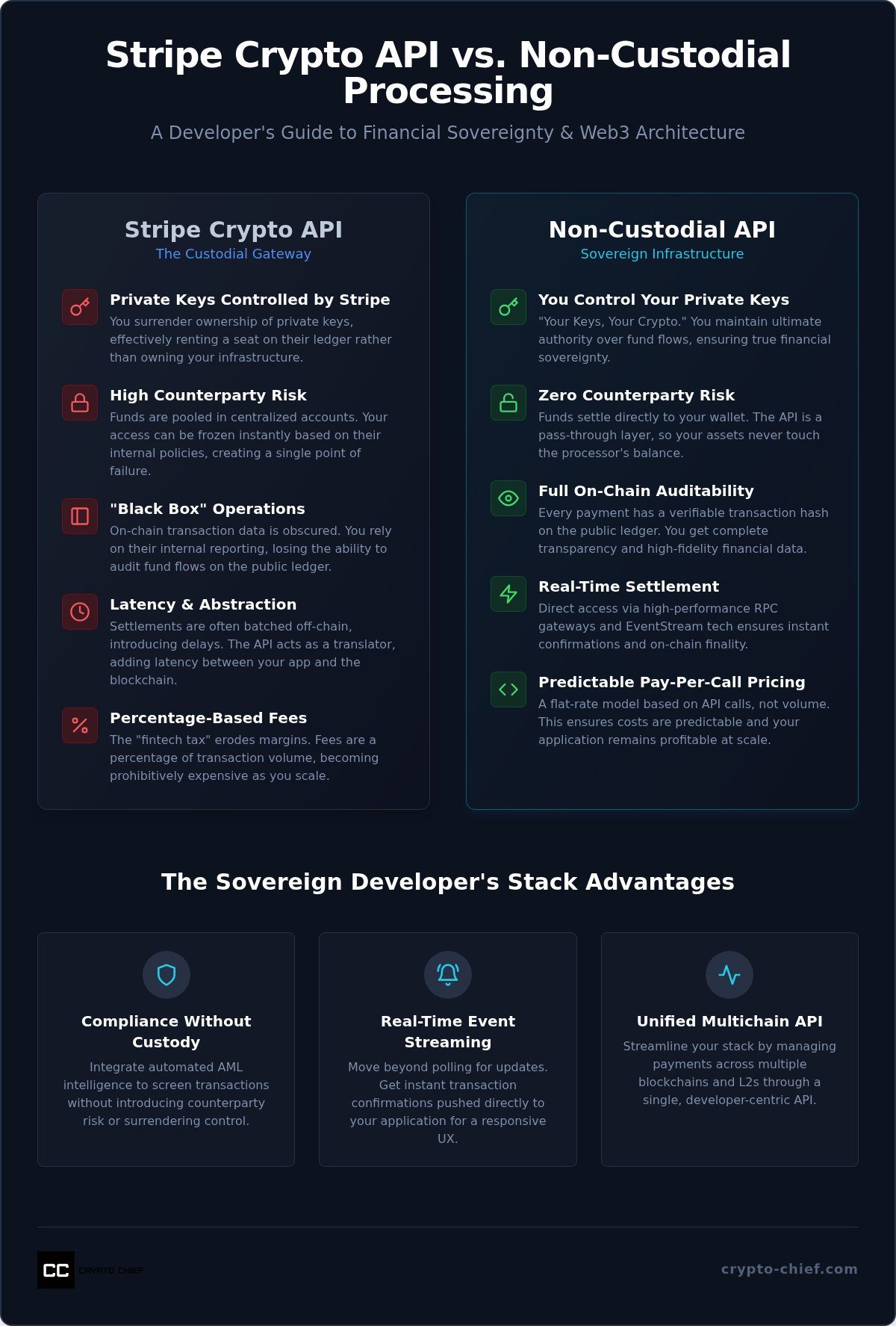
The fundamental difference between the stripe crypto api vs non-custodial stacks lies in the location of the private keys. Keys define control. When you use a centralized API, you're essentially renting a seat on their ledger. This arrangement places a platform between your application and the blockchain. For many enterprise builders in 2026, this layer represents an unacceptable point of failure. True ownership requires that the merchant, not the processor, maintains the ultimate authority over fund flows. Architects are moving away from these "wrappers" because they want to build on the protocol itself, not a fintech company's interpretation of it.
Custodial Ledgers: The Stripe Approach
Stripe's model prioritizes ease of use by abstracting the complexities of the blockchain. This abstraction, however, comes at a cost. Funds are often pooled into centralized accounts before being settled to your balance. This off-chain settlement creates a "black box" where on-chain data is hidden from the developer's view. You can't easily audit the specific movement of assets or verify real-time balances without relying on the provider's internal reporting tools. If the platform decides to freeze an account due to shifting internal policies, your access to capital vanishes instantly. This lack of transparency is a significant hurdle for applications that require high-fidelity financial data. It also limits your ability to interact with other DeFi protocols directly from your processing balance.
Sovereign Pipelines: The Non-Custodial Advantage
Non-custodial APIs operate as transparent pass-through layers. They don't hold assets; they coordinate them. By integrating a sovereign Cryptocurrency wallet architecture, you ensure that every transaction settles directly into a wallet you control. This eliminates the middleman and the associated counterparty risk. These systems often use unique derived addresses to track individual customer payments, maintaining privacy while ensuring clear attribution. Modern Unified APIs enable this by normalizing multichain data into a single stream. You get the stability of a professional service with the security of on-chain finality.
- Zero Counterparty Risk: Funds never touch the processor's balance, preventing platform-level freezes.
- Real-Time Settlement: Transactions move directly on-chain to your destination without waiting for off-chain batching.
- Auditability: Every payment has a verifiable transaction hash on the public ledger for instant verification.
Builders are choosing this path to avoid the "fintech tax" and the risk of platform-wide fund freezes. It's a shift from being a user of a platform to being an architect of a financial network. Because the API is a pass-through, it allows for a more modular approach to building. You can swap out compliance layers or analytics tools without migrating your entire fund flow. In 2026, the "Your Keys, Your Crypto" mantra isn't just for retail investors; it's a core requirement for enterprise-grade payment processing.
Technical Performance: On-Chain Reality vs. API Abstractions
When choosing between a stripe crypto api vs non-custodial stack, performance isn't just about API response times; it's about on-chain visibility. Centralized gateways act as translators, often introducing latency as they reconcile their internal ledgers with the blockchain. For high-frequency dApps, these milliseconds matter. True Web3 applications require a high-performance Web3 RPC gateway that provides direct access to the network without a middleman slowing down the data flow. This direct connection ensures that your application sees the state of the chain exactly as it is, not as a third-party reports it.
Infrastructure Depth: Beyond the Payment Button
A payment button is only as resilient as the nodes behind it. While custodial giants focus on a handful of high-liquidity chains like Ethereum and Solana, architects often need broader multichain support to reach global users. Relying on a "managed" infrastructure means your application is at the mercy of the provider's chain prioritization. If they don't support a specific Layer 2 or a niche network, your expansion stops. Instant transaction confirmation is equally critical. Instead of polling for updates, sophisticated stacks use EventStream technology to push real-time webhooks directly to your backend. This ensures your user interface reflects the on-chain reality the moment a block is confirmed.
Scalability and Global Uptime
Centralized architectures create single points of failure. If the gateway's internal ledger goes offline, your processing stops, even if the blockchain itself is perfectly healthy. Decentralized infrastructure distributes the load across global node clusters, ensuring that transaction propagation remains fast regardless of where the user is located. Multichain RPC gateways ensure 99.9% uptime for global dApps by automatically routing requests to the healthiest available nodes in real-time. This level of redundancy is difficult to achieve with a single-provider API abstraction.
Managing gas fees and transaction signing shouldn't be a manual burden. In a non-custodial environment, you can automate these workflows to handle spikes in network congestion. While Ethereum gas fees averaged $0.17 in July 2026, Solana fees remained consistently low at approximately $0.00025; your infrastructure should allow you to toggle between these environments seamlessly. You don't want to be locked into a single provider's abstraction layer when network conditions change. Consider exploring how a dedicated RPC Gateway can optimize your application's reliability and performance across multiple networks.
Cost Optimization: % Fees vs. Pay-Per-Call Pricing Models
Percentage-based fees are a legacy of the credit card era. While a 1.5% fee might seem manageable for small retail transactions, it quickly becomes a significant drain on margins as your platform scales toward high-value enterprise transfers or high-frequency micro-payments. In the debate of stripe crypto api vs non-custodial infrastructure, the most striking difference is how you pay for the service. Architects are increasingly rejecting the "fintech tax" in favor of models that charge for the underlying infrastructure rather than taking a slice of your revenue. This shift allows your business to scale its volume without a linear increase in operational costs.
The Hidden Costs of Custody
The headline transaction fee is rarely the total cost of a custodial solution. Beyond the initial percentage, custodial providers often profit from the "float," holding your funds for a settlement period before they're available for withdrawal. During this time, you lose the opportunity to put that capital to work. You'll also encounter conversion spreads when moving between crypto and fiat, along with potential withdrawal fees that eat into your final settlement. These invisible expenses make it difficult to calculate true ROI. The cost of platform lock-in is high; migrating custodial data or moving funds out of a centralized "black box" can be technically complex and financially draining if the provider's policies change.
Efficiency Through Pay-Per-Call
A pay-per-call model treats blockchain infrastructure like a utility. You pay for the requests you make to the network, not the value of the assets being moved. This provides a level of predictable budgeting that percentage-based models can't match. Developers can use prepaid token balances to manage their usage, eliminating the friction of recurring monthly tiers or unexpected overage charges. It's a cleaner approach for high-volume applications where the goal is to maximize throughput while keeping overhead low. To optimize these expenses, architects often implement RPC request batching, which reduces the total number of calls required to maintain real-time state.
- Decoupled Revenue: Your infrastructure costs remain stable even if your transaction value increases by 10x.
- Zero Settlement Delay: Funds move directly to your wallet, eliminating the "float" period and giving you instant access to capital.
- Granular Control: Budgeting is based on actual technical usage, allowing for more accurate financial forecasting.
Calculating the ROI for a switch becomes simple once you reach a certain volume. If your monthly percentage fees exceed the cost of a dedicated API and the associated RPC calls, the transition to a non-custodial stack is no longer just a technical choice; it's a financial necessity. By 2026, the standard for professional Web3 builds has moved toward this sovereign, cost-efficient model that prioritizes your margins over the processor's bottom line.
Compliance Without Custody: The AML Intelligence Frontier
Compliance doesn't require fund possession. While custodial providers often argue that their "managed" approach is the only way to stay legal, modern infrastructure proves otherwise. In the decision between stripe crypto api vs non-custodial processing, the ability to screen transactions at the edge is a game-changer. You can identify high-risk wallets before a single block is confirmed. By utilizing AML Intelligence, developers integrate automated "go/no-go" logic directly into their payment flows. This approach ensures that your application remains compliant with global standards without ever touching the user's private keys or holding their assets. It's a shift from reactive reporting to proactive risk management.
Risk Detection and Funds Tracing
Blockchain analytics have evolved to provide high-fidelity risk scoring in real-time. Non-custodial gateways integrate with specialized AML APIs to trace illicit flows and detect sanctioned entities across multiple chains. This "Sovereign Compliance" model allows you to screen at the point of interaction while settling directly into your own wallet. It's a proactive defense. If a transaction originates from a high-risk source, your logic can automatically reject it or flag it for manual review. This prevents your business from inadvertently facilitating money laundering while maintaining the speed and sovereignty of a non-custodial stack. You get the same level of security as a bank without the associated counterparty risk of a middleman.
Regulatory Simplicity and Future-Proofing
Licensing hurdles are often significantly lower for non-custodial software providers than for custodial money transmitters. Because you aren't holding client funds, your regulatory burden under frameworks like MiCA is often more manageable. You're building with tools that are inherently designed for a decentralized future. Preparing for global shifts doesn't require a total rebuild of your financial infrastructure. As of July 2026, the GENIUS Act has led to proposed rules requiring stablecoin issuers to implement customer identification programs similar to traditional banks. Even in a non-custodial environment, you can meet these requirements by layering AML intelligence over your existing RPC infrastructure. Non-custodial AML screening reduces a business's liability surface by ensuring that illicit funds never enter the merchant's infrastructure or the processor's custody.
Protect your business and maintain full control over your assets by integrating automated AML Intelligence into your payment stack today.
Integrating Crypto Chief: The Sovereign Developer’s Choice
Choosing between the stripe crypto api vs non-custodial stacks often comes down to a choice between comfort and capability. Crypto Chief provides a unified infrastructure designed specifically for developers who refuse to compromise on sovereignty. By consolidating processing, RPC access, real-time event streaming, and AML intelligence into a single ecosystem, you eliminate the friction of managing multiple third-party vendors. This isn't just about moving assets; it's about building a resilient foundation that respects the core tenets of Web3 while delivering enterprise-grade performance. Why settle for a black-box solution when you can own the entire pipeline and maintain direct control over your fund flows?
Unified API Implementation
Consolidating your stack reduces technical debt and simplifies your operational overhead. Instead of maintaining separate integrations for node access, payment tracking, and risk management, you utilize a single, normalized API response across all supported chains. This architectural consistency allows for rapid scaling into new markets without rewriting your core logic every time a new Layer 2 network emerges. You can access comprehensive documentation to begin deployment immediately, ensuring your team spends more time on your product's unique value and less on infrastructure maintenance. The pay-per-call model ensures that your costs remain predictable as you scale, removing the anxiety of percentage-based fees that punish your business for its success.
Next Steps for Architects
Transitioning to a sovereign model is a strategic move for any long-term project. Start by assessing your current stack for custodial vulnerabilities, such as fund-freeze risks or the lack of real-time on-chain transparency. You can test the RPC Gateway using a free faucet or testnet balance to verify latency and performance in your specific environment. This hands-on approach allows you to see the speed of global node clusters before committing to a full migration. Once you've validated the technical fit, registering for an account allows you to unlock the full potential of non-custodial processing with a platform that understands the practical challenges of building in 2026.
The shift toward non-custodial power is the inevitable conclusion for high-volume applications that value uptime, logic, and financial autonomy. By integrating the Crypto Processing API, you position your application at the forefront of the modern financial landscape. You deserve a partner that acts as a silent, powerful engine for your growth. Don't let a centralized middleman dictate your roadmap or restrict your access to capital. Take control of your infrastructure today and build with a platform designed for architects who value precision and structural integrity.
Architecting Financial Sovereignty in 2026
The choice between the stripe crypto api vs non-custodial processing defines the future resilience of your application. While centralized abstractions offer a familiar starting point, they often introduce bottlenecks that stifle growth and compromise security. By prioritizing direct-to-wallet settlement and pay-per-call infrastructure, you eliminate the "fintech tax" and reclaim control over your financial narrative. Control is yours. You don't have to sacrifice compliance for autonomy; modern AML intelligence provides the necessary safeguards without requiring you to surrender your private keys.
Crypto Chief empowers you with a zero-custody architecture for maximum security and a global multichain RPC network that ensures 99.9% uptime for your global users. Consolidating your stack with integrated AML intelligence allows for seamless compliance within a unified, high-performance environment. The era of the centralized middleman is fading as architects embrace tools that value logic, scalability, and technical transparency. It's time to build on a foundation that understands the practical challenges of the Web3 field.
Build your sovereign payment stack; register for Crypto Chief today. Your path toward a more efficient and autonomous payment ecosystem starts with a single, strategic integration.
Frequently Asked Questions
What is the main difference between Stripe's crypto API and a non-custodial API?
The primary distinction in the stripe crypto api vs non-custodial debate is the custody of private keys and the location of fund settlement. Stripe's custodial model settles payments into a managed ledger, whereas a non-custodial API facilitates direct-to-wallet transactions. This ensures the merchant maintains absolute control over their assets without relying on a third-party holding tank that could freeze or restrict access to capital.
Is non-custodial crypto processing safe for businesses?
Non-custodial processing is highly secure because it removes the risk of a middleman freezing your corporate funds or suffering a platform-wide hack. By eliminating counterparty risk, you ensure that your capital is always accessible on-chain. While you assume responsibility for your own private key management, this sovereign approach prevents infrastructure failures from affecting your ability to access settled revenue.
How do fees compare between custodial gateways and pay-per-call APIs?
Custodial gateways typically charge a percentage-based fee, such as Stripe's 1.5% for crypto payments, which can become prohibitively expensive for high-volume enterprises. In contrast, pay-per-call APIs treat infrastructure as a utility. You pay only for the technical requests you make to the network; this allows your revenue to scale without a linear increase in your processing overhead.
Can I still be AML compliant if I use a non-custodial payment gateway?
You can maintain full AML compliance in a non-custodial environment by integrating specialized risk-detection APIs. These tools provide real-time risk scoring for wallet addresses, allowing you to reject illicit transactions before they are processed. This "compliance at the edge" model ensures you meet global regulatory standards without the need for a custodial intermediary to manage your fund flows.
Which blockchains does Crypto Chief's non-custodial API support?
The Unified API provides comprehensive support for a wide range of multichain environments, including Ethereum, BNB Smart Chain, Polygon, and Solana. It also extends to networks like Tron, Bitcoin, TON, and Bitcoin Cash. This broad support allows architects to build global applications that reach users across various Layer 1 and Layer 2 ecosystems through a single, normalized integration.
What happens if a non-custodial API provider goes offline?
If a non-custodial API provider experiences an outage, your existing funds remain entirely safe within your own wallet. Unlike custodial models, where an outage might block access to your balance, a non-custodial stack ensures your assets are on-chain and under your control. You simply need to restore the API connection or switch to a redundant RPC gateway to resume new transaction processing.
Do I need to manage my own nodes to use a non-custodial API?
You don't need to manage your own physical nodes to utilize a non-custodial API. The RPC gateway serves as the high-performance bridge to the blockchain, handling the complex maintenance and synchronization of global node clusters. This allows your development team to focus on building core application logic while relying on a stable, managed infrastructure for reliable network communication.
How does real-time event streaming improve the crypto checkout experience?
Real-time event streaming eliminates the need for manual polling, providing instant confirmation of on-chain transactions to your backend. This creates a seamless checkout experience by updating the user interface the moment a block is confirmed. It ensures that your application remains synchronized with the blockchain's state, reducing user anxiety and improving overall conversion rates for digital commerce.